Needing A Substitution
IINE Career Navigators Gordon Parris and Luqman Alkhaneqeeni were facing an unexpected challenge.
In their roles, they help refugees, who arrive with diverse education and work backgrounds, to set career goals and advance toward them as quickly as possible.
Demand for this support is high.
Federal policies, however, had been steadily narrowing who is eligible for these services. Now, because of the latest law change, most of the immigrants Gordon and Luqman had enrolled in the federally funded “Refugee Career Pathways” program were about to lose their permission to work in the U.S.
In order to keep running an extremely useful program, Gordon and Luqman would have to find a new group of immigrants who would benefit from this career advancement support.
Fortunately, they had a hunch on where they might be able to find some new recruits in a hurry: the soccer pitch on a Saturday.
Game On
“Luqman’s thought was, you know, we’ve got a bunch of dudes who play pickup soccer with us, who do want help and assistance, and they already know us,” says Gordon, “particularly, they know Luqman, very, very well.”
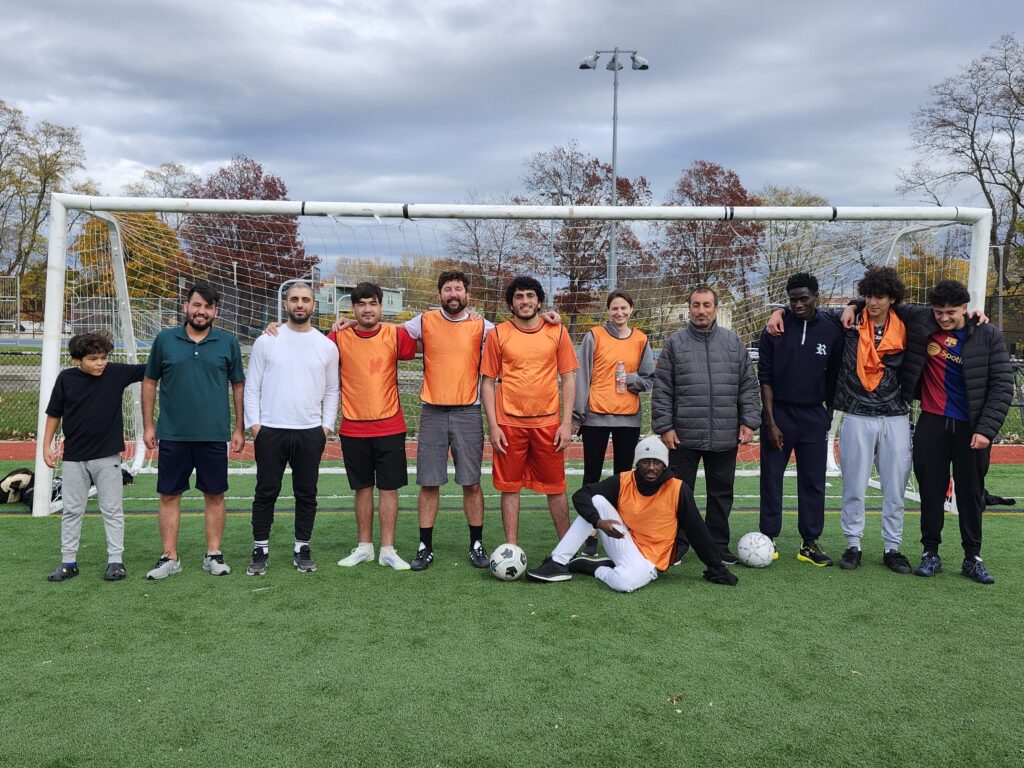
A passionate player and fan, Luqman had been running IINE’s informal soccer meet in the Boston area for more than a year. Anyone who has worked at or with IINE is invited to join. The game draws a regular crew of refugees, including players from Sudan, Cote d’Ivoire, Central African Republic, South Africa, Nigeria, Cameroon, Senegal, Syria, Afghanistan, and Colombia. Players get subbed in and out, and there’s plenty of time between matches to chat with one another (generally switching between English, French, and Arabic). There’s also time to chat with Luqman.
“One client, Ahmed, a refugee from Sudan, wants to be an electrician,” Luqman says. “He was an electrician for years back home, and he wants to eventually open his own shop here. We briefly talked about the requirements, and I learned that he doesn’t have a high school diploma. I told him about the Refugee Career Pathways program, and how he could receive guidance to get his GED—which he would need to get into a vocational training—and he could take it from there.”
Ahmed was excited. He signed up. Then he immediately started spreading the word.
“That’s how it started. He talked to his friends, his roommates…pretty soon we had ten clients, all from the soccer game, all who needed their GEDs.”
They would approach Luqman during half time and tell them their stories. While they had different life goals, they were facing a common obstacle.
“They wanted to improve their living conditions, whether that meant getting a promotion, a better job, or to get back into a previous field. They had all looked into getting into a vocational training, or another educational opportunity, to achieve their goals, but then they found out that they couldn’t because they didn’t have a high school diploma. So, they were saying, ‘Okay, I want to get a GED as soon as possible.’”
As Luqman collected enrollments, he passed the information on to Gordon, who quickly began putting together a plan. They learned that, while most of the crew had fairly strong conversational English, they would need to improve their reading and writing skills before they would qualify for external HiSet—High School Equivalency Test—preparation classes. A “Bridge to HiSet” class would be a crucial stop on their “Refuge Career Pathway.”
“They were all excited!” Luqman says. “Every time we played soccer they were asking me, ‘When is class starting?’ I would say, ‘pretty soon!’”
It was particularly gratifying for Luqman that the soccer game ended up playing such a central role in recruitment. “What inspired them and encouraged them to get their GED was that they knew each other and that they were a group,” he says.
Gordon agrees. “We don’t have many spaces that are, like, refugee- and immigrant-focused third spaces. That’s what the soccer field became—a place where people hang out and have a chance to ask each other, like, ‘Hey, how are you improving your career and your life now that you’ve gotten here?’ Luckily enough for us, possibly because Luqman and I had spent so long hustling around a field with them, sweating and all that, the players believed that we were committed to them and their success.”
Team HiSet Prep
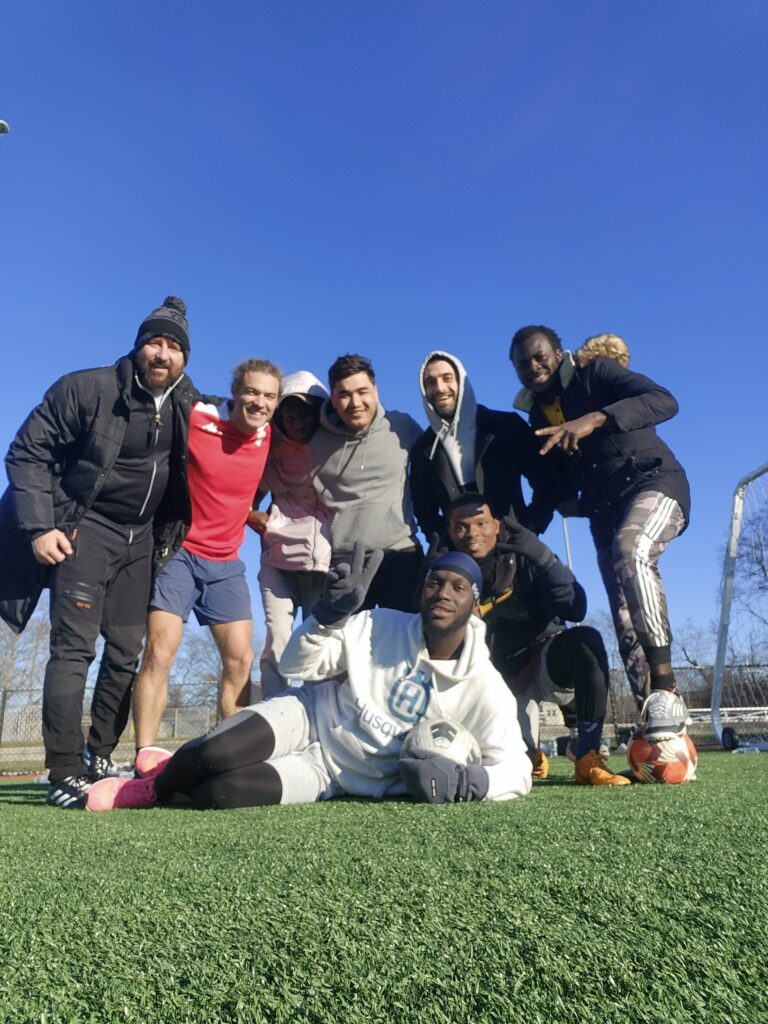
One of the soccer players to enroll in Bridge to HiSet was Omar, a refugee from Senegal, described by Gordon as “a talented midfielder and the life of our convos on WhatsApp, on the field, and in class.”
Omar arrived in Boston in 2024, and IINE set him in his first apartment, helped him access healthcare and cash assistance, instructed him in ESOL and helped him get his first job in the U.S. Later, he took Luqman and Gordon’s Bridge to IT Proficiency class to improve his computer skills. “They’re so nice,” he says, “they’re great to work with.”
When he learned that current and former IINE clients were going to start playing pick-up soccer together, he showed up for the first game, ready to play.
“I love to play soccer,” he says with a smile. In response to the suggestion that he’s often the MVP in the IINE games, his smile widens, and he very quietly replies, “Well, that’s what they tell me.”
Omar says that he showed talent at a very early age, but that in Senegal, he had been discouraged from playing as the game could be seen as a waste of time. Getting the chance to play now is a big deal for him. He also says that the camaraderie he feels on the field carried over into the classroom.
“I really enjoyed the soccer and the HiSet class! We were learning but we were also having a fun day. I learned a lot from the [instructors] and also from some of the students I met there—their experiences and their opinions.”
One of things that Omar likes best about U.S. culture is the work ethic he sees here. “I really like to keep busy,” he says. Currently, he works in an environmental services role at a Boston hospital. He “love[s] working at the hospital…[and] helping people,” and hoped to move up into a role as a pharmacy technician. Whenever he inquired about an opening, however, “they’d ask me about my high school diploma.”
Omar also looked into getting back into metal welding, a craft he learned from his father and practiced for seven years in Senegal. “I don’t want to lose it,” he says. Again, he found his lack of a high school diploma to a be a barrier. “I’m like, ‘Ok, to grow or meet my career goals I need to get a GED.’”
Towards the Goal
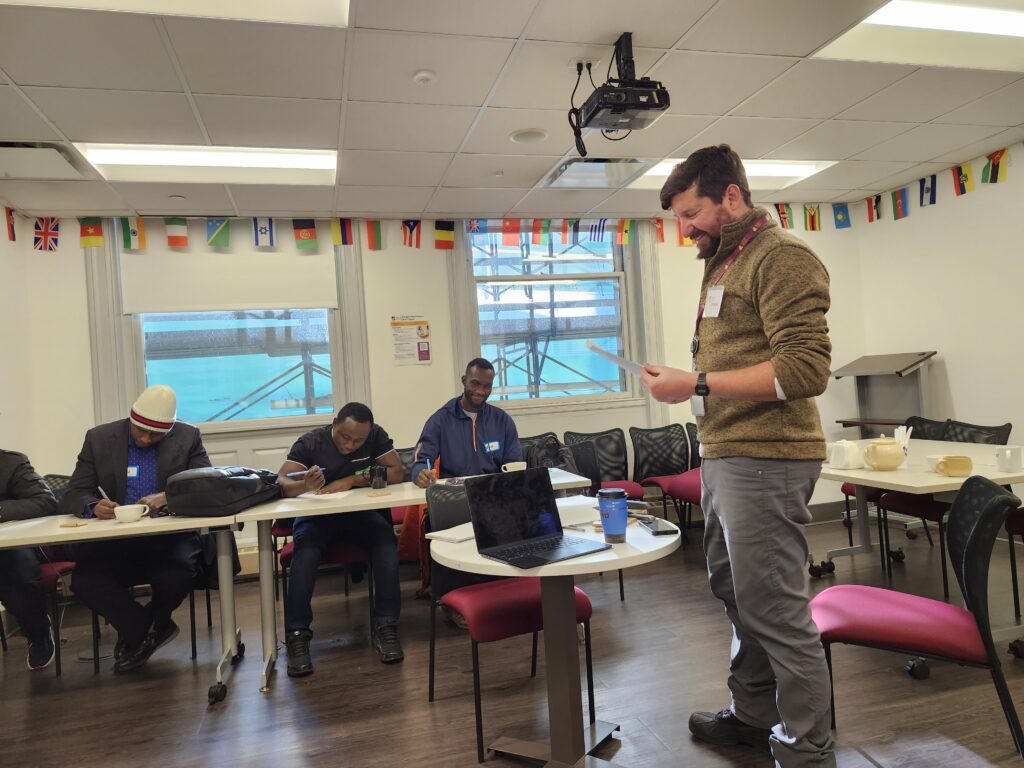
While his students still have a ways to go to reach their goals, Gordon says that the first cohort of Bridge to HiSet was a clear success, and that he saw many exciting breakthroughs.
“This was a pilot program, but we’re convinced we have the test scores, the attendance levels, and the anecdotal evidence to show that, hey, this program is actually a pretty good idea. And we’ve identified a gap in the services that other people provide.”
Ahmed, who got the ball rolling when he told Luqman about his obstacles in working towards resuming his career as an electrician, is now enrolled in an intensive daily English class while also holding down one job in food service, and a second in security.
Omar says that the Bridge to HiSet class has helped him, and he continues to work on growing his English skills. He’s grateful to IINE for the continuing support.
“If I need anything, then I can send them a message saying, ‘I need help for this,’ and they will make an appointment for me.”
With the federal Refugee Career Pathways program now ending—another unfortunate federal policy change—Luqman and Gordon are hoping to find different funding source to continue the Bridge to HiSet program.
Meanwhile, they will continue to show up to the soccer field ready to play—and more.
- - -
يقوم اللاجئون والمهاجرون برحلات طويلة وصعبة للهروب من العنف وإعادة بناء حياتهم في الولايات المتحدة .
مقالات ذات صلة

Maryam and Mauret: A Volunteer Helps a Young Afghan Refugee Pursue Her Dreams in New Hampshire

Restrictive and Unjust: IINE Statement on Presidential Determination on 2027 Refugee Admissions

Spotlight Report Excerpt: On Connecting Immigrant Talent to Healthcare Careers