UPDATED: OCTOBER 2026
The U.S. refugee resettlement program helps refugees who have been forced to flee their home countries begin new lives in the United States. Refugees are referred to the U.S. for resettlement after undergoing extensive screening, and nonprofit organizations like IINE help them build stability after they arrive. The process has two distinct parts: the federal refugee admissions process and the resettlement services refugees receive after arriving in the United States. Here’s how each works.
First, what is a refugee?
Refugees leave their home countries and are unable or unwilling to return because of a well-founded fear of being persecuted for reasons of race, religion, nationality, membership of a particular social group, or political opinion.
Those who obtain the legal status of “refugee” are given protections under international laws and conventions. They can live and work legally and receive federal benefits and lifesaving support from agencies like IINE. The determination is made by an official entity such as a government or the UN Refugee Agency before the journey is made to a new country. In the U.S., refugees can join the workforce and have pathways to become lawful permanent residents and eventually citizens. Learn more about the different terms used to describe people who cross borders in our blog.
What does the U.S. refugee resettlement process entail?
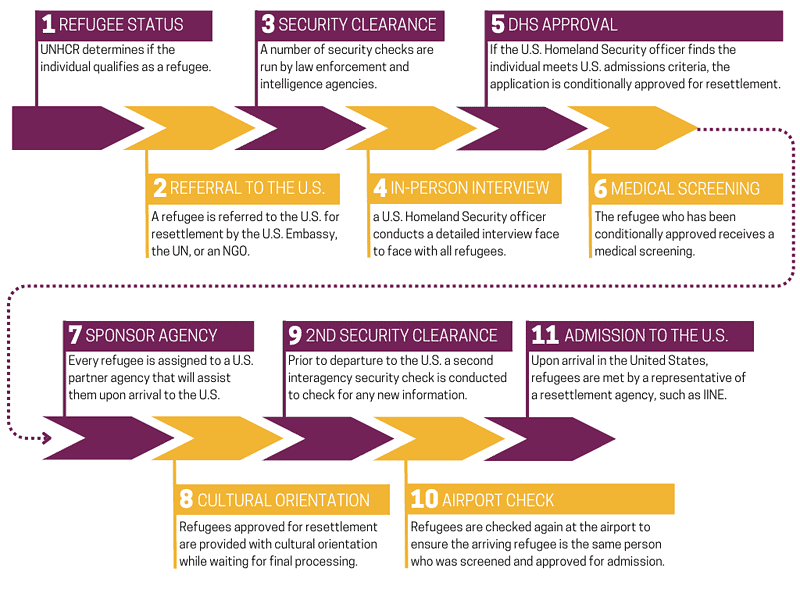
The U.S. vetting process to determine whether someone qualifies as a refugee is extensive and rigorous. These are the 11 steps from application to admission:
- UNHCR determines if the individual qualifies as a refugee.
- A refugee is referred to the U.S. for resettlement by the U.S. Embassy, the UN, or an NGO.
- A number of security checks are run by law enforcement and intelligent agencies.
- A U.S. Homeland Security officer conducts a detailed interview face to face with all refugees.
- If the U.S. Homeland Security officer finds the individual meets U.S. admissions criteria, the application is conditionally approved for resettlement.
- The refugee who has been conditionally approved receives a medical screening.
- Every refugee is assigned to a U.S. partner agency that will insist them upon arrival to the U.S.
- Refugees approved for resettlement are provided with cultural orientation while waitign for final processing.
- Prior to departure to the U.S. a second interagency security check is conducted to check for any new information.
- Refugees are checked again at the airport to ensure the arriving refugee is the same person who was screened and approved for admission.
- Upon arrival in the U.S., refugees are met by a representative of a resettlement agency, such as the International Institute of New England.
How long does refugee resettlement take?
The refugee resettlement vetting and admissions process takes an average of 18–36 months. However, for many, it takes ten years or more.
What happens when refugees arrive in the U.S.?
Once in the U.S., refugees are resettled by a refugee agency like IINE. We place new arrivals in housing, help them navigate the healthcare system, connect them to health plans and public benefits, and enroll their children in public schools. We provide families with cultural orientation, place adults in our English classes, and help refugees find employment and career pathways in their new communities.
IINE strives to help each new arrival rebuild their life here to be full of hope and free from violence and terror.
Can refugees work in the U.S.?
Yes, refugees are eligible to work in the U.S. upon arrival, and they contribute immensely to our nation’s workforce.
Many areas of the U.S., particularly New England, have growing workforce shortages and a critical need for workers. According to the Massachusetts Department of Economic Research, by 2030, the number of jobs across the Commonwealth is expected to grow 21% yet the workforce will expand just 1.5%. Meanwhile, in New Hampshire, there are currently approximately three unfilled jobs for each unemployed worker, according to the New Hampshire Fiscal Policy Institute. Refugees who join the U.S. workforce enter all fields, contribute to the local and federal tax base, purchase homes, and start businesses. Like nearly all newcomers to the U.S., they are eager to work and contribute to the economy. A National Bureau of Economic Research study showed that over a 20-year period, refugees who enter the country between the ages of 18 and 45 pay on average $21,000 more in taxes than they receive in public benefits.
Can refugees become U.S. citizens?
Yes, refugees are eligible to become U.S. citizens once they have applied for and received a green card and met the permanent residency requirements.
What is the difference between a refugee, asylum seeker, and immigrant?
Refugees leave their home countries and are unable or unwilling to return because of a well-founded fear of being persecuted for reasons of race, religion, nationality, membership of a particular social group, or political opinion. Those who obtain the legal status of “refugee,” are given protections under international laws and conventions. They can live and work legally and receive lifesaving support from agencies like IINE.
Asylum seekers leave their home countries with the hope of obtaining the same protections given to refugees once they arrive at their country of destination. Upon reaching or crossing the border, they must apply for “Asylum,” and prove to authorities that they have suffered persecution, or fear that they will suffer persecution, based upon race, religion, nationality, membership in a particular social group, or political opinion. Those whose claims are successful—and who are granted protections within their new countries—are called “Asylees.” Asylum seekers can apply to work in the U.S. while their cases are pending, and like refugees, asylees have a path to a green card, and eventually, citizenship.
Immigrant refers to anyone who moves to a foreign country with the intention of settling there. Immigrants often go through a lengthy vetting process. Many become lawful permanent residents and eventually citizens.
Learn more in our blog, “Migrants, Immigrants, Refugees, Asylum-Seekers, Parolees: Understanding the Key Differences.”
Why does the U.S. have a refugee resettlement program?
Beyond the humanitarian motives, there are strategic reasons the U.S. established a formal refugee resettlement program in 1980 with bi-partisan congressional support, which continues to this day.
Resettlement is a diplomatic strategy of the U.S. government. By continuing to welcome and resettle refugees, the U.S. models fulfillment of the expectation that countries together create refuge for forcibly displaced people, either through offering neighboring asylum, hosting refugee camps, or admitting and integrating refugees into their communities.
How many refugees does the U.S. resettle every year?
Since 1975, the U.S. has admitted more than 3.3 million refugees, an average of 80,000 per year.
Under U.S. law, the president has the authority to determine the number of refugees the United States will admit each year. In Fiscal Year (FY) 2017 (October 1, 2016 to September 30, 2017), President Obama raised the admission ceiling to 110,000 to respond to a humanitarian crisis that had driven the number of refugees to the highest levels since the end of World War II. Once President Trump took office, however, his administration suspended the refugee program for four months and drastically reduced the number of refugees admitted to the U.S. He went on to lower the refugee admissions ceiling to 45,000 in FY18, 30,000 in FY19, and 18,000 in FY20, the lowest refugee admissions numbers in U.S. history. President Biden reaffirmed the United States’ commitment to welcoming and supporting refugees, increasing the admissions ceiling to 125,000, the highest target in U.S. history.
In 2025, President Trump suspended the refugee program once again. Read our statement calling for a humane and strategic refugee program here.
How can I help refugees who have been resettled to the U.S.?
Financial support is the U.S. resettlement providers’ number one need. The process of admitting refugees is managed by the federal government but refugee resettlement services are sub-contracted to local agencies and only partially federally funded. By offering your financial support, you play a critical role in securing resources for your local organization and ensuring that refugees find hope, safety, and a brighter future in our communities.
مقالات ذات صلة

From the Desk of the CEO: Voting For a More Humane, Inclusive, and Welcoming Nation

“I Rode for Human Rights and Dignity for Everyone”: Cyclists Raise Awareness and Funds at 7th Annual Ride for Refugees and Immigrants

IINE Sues to Block Trump-Vance Administration Rules that Strip Refugees of Legal Protections Without Due Process