The Spotlight Report is a quarterly report to bring you a deeper understanding of our work. This Spotlight Report focuses on ourimmigration legal services, which address the urgent needs of newcomers to our country.
On Monday, March 4, 480 IINE community members gathered at the Fairmont Copley Plaza Hotel in Boston for our 42nd Golden Door Award Gala. Each year, the Golden Door Award is presented to an immigrant who has made outstanding contributions to U.S. society. The award takes its name from Emma Lazarus’s words, which are inscribed at the base of the Statue of Liberty: “From her beacon hand glows world-wide welcome…I lift my lamp beside the golden door.” This year, the award was presented to Giovanni Caforio, Executive Chairman of the Board and Former CEO at Bristol Myers Squibb.
Highlights of the Evening
Golden Door Award Honoree Giovanni Caforio Advocates for Equitable Support for All Immigrants So They Can Pursue Their Dreams
Born and educated as a trained physician in Italy, Giovanni joined Bristol Myers Squibb in 2000, assuming a number of roles over the years, most notably as CEO and today, as the Executive Chairman of the Board. At the Golden Door Award gala, Giovanni’s colleagues, including Vicki Sato, Chair, Denali Therapeutics and VIR Biotechnology, and Ted Samuels, Lead Independent Director, Bristol Myers Squibb, paid tribute to his impactful leadership, which has led to the development of medicines that have fundamentally changed the way we treat cancer; his commitment to developing a patient-focused culture driven by innovation and accountability; and his strong belief in the business value of diversity and inclusion.

Giovanni accepted the Golden Door Award with humility, taking a moment to acknowledge the privilege he had when coming to the U.S. as an immigrant—a medical degree and an American company supporting him—and to call on our country to provide newly arrived immigrants with the necessary support to build a strong foundation. Learn more about Giovanni and his exceptional accomplishments in the video below.
IINE’s Own Lead Case Specialists Pierre Julnor Laurent and Safeena Niazi Share Inspiring and Difficult Stories of Forced Migration
In Haiti, Pierre rose through the ranks as a talented doctor, ultimatelyleadingPort-au-Prince’s citywide response to the COVID outbreak. It was a role he embraced, having always been drawn to help those in need. When gang violence escalated in his beloved home country, Pierre had no choice but to leave. He didn’t want to go, butafter several kidnapping attempts, he knew it was the only way to ensure his and his family’s safety. In the U.S., Pierre found IINE – and a new purpose. As a Lead Case Specialist, he continues to serve others by helping fellow Haitians find security and a new start in Massachusetts. Hear Pierre’s story in the video above.
A host of the evening, Lead Case Specialist Safeena Niazi also reflected on her own journey of forced migration. Originally from Afghanistan, Safeena came to the U.S. in 2017 and was resettled by IINE; today, she is a member of our Legal team. Safeena shared how she fearfully watched from afar as the Taliban took over her home country in 2021 and the relief she felt when a close friend and trusted colleague was able to escape and reunite with her here.
Both Pierre and Safeena’s stories brought tears to the gala attendees’ eyes as they remindedusall of how much refugees and immigrants often have to leave behind tofind safety and rebuild their lives in our communities.
IINE Supporters Raise Nearly $1.7 Million for Refugees and Immigrants
The evening was a resounding success, thanks to the generous support of our attendees and sponsors, including Gordon Dyal & Co. Advisory Group LP, Bristol Myers Squibb, Biogen, Evercore, Jean Hynes and Mark Joseph Condon, Mark and Becky Levin, Moderna, Morgan Stanley, and ThermoFisher Scientific. The $1.7M raised comes just in time. “IINE is now the largest-scale resource for newly arrived refugees and immigrants seeking humanitarian relief in Massachusetts and New Hampshire,” said CEO and President Jeff Thielman. “Three years ago, we served 4,000 clients; this year, we are on pace to serve 18,000 individuals and families, including thousands of Haitian, Afghan, and Ukrainian families seeking peace and security...Thank you for being here tonight, for celebrating and supporting our mission, and for believing in immigrants and refugees.”
We were saddened to learn that Wayne Chen passed away on March 5, 2024. His family surrounded him in love and comfort during his final days at home.
After attending an IINE Suitcase Stories event in Weston, MA, Wayne Chen became a dedicated volunteer and cherished member of the IINE team. Never missing live Suitcase Stories® showcases, the annual Golden Door Award Gala, and International Women’s Day events, Wayne was knit into the fabric of all we do at IINE. He was passionate about our work, and we were the grateful recipients of his many talents and selfless dedication.
Wayne was an active member of the Leadership Council at IINE, a dedicated English for Speakers of Other Languages (ESOL) tutor, a voluntary photographer at events, and often offered support to the Advancement team, preparing important documents for much-needed grants. Wayne and his partner Randi generously donated to IINE’s Refugee Resettlement and ESOL program. He worked closely with our Lowell office, and most recently volunteered as a guest speaker in our workshops for refugee youth.
We will miss Wayne and his warm, caring spirit and will continue to celebrate his contributions to IINE for years to come.
It’s no secret that housing is extremely scarce in New England’s cities. A “vacancy rate” is the percentage of a city’s existing housing that’s available to rent. Lowell, Massachusetts has a vacancy rate of 7%. Boston’s hovers around 2% and Manchester, New Hampshire’s is less than 1%.
Affordable housing is even more scarce, and when refugees first arrive, they face significant disadvantages as prospective tenants. Having been forced to suddenly leave their home countries under terrible circumstances, they start out in the U.S. without the security of jobs, credit, references, the funds to pay their deposits, and often, the English language skills and cultural knowledge to build the needed relationships with property owners.
What they do have is remarkable resilience, drive, and adaptability—and they have IINE. Refugees, asylees, and other protected immigrants are eligible for housing support under federal law, and the International Institute of New England has been successfully securing them housing before they arrive, setting up their apartments, and bringing them from their ports of entry to their first homes in the U.S., for more than 100 years.
IINE is notified by the U.S. Committee for Refugees and Immigrants that refugee families and individuals will be arriving about one to two weeks in advance. The word goes out to our Housing Coordinators and they’re off to the races, looking for housing that will meet the arriving refugees’ needs, is withinwalking distance to necessities such as grocery and convenience stores, and ideally, is situated in a diverse community that will connect them to fellow immigrants and former refugees who will embrace their arrival. Last year, IINE successfully found housing for more than 345 new arrivals. Read on to learn how.
IINE housing coordinators draw from networks and experience.
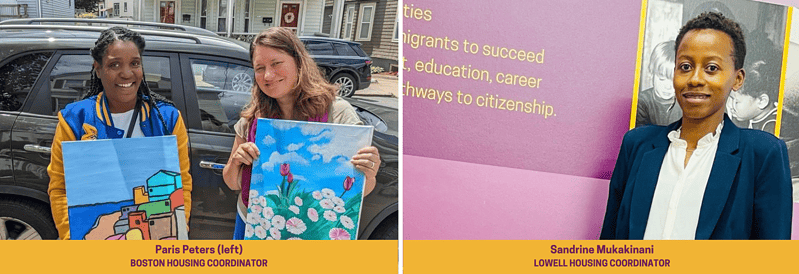
Paris Peters had a full 20 years of experience as a realtor in Boston before becoming an IINE Housing Coordinator at the beginning of 2023—so she already knew a lot about finding people housing in Boston. “Or I thought I did!” she says, laughing.
She explains that finding housing for people who arrive without the resources of other potential tenants is a whole different ballgame, but she does draw from a network of about 20 realtors who trust her and understand what she needs, “my backbone,” she says. “They come up with something, even if we can’t take it. Every time I say, hey I need, this…they’re like, hey, we’ve got it.”
Still, they won’t always have apartments that meet a particular family’s needs, so Paris has to constantly grow her network. “Apartments.com, Craigslist, Facebook has a whole housing section—I also am a member of quite a few real estate groups and find them to be the most helpful. I get the quickest responses from them. So, networking and using the community really, really helps. Something as simple as speaking to your neighbor—that has gotten me an apartment.”
Sandrine Mukakinani, Paris’ counterpart in IINE’s Lowell office, was a local property manager who had been providing housing for our clients when she became an IINE Housing Coordinator in 2023. A former refugee from Rwanda, she was resettled by IINE in 2015, and after exploring several careers, became interested in realty. “It’s something I have a passion for doing. I like anything related to properties,” she says. “I want to grow in the property business. Doing this job…I meet many landlords, I learn a lot, and I can also serve our office. So, I like it. It’s challenging, yes, but I do accept that challenge because I’m learning.”
Sandrine says she has a network of about 18 realtors that serve as her go-to’s in Greater Lowell, and like Paris, frequently checks apartment listing sites, Facebook, and Craigslist as well.
“I start with the landlords we already have an existing relationship with. I call, I send messages, I disturb them all the time,” she says, laughing. “I use my friends who are involved in properties as well. I do it all. Any way I can get to, luckily, yeah, we have something available.”
For IINE’s Manchester, New Hampshire office, the network is much smaller but has been equally effective. “Manchester uses only three property managers,” explains Senior Program and Contract Manager Kateryna Kelly. “They manage not whole buildings, but large quantities of units in buildings here and there throughout Manchester.” One of these is actually based in Massachusetts and also finds units for IINE clients in Lowell. “We have a very informal relationship with him. Sometimes we just text him and let him know what we need and when.”
Property owners who are also immigrants are a good bet.
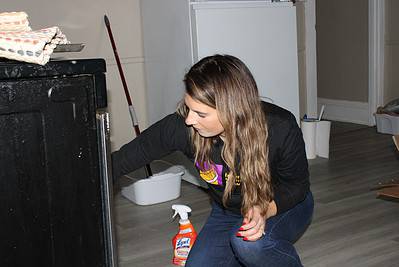
IINE staff and volunteers ensure apartments are freshly cleaned, set up with furniture and household goods, and stocked with culturally appropriate groceries
Paris is the granddaughter of immigrants from Cape Verde, Sandrine a former refugee from Rwanda, and Kateryna, an immigrant from Ukraine. While their experiences werevery different, they are all able to empathize with the challenges our clients face. They find the same is true when they connect with property owners who are immigrants.
“Most of the landlords that I have found are also from immigrant populations themselves, or their parents were immigrants,” says Paris. “That’s the great thing about Boston. It’s got a large immigrant/refugeehistory and population. Either their grandparents, their parents,orthey came from somewhere else, myself included. You understand what kind of difficulty it is, you know, moving from one country to another, what cultural shocks they’re going to go through, because they understand the process.” Sandrine reflects, “It’s not that easy when you come from far away,especially when you come from Africa. It’s a new country, new culture, new everything, new people. You leave your family back home,so you start all over again. It takes time to settle.The Lowell community has a lot of immigrants. So those [go-to] landlords—not all but many—they also came as immigrants. They understand and they are willing to help.”
IINE’s strong track recordcan makeall the difference.
Building up a network of reliable realtors and property owners who will quickly respond to requests with opportunities takes charm, patience, and relationship-building.
“It does help when there is a program assisting a tenant,” says Paris. “I make that a benefit of us, a benefit for the landlord, and I use myself as a backup. I tell the landlord if you’re having a problem with the tenant, please call me.” She explains that not only will the landlord have her support, but that IINE’s clients have support, from federal benefits helping them to cover rent until they’re able to work, to interpreters who can help with communications, to case specialists and volunteers who are helping to orient them to their new lives and expectations. She points out that as far back as her records go, IINE clients have never been evicted from their apartments.
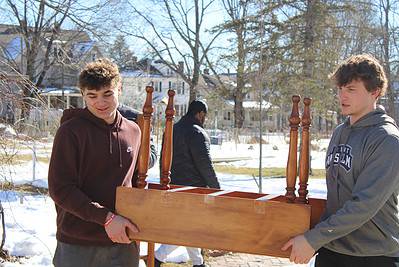
Members of the St. Anselm College football team help prepare an apartment for a refugee family of six from the Democratic Republic of the Congo
Kateryna remembers struggling to convince a property manager she now relies on. “It took us a bunch of explanations of what we do, where clients are [in the resettlement process], that they are going to be employed…but once he started working with us, he saw how consistently we reach out, how responsive we are, and how consistently we can fill his vacancies. That’s appealing.”
Volunteers turn a housing unit into a home.
When you’re bringing someone who has lost their home to their first new living space in an unfamiliar country, you want it to feel as welcoming as possible. Once IINE has secured an apartment, community volunteers spring into action, helping to deliver and set up furniture, plates, silverware and cookware, cleaning supplies, bedding, and even art for the walls, all donated by community members.
Mike Mailloux, Volunteer Coordinator at IINE’s Manchester office, explains, “We will make the apartment look homey and welcoming, put toys on the beds for the kids and provide everything a family may need for the first few months.”
“Today I actually happened to be there when a family from the Democratic Republic of the Congo—a mom and three kids—showed up. I opened the doors for them, and all the kids were super excited, running around the apartment and playing. They immediately busted open a box of toys in the living room. They were so happy that they had some stuffed animals. It was so fun and so nice to see that.”
When IINE’s community volunteers secure housing for refugees, the keysare resourcefulness and persistence.
The Westside Welcoming Committee Resettle Together team has successfully sponsored two families of refugees, including finding them housing. Group leader Jon Levine’s description of his approach mirrors Paris’s: “Call and beg, call and beg, and keep doing that.”
“It’s just a matter of calling a LOT of real estate agents about any unit on any of the listing websites that looks like it could suit a family’s needs,” he says, adding that it helps to find realtors’ direct numbers, to which a member of Westside Welcoming Committee often has access as a fellow realtor. When he gets a ‘no,’ he asks the realtor if they have a contact who might say ‘yes.’ Once he gets his foot in the door, he has to make his pitch.
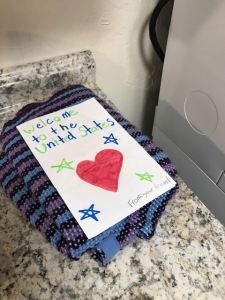
A handmade card at an apartment provides a warm welcome
“There’s no greater challenge than getting the agent to believe you can produce a legitimate ’safe’ prospect for their landlord—safe meaning that they’ll pay the rent regularly and not cause trouble! Your own presence and demeanor in representing IINE and its clients can go a long way to doing that. It helps to have your finger on the numbers—to know exactly what you can (and can’t) assure the landlord in terms of rent funds. And if your community group is committed to seeing this family through, then making that clear to the agent and landlord as well.”
Jon likes to say:
“IINE has been settling families like this for more than 100 years, finding them housing, providing English language lessons, full medical coverage, and then working with them to find jobs so that usually within six months or so, they become self-supporting. And our support group of local Boston citizens is committed to doing everything in our power to get them on their feet as quickly as possible.”
He’s gotten good at evaluating an apartment once he gets an offer. “There’s an invaluable website called walkscore.com. Just plug in the address you’re considering, and it will give you both a walkability and a transport score, with bus, T, and train routes near the location, as well as maps that show shopping in the vicinity.”
The Westside Welcoming Committee successfully found housing for a family of four from Iraq in the Boston suburb of Newton and a family of three from Cameroon in the Boston neighborhood of Dorchester.
“The first family is still in their Newton apartment one year later, and the kids love the school they’re in. I think the family in Dorchester was thrilled to have a place to call their own—they’re very happy with the space!”
IINE is looking for long-term (12 months or more) housing in Massachusetts and New Hampshire for newly arrived refugees and immigrants, including families who are currently in MA’s emergency shelter system. Learn more about housing needs here. If you have housing to offer or know someone who might, please be in touch.
Jessica joined IINE in 2023 as an Immigrant Family Support Coordinator on our Unaccompanied Children’s Program (UCP) team. The UCP team helps children, some as young as two years old, who have fled their homes in Central America and crossed the Mexico/U.S. border unaccompanied to seek refuge from violence, poverty, and instability, to reunite with their families in the U.S. Working throughout Massachusetts, Connecticut, Rhode Island, parts of New Hampshire and Maine, and the New York City area, the UCP team serves more than 600 children and their families every year. In our latest employee profile, Jessica shares her journey to IINE, what she enjoys most about her role, and how she likes to spend her time outside of the office.
Що привело вас до Міжнародного інституту Нової Англії?
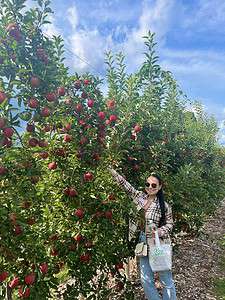
Jessica enjoys apple picking during an IINE staff outing
I graduated from Lesley University in 2020 with a Bachelor’s in Children, Youth, and Families Studies with a minor in Social Work. I’ve always wanted to work with people and help those in need. My first job out of college was at a nonprofit organization working with adults with developmental disabilities. I was there for two years and knew I wanted to keep exploring different fields. During undergrad, I completed an internship at a nonprofit legal organization and was interested in working with the immigrant community. At a young age, as a bilingual, I was translating and interpreting documents for my family and friends. When I was searching for my next endeavor, I was considering continuing to work in the developmental disability field but was having a hard time. I then started searching for something I knew I had a passion for: working with refugees and immigrants.
What does your day-to-day look like?
On an average day, I begin by checking my calendar to see if I have any home visits or meetings scheduled. I have team meetings weekly where we learn about new topics related to our clients. I then read my emails to see if there are any urgent emails I have to answer right away. I also turn my work phone on and return any messages or calls from clients. I usually spend the morning working on a home visit assessment or my case notes, or looking for resources for my clients. When I have finished those tasks, I will complete check-in calls with my clients or home visits in the afternoon. During check-in calls, I assess my client’s safety, making sure they feel comfortable in their placement, and discuss their ongoing goals and how I can help them achieve them. During home visits, I get to know the families and help them connect to the appropriate resources.
What aspect of your role do you enjoy the most?
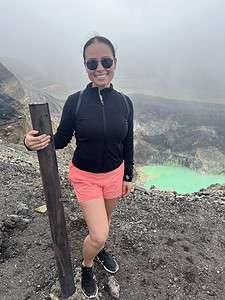
Jessica hiking a volcano in El Salvador
I enjoy getting to know all the families I work with and being able to talk and motivate the children/youth and encourage them to be their best! Families really appreciate someone being there for them, to listen and share resources. Another aspect I enjoy is collaborating with my colleagues. They all bring their own experience to the team and are very helpful. My role challenges me every day as each case brings new tasks to learn.
Що б ви порадили тим, хто цікавиться цією роботою?
Be dedicated to helping your clients, and your clients will always appreciate your efforts, small or big. Also, don’t be afraid to ask your colleagues for support; they are full of knowledge and willing to help!
Як ви любите проводити час поза офісом?
During my free time, I love finding a good series to watch. Summer is my favorite season; I love going on walks/runs on a nice hot day or soaking up the sun and reading a good book. This year I’m looking forward to learning new recipes!
Бажаєте приєднатися до нашої команди? Наше спільне, командно-орієнтоване середовище пропонує можливості служити біженцям та іммігрантам, навчаючись у інших співробітників та відділів. Переглянути кар'єрні можливості тут.
February marks 100 years since the International Institute of Boston first opened its doors to welcome and support people from all around the world
BOSTON – February 15, 2024 – The International Institute of New England (IINE) celebrates the centennial anniversary of its Boston, Massachusetts office, marking 100 years of welcoming and serving refugees and immigrants in the city and surrounding communities. Over the century, IINE’s Boston office has expanded to support more than 3,000 individuals from all around the world every year—many of whom have fled persecution, war, famine, and climate disasters. Their programs—which span resettlement, adult education, workforce development, pathways to citizenship and much more—help immigrants find safety and a fresh start in Greater Boston.
IINE started in its earliest form in the early 1900s when women at YMCA’s all around the country noted the nation’s growing immigrant population and sought to create a more welcoming, inclusive place where their newest community members could access multilingual social services. The first “International Institute” opened in New York in 1911, and the model quickly spread. By the 1920s, there were 55 International Institutes across the country. The International Institute of Lowell opened in 1918 and in Boston in 1924. Over the next ten decades, hundreds of community groups, individuals, employers, city departments, corporations, and foundations joined forces with the International Institute to help immigrants integrate into New England. IINE’s third and final location in Manchester, NH, was founded in 1994 and in 2001 the three sites consolidated to become the International Institute of New England.
Today, IINE’s services are organized around its strategic resettlement model—rooted in responsiveness, equity, and advocacy—which provides a framework to successfully welcome and integrate refugees and immigrants into Massachusetts communities where they both benefit and contribute. Through its evolving model and programs, IINE has played a critical role in building Boston into the welcoming, diverse city it is today, where 28% of residents are immigrants, and many more are multi-generational descendants of those who first arrived.
“During our centennial year and amidst a surge of newly arriving families in the Commonwealth, we celebrate 100 years of life-changing support to families in Greater Boston as we prepare for our second century of service,” said Jeff Thielman, President and CEO of the International Institute of New England. “Around the world there are more displaced people than ever before, and the causes of displacement are shifting. We can’t know when or where the next natural disaster, conflict, or humanitarian crisis will occur, but we know that IINE will always strive to be prepared to welcome them and provide critical resettlement services including social connection, language acquisition, and workforce integration.”
IINE’s work of welcoming newcomers into the Commonwealth, while valuing and preserving their unique cultural contributions, is integral to the city’s growth, success, and identity as a city of belonging. Providing refugees and immigrants with a strong foundation of support means new arrivals have the opportunity to integrate into our communities, achieve self-sufficiency, and meaningfully contribute to Boston’s culture and economy.
IINE Boston marks its centennial with a year-long celebration with several upcoming events and a new series exploring its history and Boston as a city of immigrants: “100 Years of Welcome: Commemorating IINE’s Boston Centennial”. Events throughout the year include an Immigrant Heritage Month celebration in partnership with the City of Boston, an interactive “Centennial Walk” journeying through 100 years of service, and the Golden Door Award Gala in 2025, a time-honored celebration which will for the first-time honor IINE itself for its contribution to American society and to shaping Boston’s vibrant diversity.
To learn more about the International Institute of New England and its upcoming centennial anniversary plans, visit https://iine.org/boston-100/.
ПРО МІЖНАРОДНИЙ ІНСТИТУТ НОВОЇ АНГЛІЇ
Міжнародний інститут Нової Англії (IINE) створює можливості для біженців та іммігрантів досягти успіху через переселення, освіту, кар'єрне зростання та шляхи до громадянства. Розташований у Бостоні та Лоуеллі, штат Массачусетс, і Манчестері, штат Нью-Гемпшир, IINE щорічно обслуговує понад 10 000 осіб, включаючи людей, переміщених внаслідок політичної нестабільності, насильства та кліматичних криз, дітей та дорослих, які постраждали від торгівлі людьми, а також дітей без супроводу дорослих, які приєднуються до членів сім'ї в Новій Англії. IINE пропонує широкий спектр програм і послуг, щоб допомогти цим новоприбулим відчути себе бажаними гостями, досягти стабільності та безпеки, отримати доступ до ресурсів у нових громадах, просунутися в освіті та працевлаштуванні, а також інтегруватися у свої громади. Досвід IINE ґрунтується на більш ніж столітньому досвіді роботи, і завдяки постійному партнерству з громадськими групами та підтримці благодійників по всій Новій Англії, IINE продовжуватиме свою діяльність протягом наступних 100 років і надалі.
The International Institute of New England is thrilled to share the first installment of our new series,“100 Years of Welcome: Commemorating IINE’s BostonCentennial.”The series will begin in 1910 and guide us to present day, chronicling the founding and growth of IINE’s Boston programming, Boston’s history as a city of immigrants, and how the two are deeply entwined. We begin during a period of record immigration in Boston—and increased backlash, as a result—as International Institutes were beginning to take shape across the country.
The “International Institute” model was an integration movement born during an immigration boom thatbothfueledthe newfactory economy in cities like Boston, andspurred debate nationwide on how newcomers should be welcomed and integrated.
A Port of Welcome
The early 1900s was a period of peak immigration to the U.S. and Boston Harbor was one of the busiest ports of entry for newcomers from around the world. Whether displaced by persecution, ravaged economies, or famine, individuals and families came to Boston for safety, freedom, and work.
By the 1910s, tens-of-thousands of people were arriving in Boston each year, and nearly 40% of the city’s population were immigrants. Already home to a large Irish community, Boston’s North, West, and South End neighborhoods filled with newly arrived Italians, Russian Jews, and Canadians, as well as smaller new communities from China, Portugal, Poland, Lithuania, the Balkans, the West Indies, and beyond.
Most people found jobs in the city’s new factories, making products like clothing and textiles, chemicals and rubber goods, or candy. Others worked as day laborers on Boston’s docks and railroads or filled construction jobs on the rapidly expanding roads, subways, and streetcar lines that gave more people access to the city and to factory jobs. Some took to selling produce or dry goods on the streets, and the most successful of these were able to earn enough to start their own grocery stores or retail shops.
Backlash and Pressure
The boom in immigration across the Northeast helped to build up cities and strengthen economies. But it also inspired fear and prejudice which worsened as the country became embroiled in the First World War. Throughout the 1910s and ‘20s, the U.S. government passed a series of discriminatory bills imposing harsh requirements for all would-be immigrants, quotas on immigration from some countries, and outright bans on others.
For organizations that worked with immigrants at the local level, a belief in the need for assimilation, or “Americanization,” became the dominant view. Immigrants were urged to shed their “old world” ways and emulate the Anglo-Protestant majority. This was the “melting pot” ideal in which immigrant cultures would melt away and be replaced by a superior American culture. A popular slogan during the war became: “100% Americanism.”
But a movement led by newly forming “International Institutes” took a radically different approach.
A New Approach to Welcome
The first International Institute was established by Edith Terry Bremer in New York in 1911 under the sponsorship of the local Young Women’s Christian Association (YWCA), A graduate of the University of Chicago, Bremer had extensive social services experience and had worked as a Special Agent for the United States Immigration Commission. At the YWCA, she administered a survey on the status of immigrant women in the city and learned how great their needs were. In response, she founded the International Institute to provide immigrant girls and women with English language classes and recreational and club activities, and to support them with housing, employment, and citizenship.
What set her International Institute apart was Bremer’s adoption of “Cultural Pluralism,” the philosophy that—in contrast to assimilation or “Americanization”—immigrants should be encouraged to not only preserve their cultural heritage but to share and celebrate their cultures while also participating in U.S. civic life. International Institutes became places where immigrants could continue to be themselves while learning how to navigate their new lives in the U.S.
Bremer’s model spread, and by the 1920s, 55 International Institutes opened in YWCAs in cities with large immigrant populations throughout the U.S., including the International Institute of Lowell in 1918 and the International Institute of Boston in 1924. These are the origins of the International Institute of New England of today.
Staff at International Institutes often became experts in immigration and naturalization law and served as mediators between newcomers and various government agencies. They quickly came to expand their services to work with entire families instead of only girls and women, and they often went and visited them in their homes.
The International Institutes prioritized hiring immigrants as case workers—then called “nationality workers”—who were familiar with the languages and traditions of the families they served and were often already known in their communities. An important part of implementing cultural pluralism, these staff members were usually either first- or second-generation immigrants, received training in social work, and had unique sensitivity, insight, and access into the communities they served. This practice was unique at the time and remains a priority for the International Institute of New England today.
The International Institute of Boston is Born
Georgia Ely. Courtesy of Schlesinger Library, Harvard Radcliffe Institute.
The International Institute of Boston was founded by Georgia Ely in 1924 at the city’s YWCA, very much in the spirit of Edith Terry Bremer and cultural pluralism. From the beginning, it was staffed with “Nationality Workers” with origins in Armenia, Greece, Syria, Russia, Poland, and Italy. Recruited from Boston’s immigrant communities, they were all college graduates with graduate-level social work training.
Speaking to immigrants in their own languages, the nationality workers helped new arrivals to access health services and educational opportunities, served as translators when needed, intervened in cases of employment discrimination, and helped people navigate the ever-changing U.S. immigration legal system and work toward citizenship.
Члени іноземних жіночих клубів при Міжнародному інституті Бостона насолоджуються катанням на ковзанах у спортзалі YWCA, бл. 1924-1934 рр. Фото надане Бібліотекою Шлезінгера, Гарвардський інститут Редкліффа.
At the same time, nationality workers were committed to “group and community work,” helping to organize vibrant social, educational, and arts performance groups in which immigrants could explore and share their cultures. On any given night in Boston in the mid-1920s and 1930s, there might be a lecture on childcare sponsored by the South Boston Armenian’s Women Club, a play performed by a Greek youth group, or a book discussion at the South End Greek Mother’s Club. A visitor to the International Institute of Boston might encounter the Syrian Girls Club singing songs in Arabic or a performance group practicing Ukrainian folk dance and music.
As they resettled in Boston, newcomers not only found support to meet their basic needs at the International Institute, but they also found the freedom to retain their cultural identity as they built their new lives and contributed to their new communities.
Today, the International Institute of New England employs staff from over 40 countries, dedicated to continuing the practices pioneered by nationality workers over a century ago. We have seen through decades of service the value immigrants bring to our communities and our economies as they become part of us. We are excited to share their stories with you through this centennial series.
During our centennial year, we celebrate 100 years of life-changing support to refugees and immigrants in Greater Boston and prepare for our second century of service. Learn more here: IINE Boston Centennial.
6 things to understand about how the climate crisis is displacing people worldwide and what we can do to help
“The period of global warming has ended; the period of global boiling has arrived,” United Nations Secretary General Antonio Guterres announced during another record-breaking summer for global temperature in 2023. Global warming affects food and water supplies, causes rising sea levels that decrease livable land, and creates destructive natural disasters. It’s already a factor in displacing millions from their homes worldwide each year, often termed “climate refugees.” Countries around the world need to prepare for this problem to get much worse if trends are not reversed, and as we work to reduce the causes of climate crises, we also need to better protect the people most at risk.
Here are 6 important things to know about “climate refugees.”
1. “Climate Refugees” are people who have been forced to leave their homes because of the effects of climate change, but the term isn’t entirely accurate.
“Refugee” is a term with a precise legal meaning. Defined by the United Nations High Commissioner on Refugees, refugees are people who have left their home countries and are unable or unwilling to return because of a well-founded fear of being persecuted for reasons of race, religion, nationality, membership of a particular social group, or political opinion.When granted, refugee status gives people important rights in their new country, allowing them to stay, work, and receive life-changing support from resettlement agencies like IINE. Currently, refugee status is not legally conferred to people who lose their homes because of the climate crisis.
“Climate displaced persons” is a more accurate umbrella term for those displaced by the climate crisis. The term “climate migrants” often appears in the media, but only describes those planning to stay at their destination temporarily.
2. Not legally considered “refugees,” people displaced by climate disasters are not protected by international law.
Legislation has been proposed to protect climate displaced persons, but so far has stalled.U.S. Senator Ed Markey (D-MA)introduced a bill toestablish a Global Climate Change Resilience Strategyin 2019, and then with Nydia Velásquez (D-NY) in 2021, and again on November 20, 2023, with IINE’s endorsement. Among other needed measures, it would create a U.S. resettlement pathway for climatedisplaced persons.
3. Climate disasters can destroy homes either very quickly or slowly over time.
Climate disasters can take two forms: sudden-onset and slow-onset.
Sudden-onset climate disasters are events that strike quickly and cause tremendous damage like earthquakes, hurricanes and cyclones, tsunamis, floods, and volcanic eruptions. In many cases, they cause people to migrate to new areas within their own countries, becoming “internally displaced.”
Slow-onset climate disasters are not caused by one sudden event but are the consequences of prolonged stressors like droughts or slow but devastating erosions like when sea-level rise shrinks habitable land. These disasters can be not only destabilizing, but in some cases, make places permanently unlivable.
4. Even when not the sole cause, climate disastersworsen other causes of displacement.
Seventy percentof refugees and eighty percent of internally displaced people have fled from countries that are among the most affected by climate crisis according to the UNHCR, the U.N.’s refugee agency.
Climate change is a threat multiplier. For countries struggling with stressors like poverty and job loss, competition over dwindling resources, damaged infrastructure, and government corruption, climate disasters make these challenges worse, which can enflame tensions, provoke conflicts and push people to the breaking point of needing to leave their homes.
Climate disasters can also make people more vulnerable to becoming victims of human trafficking. “Traffickers can exploit [climate crisis] conditionsby promising food, shelter, and other resources,sometimes posing as disaster responders or social service professionals to gain trust,”according to the U.S. government’s Office on Trafficking in Persons.
5. Globally, women, children, persecuted minorities, indigenous people with strong ties to their land, lower-income people, and migrants of all kinds are disproportionately at risk from climate disasters.
Disadvantages can be dire. These populations are more at risk because they tend to have less decision-making power, fewer government protections, fewer resources to adapt to climate-related shocks, more to lose when land becomes unfarmable, and less ability to resist when others try to force them to leave their land or take their resources.
Ensuring that new arrivals to the U.S. have access to information in their own languages about local efforts to mitigate climate change, and rights, protections, and procedures in the event of local climate emergencies.
Contributing to efforts to reduce and mitigate carbon emissions and increase sustainability on the local level.
Committing to welcome and support climate displaced people in all the ways we currently welcome and support refugees.
As more people are displaced worldwide by the climate disaster, IINE is prepared to welcome them. We are proud to provide life-changing services to more than 10,000 refugees and immigrants every year. Please consider donating today to support our work.
Під час суворого холоду своєї першої зими в Новій Англії кілька клієнтів IINE з числа біженців знаходять тепло в красивих ковдрах ручної роботи від багаторічного волонтера Лідії Волшин, яка працює в громаді.
Щоразу, коли Лідія дарує одну з барвистих "вітальних ковдр", які вона зв'язала гачком, вона прикріплює до неї листівку з вітальним посланням, що пояснює їхню історію:
"Ласкаво просимо до Сполучених Штатів. Ми дуже раді, що ви тут.
Мене звуть Лідія, я живу в Бостоні з чоловіком, який іммігрував сюди з Канади. Мої бабуся і дідусь приїхали до США з Польщі в 1920-х роках і жили в Нью-Йорку, де я народилася. Бабуся навчила мене робити такі ковдри, як ця, тож мені приємно поділитися з вами любов'ю моєї бабусі. Цей візерунок називається "бабусин квадрат" - "бабуся" - це скорочено від "бабуся"!
Я сподіваюся, що ваше життя в Бостоні наповнить вас миром і радістю, що ваша сім'я знайде затишок і дружбу, а ви відчуєте себе вільними. Люди тут доброзичливі і намагатимуться зробити все можливе, щоб допомогти вам. Я і моя сім'я бажаємо тобі всього найкращого."
Лідія почала робити привітальні ковдри ще у 2017 році в рамках національного проекту крафтивізму. Свої ковдри вона відправляла спочатку до музейних експозицій, а потім на південний кордон, де їх роздавали новоприбулим іммігрантам. Це був один із способів використати свої навички для позитивних дій і полегшити тривогу, яку вона відчувала через антиіммігрантську риторику і політику, пов'язану з нещодавніми президентськими виборами.
Ще одна - волонтерство в якості викладача англійської мови як іноземної. "Я ніколи раніше не займалася такою роботою, але я все життя була письменницею", - пояснює Лідія. Вона - кулінарний письменник, автор кількох електронних книг і блогу під назвою Lydia Likes It. "Я досить добре володію англійською мовою, багато подорожувала, і в багатьох країнах світу мені доводилося прокладати собі шлях як людині, яка розмовляє лише англійською, тому я вирішила спробувати, і мені це сподобалося".
Мешканка бостонського Чайнатауну, вона почала працювати волонтером у кількох місцевих агенціях, що обслуговують іммігрантів, і їй особливо сподобалося працювати з IINE.
"IINE був чудовим! Викладач був дуже креативним і дійсно мене захопив! Студенти, очевидно, поважали його. Вони старанно працювали і багато сміялися. Вони були сповнені рішучості досягти успіху, чого б це не коштувало, і це мене дуже вразило".
Лідія постійно продовжує працювати волонтером у класах ESOL, використовуючи свою пристрасть до їжі, міжнародного футболу та письменництва, щоб спілкуватися з дорослими учнями з усього світу.
Лідія зв'язалася з координатором волонтерів IINE Кейт Вайдлер, яка з радістю прийняла вітальні ковдри Лідії. Лідія почала робити і дарувати все більше і більше таких ковдр. Вона не знає, хто саме їх отримає, але каже: "Я намагаюся відправляти їх з великою любов'ю в серці і сподіваюся, що цей дух приведе їх туди, куди їм потрібно".
Анніс Робертс - одна з спеціалістів IINE, яка мала честь подарувати вітальну ковдру новоприбулій родині. "Їхній майже трирічній доньці вона дуже сподобалася!" каже Енніс. "Вона любить рожевий колір, тому ця ковдра ідеально їй підійшла. Коли я йшла, вона загортала в неї свою ляльку, тож можна з упевненістю сказати, що вона була дуже щаслива отримати її!"
Лідія називає рожеві візерунки своїми ковдрами "Барбі". Вона також полюбляє робити райдужні візерунки. "Я роблю багато райдужних речей, тому що вважаю, що веселка - це оптимізм, і ми намагаємося сказати людям: "Ми дуже раді, що ви тут. Ми хочемо, щоб у вас було чудове життя, і ми тут, щоб допомогти вам". Я думаю, що веселки говорять саме це".
Вона сподівається, що інші волонтери приєднаються до неї у виготовленні вітальних ковдр, і підкреслює, що це простий проект для будь-якого майстра з волоконного мистецтва. Їх можна зшити, в'язати або зв'язати гачком, а на сайті Welcome Blanket Website пропонує викрійки, фотографії та джерела матеріалів. Для неї цей проєкт - спосіб не втрачати динаміку.
"Як людина, яка все ще навчає студентів і ходить на заняття, це те, що я можу робити вдома, щоб продовжувати рух, але трохи тихіше і спокійніше. Мені приносить радість уявляти, як люди відкривають коробку, бачать ковдру і кажуть: "Вау!" Я вважаю, що це чудово".
Якщо ви хочете долучитися до виготовлення вітальних ковдр, ви можете зв'язатися з Лідією безпосередньо за адресою lydiawalshin42@gmail.com.
Андрій приєднався до IINE у 2023 році після роботи з венесуельськими іммігрантамимігрантами як асистент викладання англійської мови за програмою Фулбрайта в Колумбії та минулі зусилля з іммігрантами та біженцями як аспірантка у Вустері, штат Массачусетс..Як спеціаліст програми допомоги жертвам торгівлі людьми TVAP (Trafficking Victim Assistance Program) в нашому бостонському офісі, Ендрю забезпечує наших клієнтів-іммігрантів, які постраждали від торгівлі людьми, підтримкою та ресурсами, необхідними для того, щоб вони могли відновити своє життя. У нашому новому профілі співробітника Ендрю розповідає про TVAP та поширені помилкові уявлення про програму, ділиться тим, як виглядає його повсякденна робота в IINE, а також дає поради тим, хто зацікавлений у подібній ролі.
Що привело вас до Міжнародного інституту Нової Англії?
Коли я вперше звернулася до IINE, я не обов'язково хотіла працювати у сфері протидії торгівлі людьми - так сталося, що мене направила подруга в той самий час, коли IINE шукав найняти спеціаліста з кейсів TVAP (Програма допомоги жертвам торгівлі людьми). Однак, я дуже рада, що це спрацювало. Мені завжди завжди дуже подобалося працювати з людьми, які походять з більш неблагополучних верств населенняі особливо мені подобалася робота з представниками різних культур.тому що довгий час, мене цікавило вивчення мов і знайомство з тим, як живуть різні люди. Як спеціаліст програми TVAP, я маю можливість допомагати найбільш нужденним клієнтам IINE з числа іммігрантів.
Розкажіть більше про роботу, яку ви виконуєте в TVAP.
TVAP є неймовірно важливою. Ця програма по суті для людей, які нещодавно вийшли з активної фази торгівлі людьми, але або ще не отримали легального статусу, а отже, не можуть не можуть працювати легально і не можуть претендувати на багато державних виплат - або отримали легальний статус, але статус, але але все ще працюють над тим, щоб стати на ноги. TVAP працює над тим, щоб заповнити прогалини - від надання фінансової допомоги до допомоги клієнтам в отриманні медичної допомоги та забезпечення їх їжею. Мова йде про те, щоб про надання допомоги в критичний момент, коли багатьом клієнтам більше немає до кого звернутися за допомога щоб вони могли знову стати на ноги і рухатися до самозабезпечення.
Що люди зазвичай не розуміють про TVAP?
Я думаю, що є три основні хибні уявлення. По-перше, люди неправильно розуміють, що таке торгівля людьми - це не просто переміщення людей. Це контрабанда - переміщення людей через кордон. На відміну від цього, торгівля людьми передбачає дію, засоби та мету. Наприклад, використання несприятливого становища людини або відсутності у неї правового статусу для примусу її до надання трудових або сексуальних послуг проти її волі. Цей примус є визначальним аспектом торгівлі людьми.
По-друге, хоча секс-торгівля більш відома і висвітлюється в ЗМІ, в реальності торгівля людьми набагато поширеніша, ніж торгівля людьми. Приблизно 80-90% жертв торгівлі людьми в США зазнали трудової експлуатації.
Нарешті, я думаю, що багато людей навіть не знають, що TVAP існує! Є багато людей, які мають право на підтримку через TVAP, але не отримують послуг, бо не знають, що це можливо. Тому ми завжди працюємо над тим, щоб залучити більше клієнтів.
Як виглядає ваше повсякденне життя?
Як і у кожного з нас в IINE, мій день дуже різниться. Іноді я працюю в офісі, допомагаючи клієнтам оформити певні пільги/програми - це часто включає в себе проходження складних бюрократичних процедур. В інші дні я відвідую клієнтів вдома і допомагаю їм усім, чим можу. Це може бути роздача зимового одягу - так багато наших клієнтів не мають теплих пальт, шарфів і т.д. - або просто перевірка того, що їм потрібно.
Мені часто доводиться бути адвокатом для моїх клієнтів. Як людина, яка жила в країні, де державна мова не є моєю рідною, я знаю, як важко буває відстоювати свої інтереси, особливо коли йдеться про складні політичні питання. Тому я роблю все можливе, щоб вони отримували допомогу, якої потребують і на яку заслуговують.
Ендрю та його друзі святкують "Día de las Velitas" у Медельїні протягом року, який він провів у Колумбії як асистент викладача англійської мови за програмою Фулбрайта
Що б ви порадили тим, хто цікавиться цією роботою?
Думаю, щоб займатися такою роботою, треба мати любов до людей взагалі. Ви маєш сприймати людей, яким ви допомагаєте, як рівних собі, які мають свої власні життя та історії, як і ви, але народилися в інших обставинах. Це Це все ще професійні стосунки, які ви формуєте зі своїми клієнтами, але я думаю, що сприйняття їх як рівних - це ключ до того, щоб допомогти їм з повагою та співчуттям.
Як ви любите проводити час поза офісом?
Я дуже люблю природу і мистецтво! З дев'яти років беру участь у театральних постановках і хорах з дев'яти років. Я вважаю, що акторська майстерність і спів є справжнім катарсисом від повсякденних життєвих стресів, особливо коли ти можеш захопити аудиторію, залучаючи її до історії, яку розповідаєш.емоції аудиторії, залучаючи їх до історії, яку ти розповідаєш. Я також дуже люблю природу і біг.. I брала участь в університетському кросі в коледжі, і хоча я не сумую за перегонами, я все ще люблю повільні довгі пробіжки на природі..
Бажаєте приєднатися до нашої команди? Наше спільне, командно-орієнтоване середовище пропонує можливості служити біженцям та іммігрантам, навчаючись у інших співробітників та відділів. Переглянути кар'єрні можливості тут.
AНастасія не хотіла не хотіла залишати свій дім в Одесі, Україна, але коли вторгнення посилилосявона зрозуміла, що не має вибору. Приїхавши до Бостона влітку 2023 року влітку 2023 року зі своїм чоловіком, Анастасія звернулася до до Міжнародного інституту Нової Англії за базових послуг та підтримки упрацевлаштуванні. Команда з працевлаштування IINEдопомогла їймаксимально ефективно використати свій новий початок у кар'єрі, про яку вона мріяла. Анстасія поділилася своєю історією своїми словами.
Мене звуть Анастасія, я з України. До початку війни я щасливо жила у своєму рідному місті - Одесі. З підліткового віку я дуже любила моду. Закінчуючи Одеський національний університет, я почала будувати свій справжній зв'язок з модою, і, нарешті, коли я отримала ступінь магістра економіки, я зрозуміла, що моя справжня пристрасть - це мода, і що я хочу зробити її своєю роботою.
Я почала будувати свою кар'єру в індустрії моди, ставши модним інфлюенсером, почавши вести блог про моду в Instagram у 2015 році. Потім я також почала працювати з різними українськими модними брендами як бренд-менеджер, керівник відділу маркетингу, стиліст і навіть дизайнер.
Можу також сказати, що жити в США було моєю дитячою мрією. Всі ті різдвяні фільми 90-х, які я дивився, застрягли глибоко в моїй пам'яті.
У день, коли почалася війна, я був спустошений, але не хотів їхати. Я народилася в Україні і прожила там усе своє життя. Мені було дуже страшно, але я залишився. Минув рік, я втратив роботу, багато моїх друзів виїхали, я на власні очі бачив, як бомбили моє рідне місто, і я провів багато холодних зимових ночей без жодних зручностей, які потрібні людині у 2023 році - без електрики, води, інтернету, мобільного зв'язку та тепла. Тож я вирішив, що настав час їхати. Поїхати туди, куди прагнуло моє серце, щоб мати можливість жити мирно, працювати і просто жити власним життям, знаючи, що я в безпеці і що я можу допомогти своїм батькам.
На жаль, такі сумні обставини привели мене сюди. Але я безмежно вдячна за можливість почати тут своє життя заново, жити в мирі, мати можливість працювати, утримувати сім'ю і просто жити повноцінним життям.
Завдяки Міжнародному інституту Нової Англії я маю можливість працювати і професійно розвиватися в моїй улюбленій індустрії - моді.
IINE дуже допоміг мені - зробити моє резюме ідеальним і пройти співбесіду. Мій спеціаліст з працевлаштування завжди був на зв'язку, тож я могла легко поставити будь-які запитання. Воназв'язала мене з директором магазину Gucci. Це така мрія здійснилася. Будучи фанатом бренду, знаючи всю історію, що стоїть за продукцією, я не могла навіть уявити, що одного дня зможу стати частиною команди команди Gucci.
Я пройшла чотири серії співбесід протягом двох місяців, і врешті-решт отримала роботу координатора команди. Поки що це неповний робочий день, але є величезна можливість для зростання.
Я щойно розпочала свою роботу, але вона мені вже дуже подобається. Щодня я дізнаюся щось нове, зустрічаю багато цікавих людей і не можу дочекатися, щоб дізнатися більше, зробити більше, професійно зростати.
Я безмежно вдячна за допомогу.
Ми пишаємося тим, що прийняли, розселили та підтримуємоед біженців у регіоні Нової Англії вже понад 100 років. Дізнайтеся більше про нашуроботу з переселення біженців тут.
З непохитною підтримкою ви стояли поруч з українцями, які тікали від раптового вторгнення в їхню країну; ви були поруч з тисячами гаїтян, які були змушені покинути свої домівки через насильство, політичні заворушення та стихійні лиха; ви підтримували біженців, які втікали з кризових зон по всьому світу. Ми зіткнулися з клубком мінливих імміграційних законів, мінливою державною підтримкою та жахливою житловою кризою в нашому регіоні. Ви продовжували з'являтися, і це мало величезне значення. Ми змогли створити абсолютно нові команди та програми, щоб відповідати кожній хвилині, і допомогли понад 10 000 людей, які терміново потребували підтримки - неймовірний перший результат.
Забігаючи наперед, скажу, що потреби та виклики, без сумніву, зростатимуть, але збільшена спроможність, імпульс та міцні партнерські стосунки з громадами відкривають перед нами величезні можливості. У 2024 році ми зможемо допомогти ще більшій кількості біженців та іммігрантів і гарантувати, що кожен з них досягне вирішальних етапів на шляху до самозабезпечення. Ми можемо зміцнити сусідські мережі, які вони створюють після прибуття. Нарешті, визнаючи, що єдина константа - це зміни, ми можемо розробити плани, які забезпечать прийом і підтримку біженців та іммігрантів у Новій Англії в далекому майбутньому. У зв'язку з цим, ось три новорічні резолюції IINE на 2024 рік:
Новорічна резолюція №1: IINE буде прагнути до того, щоб кожен біженець та іммігрант, якому ми служимо, досягнув важливих етапів на шляху до самозабезпечення.
IINE працює з іммігрантами на різних етапах їхнього шляху до стабільності та інтеграції. Наші клієнти мають різний правовий статус і отримують різний рівень федеральної підтримки залежно від країни походження та способу в'їзду до США. Зважаючи на розбіжності в підтримці та ресурсах, ми працюємо з кожною людиною, щоб встановити та досягти індивідуальних цілей. У майбутньому IINE прагнутиме до більшої справедливості у підтримці всіх наших клієнтів, починаючи від рівня володіння англійською мовою, доступу до охорони здоров'я і закінчуючи можливостями працевлаштування.
Новорічна резолюція №2: Ми зміцнимо мережі громадської підтримки для новоприбулих.
Ми можемо допомогти біженцям та іммігрантам відчути себе по-справжньому бажаними у своїх нових громадах, безпосередньо зв'язавши їх із сусідами та соціальними мережами. У 2024 році IINE продовжить розвивати нашу програму спонсорства громад "Переселяємось разом пропонуючи волонтерським групам різні способи зближення з новоприбулими сім'ями, зобов'язання допомагати їм орієнтуватися в нових громадах і формувати взаємні дружні зв'язки, які приносять користь як новоприбулим, так і приймаючим громадам.
Новорічна постанова №3: Ми будемо підвищувати стійкість до погодних явищ, які ми не можемо контролювати.
Ми не знаємо точно, що буде наступного року, але, вистоявши протягом останнього десятиліття перед викликами, пов'язаними зі згортанням національної програми допомоги біженцям, пандемією Covid-19, раптовою евакуацією з Афганістану, приймаючи сотні переміщених українців і підтримуючи величезну хвилю новоприбулих бездомних гаїтянських сімей, ми знаємо, що наша організація повинна бути готовою до несподіваних змін у політиці, конфліктів і стихійних лих, а також до їхніх людських жертв. На нашому горизонті - вирішальні президентські вибори, безпрецедентні кліматичні зміни та невпинні війни по всьому світу.
Підготовка до реагування на потреби людей, переміщених по всьому світу, вимагає від IINE побудови систем, які полегшують швидке навчання нового персоналу, водночас гарантуючи, що нинішні співробітники не перевантажені, що вони мають ресурси, необхідні для ефективної роботи, і що у них є сильні партнери в місцевих громадах, які завжди готові допомогти нам прийняти і підтримати новоприбулих людей.
Від вас - нашої спільноти - також багато в чому залежатиме, чи зможете ви надати нам постійну підтримку, необхідну для того, щоб ми могли продовжувати реагувати, що б не сталося.
Будь ласка, продовжуйте допомагати біженцям та іммігрантам наступного року. Ми вирішили, що ми теж будемо. Вони потрібні нашим громадам, а вони - нам, і разом ми зможемо надати їм гостинний прийом і підтримку, яких вони потребують на шляху до того, щоб зробити Нову Англію кращим місцем для всіх.
Ще раз дякуємо за вашу постійну підтримку. Завдяки вам біженці та іммігранти знаходять безпеку та надію в нашому регіоні.