Cultural Orientation: Helping Refugees and Immigrants Adapt to the U.S. While Maintaining Their Identity
In the 1920s, immigration services in the U.S. largely focused on assimilation. The prevailing view was that newcomers should shed the cultures and languages they arrived with in order to become American.
In cities throughout the country, a new movement of “International Institutes” emerged with a different vision: integration without forced assimilation. Social workers helped newcomers to learn the language, laws, and social customs they needed to succeed in the U.S. workplace, and to become engaged community members. At the same time, immigrants were encouraged to preserve and share the cultures they brought with them. Guided by this principle, IINE has continuously provided some version of Cultural Orientation to immigrants and refugees for more than a century.
But what is “Cultural Orientation” in a nation as expansive and diverse as the U.S.? What do resettlement agencies teach refugees about U.S. culture when they first arrive?
The Basics: Learning How Life in the U.S. Works
Before boarding a plane to the U.S., refugees typically receive some form of Cultural Orientation from an agency like the U.N.’s International Organization for Migration (IOM). The goal is to sketch out what life in the U.S. will look like and what will be expected of newcomers as they navigate work, school, public services, and community life.
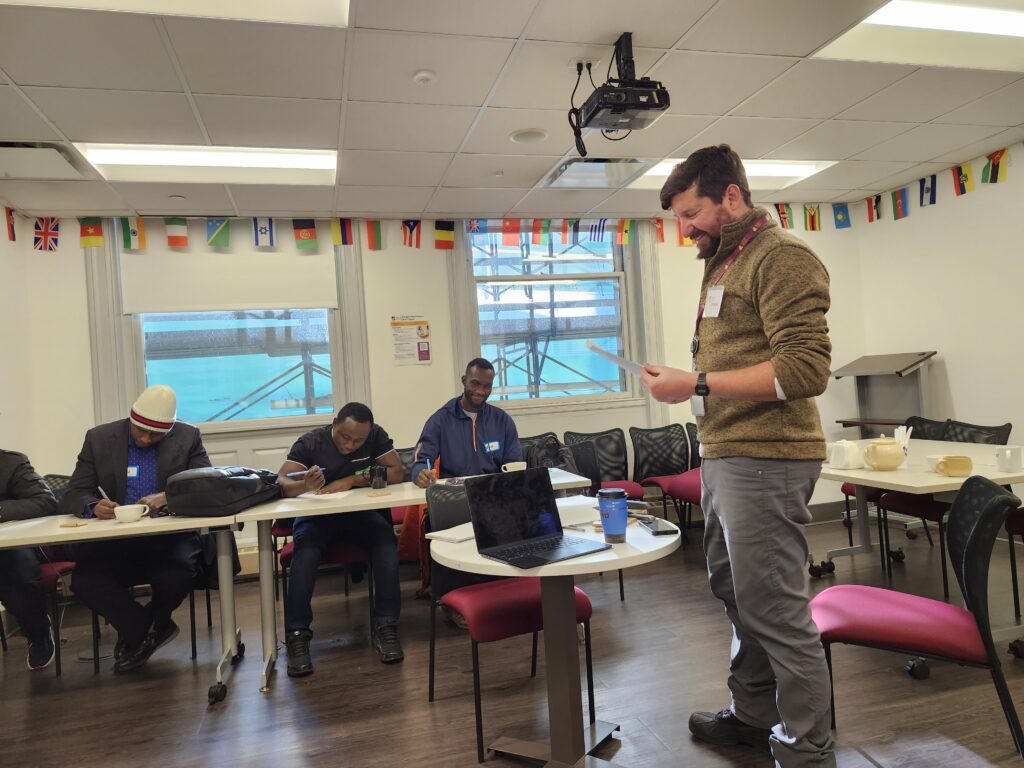
Once they arrive, local resettlement agencies offer their own Cultural Orientation presentations, typically more tailored to their new city and state. While really just the beginning of a process that plays out across departments, these presentations aim to be as comprehensive as possible with a focus on what’s most pressing and practical.
“[The presentation] is actually less about U.S. culture, and more about how things work,” explains Zazie Sawyer, a Community Services Manager based in IINE’s Manchester, New Hampshire office.
In addition to learning about IINE’s services, new arrivals learn to call 911 in an emergency, how to pay rent and bills and the importance of paying them on time, how to survive a New England winter without running up huge utility bills, how to request an interpreter in a hospital or school meeting, and more.


In each section, the focus is to avoid accidentally getting into trouble—at work and school, with landlords and roommates, on the streets, and with government officials. Importantly, presenters are explicit that they’re not assigning value to cultural norms that may differ from those of other countries. They’re helping newcomers stay safe and find success.
Farishta Shams, a longtime IINE Community Services Manager in Lowell, first came to IINE as a refugee from Afghanistan and received Cultural Orientation herself. “We build a relationship of trust with the clients,” she explains. “We’re saying we just want to make sure you know that if you do this, or don’t do this, here’s what could happen. When you accept the value and culture of the United States, it does not mean you have to give up your way of life. You can keep both or combine them.”
One common adjustment comes around gender roles, which can be tied to traditions and religious beliefs. Some newcomers aren’t accustomed to the U.S. norm of both parents working and sharing childcare responsibilities. The approach of Cultural Orientation is to avoid any judgements about this but rather focus on the reality of what will be needed to cover rent and expenses, at least in the short term.
Another surprise can come with learning what is typically considered to be personal information. For example, asking someone their age, weight, or income is perfectly normal in many countries, but may be seen as impolite by American co-workers or neighbors. The role of Cultural Orientation is to help avoid these kinds of misunderstandings.
Understanding U.S. Cultural Norms and Values
The section that explores these issues directly is called “Cultural Adjustment.” Here’s a key slide from one version of the presentation:
U.S. Culture and Values
Individualism – Individual needs, wants, and values. The freedom to achieve based upon one’s own talents, abilities and ambition.
Privacy – What is inside the American mind is considered to be private and having time alone is important.
Equality – Everyone is created equal and has the same rights.
Punctuality – Being “on time” for class, an appointment, or another meeting is important.
Achievement and hard work – Anything is possible if you work hard
The section also includes a slide on diversity, explaining that “The U.S. is an integrated, diverse, and inclusive country. Racism and discrimination are not accepted and can result in legal consequences.”
Rather than a list of beliefs newcomers are expected to adopt as their own, these “U.S. Values” help refugees and immigrants understand common behaviors, rules, and norms in their new country.
“For some people, these cultural norms are very alien to them,” explains Ian Rollins, Senior Contracts & Programs Manager at IINE’s Boston office. “So, they often start out forming their own communities here with people who share their backgrounds. But once they start working, going to school, and interacting more with the local community, they really do find ways to integrate these values into their own lives. They’re not losing their sense of self but blending their backgrounds with their American identities.” He uses the analogy of a Thanksgiving dinner. “We’ll tell them, hey, there’s going to be ham on the table. You don’t have to eat it or any food that touched it. There’ll be something else you like.”
Ian says he’s seen many moving integration success stories over the years. One of them involved a client with a conservative Christian background.
“I was the first Jewish person he had ever met and when he realized this, he had a lot of questions, which made me a little nervous at first. Like many refugees who come to the U.S. by himself, he had to share his first U.S. apartment with several other single men. One of his roommates was not only a Muslim, but an imam. They became such good friends that when they were able to move into an apartment with fewer people, they chose to stay together as roommates.”
Adaptations
Cultural Orientation follows a standard curriculum that’s defined by a checklist of topics provided in a resettlement contract, but this is only a template.
“There are topics that we are required to cover. They give us some blurbs, and then we are at liberty to expand,” explains Zazie. “We choose what to emphasize and spend time on based on what we know about different populations, and what clients have told us after going through the process.”
Presentations are adapted based on factors like clients’ educational backgrounds, religious traditions, work histories, family structures, economic backgrounds, and urban or rural living experiences. Staff members who share cultural backgrounds with clients are often helpful in identifying needs.
In some cases the focus is less a matter of nationality than circumstance. For example, Ian points out that “It’s common for people who have been separated from their families and come here as single men to need more support on sharing a living space with unknown roommates for the first time.”
Even carefully customized presentations, however, are only a launching pad. Cultural Orientation continues throughout the resettlement journey. Case specialists will expand on key concepts as they help their clients resettle. ESOL instructors teach students about local customs and traditions as they’re teaching English. Employment specialists review what to expect and how to behave in the workplace.

“When we had a lot of Congolese clients, they were having a harder time integrating into their communities, says Zazie. “We created the Congolese women’s group so they could work together through that.”
Each month, this group brings together women from the Democratic Republic of the Congo, along with in-house IINE interpreters, to socialize, share meals, do arts and crafts projects, and hear from speakers. Most of the women are mothers of young children, so speakers often touch on subjects like maternal health, and the U.S. healthcare system. The women have also taken “field trips” to learn how to shop at local stores for discount home goods, and to learn how to install car seats for their children.
Volunteers often help orient newcomers too, pairing with individual families to provide ongoing support. They’ll take clients on bus and walking tours, pointing out where helpful services are located. They might show families how to use their local laundromat or accompany parents to school when they need to meet with their children’s teachers. Some volunteers host monthly dinners with their clients, where they can practice English while sharing a home-cooked meal. These volunteers’ dedication doesn’t just help newcomers gain practical skills. As Ian puts it, “It also shows them that there are people who want them here and want them to succeed.”
Looking at the U.S. Through New Eyes
For Zazie, IINE’s work with Congolese refugees underscored for her that the U.S. has “more of an individualistic society versus a village mentality.”
Ian’s experience with Cultural Orientation reminds him of the freedom that Americans enjoy, especially watching LGBTQ+ clients who have faced persecution in their home countries finally come into their own. He says that “teaching them that they are safe and that they can fully embrace their identity here” has been transformative.

Farishta still remembers some of the U.S. values she was taught in the Cultural Orientation session she received from IINE as a newly arrived refugee. “Freedom of speech, freedom to choose whatever you want to be in this country,” and most of all, that “it’s never too late to learn.” It was learning this that inspired her to improve her English and pursue a master’s degree in business administration. Over time, she understood that she could take advantage of these freedoms without losing the parts of her own culture that she treasures. “You don’t have to give up your life. You can keep both cultures, combine them, and make a good one.”
- - -
Біженці та іммігранти здійснюють довгі, важкі подорожі, щоб уникнути насильства і почати нове життя в США . Ви можете надати їм допомогу, якої вони потребують.