metapixel
Ir al contenido principal

Etiqueta Historia de un cliente

Ride 2025

“I Do This in Their Honor”: Cyclists Raise Awareness and Funds at Sixth Annual Ride for Refugees and Immigrants

The Mission

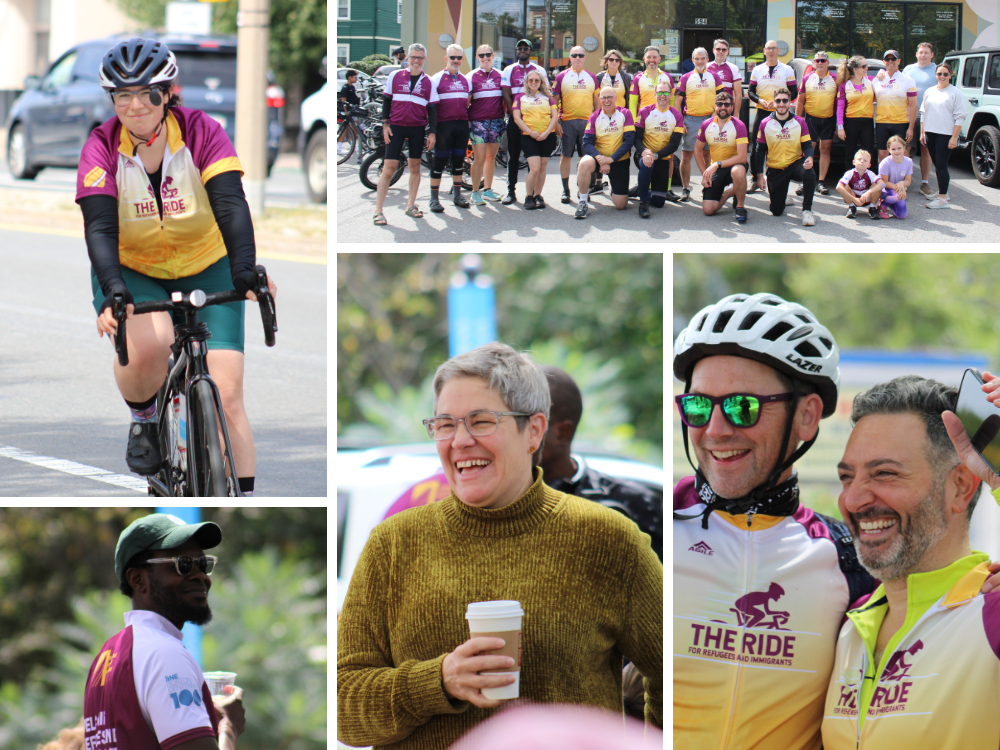
On September 21, thirty members of the IINE community, including staff, board members, volunteers, and their families, donned custom jerseys, mounted their bikes, and set off for a morning of pedaling their hearts out to raise awareness and funds in support of IINE’s mission. 

The annual Ride for Refugees and Immigrants, which was created by IINE Leadership Council member Will Krause, brings together seasoned and novice riders, united by their desire to support our newest neighbors. For weeks leading up to this year’s big day, riders gathered donations from their personal networks, spreading the word about IINE’s work and raising critical funds to help refugees and immigrants access food, shelter, and healthcare, English language and job skills training, and immigration legal support.  
 
For many, this year’s Ride felt particularly urgent as dramatic changes in federal immigration policy have dealt new challenges to refugees and immigrants in our communities—but on the day, while engaged together in action and celebration, the riders were all smiles. 
 

The Routes

Riders chose between two routes: a 12-mile route that started at the Bike Source in Bedford, Massachusetts and ended at the Kickstand Café in Arlington, and a 50-mile loop that began and ended at the café with stops in Lowell to tour IINE’s office and in Bedford to link up with the 12-milers for the home stretch.  

Participants rode at their own paces with designated team leaders guiding the way. Riders’ branded jerseys provided an important visual reminder for everyone they passed that our communities support our refugee and immigrant neighbors.  

The Finish Line

In the early afternoon, the Kickstand Café buzzed with bike-riders as one wave after another reached the finish line. IINE staff members were there to cheer on each finisher, and snacks and refreshments awaited to help them recover and celebrate. Many riders lingered long after the dismount to cheer on fellow finishers and socialize.   

One common theme heard from first-time 50-milers, as they mopped their brows, was that it felt easy to push through any of the day’s physical challenges when they thought about the cause. The challenges refugees and immigrants face are incomparable—surviving crises in their countries of origin, leaving their homes and loved ones behind, starting over in an unfamiliar place with little more than a suitcase, navigating complicated and ever-changing immigration laws, and so much more. This is not only a story shared by IINE’s clients, but also a story that can be found in each rider’s family history, and one that made their own lives as Americans possible.  

This year’s Ride for Refugees and Immigrants raised more than $50,000 in much-needed support for IINE’s mission. A huge thank you to everyone who participated!   

IINE’s annual events raise critical funds for our refugee and immigrant community members. Learn more and join us for an upcoming event.

“I Always Want to Give Back”: Suraj Budathoki’s Journey from a Refugee Camp to the NH Statehouse 

In November of 2024, Suraj Budathoki was elected to represent Hillsborough County District 40 in the New Hampshire State House, becoming the first Bhutanese-American State Representative in U.S. history. In his acceptance speech, Suraj said his victory was “the culmination of 16 years of dedication, resilience, and commitment to this community.” 

 In a recent interview, Suraj spoke to IINE about this journey. 

Learning Resilience 

Suraj became a refugee at the age of nine when the Bhutanese government suddenly stripped members of the Nepalese-speaking Lhotshampa minority of their citizenship and drove them from their homes. He spent the next nearly twenty years of his life in a refugee camp in Nepal.  

Suraj says his time there “taught me a lot; the resilience, the continuity to do things and not give up.”  

When he finally arrived in the U.S. after decades of waiting, he landed in Atlanta, Georgia. He recalls seeing a group of people at the airport handing out gifts to arriving children. “There is compassion for immigrants and refugees here,” he remembers thinking.   

Still, life was far from easy. Suraj arrived with a bachelor’s degree and a nearly-completed master’s degree but soon found himself working two full-time jobs for minimum wage—a day shift at a fast-food restaurant followed by an overnight shift stocking grocery shelves. It was difficult to save or build a social life.  

Work and Welcome in Manchester 

Suraj was excited when a friend from home told him about his life up north in Manchester, New Hampshire, where he had been resettled by the International Institute of New England. Manchester was smaller and easier to navigate. Jobs there offered better starting pay, and through IINE, Suraj could train to become a Licensed Nursing Assistant within a month.  

He was sold. In 2009, Suraj moved to Manchester, “and that’s what I did! I finished the Licensed Nursing Assistant program and then within two months, I got my license! The Employment team helped me get a job and after that I’ve been working with IINE for many, many years.” 

Suraj took to New Hampshire right away. “The mountains and the green vegetation resemble my small town in Bhutan,” he says, and compared to the sprawl of Atlanta, the compactness of Manchester was closer to the life he knew in Nepal. As in Atlanta, he took on two full-time jobs, but these he found more meaningful and in line with his goals. One was at a rehabilitation center for adults with traumatic brain injuries. The second one was to train adults who hadn’t completed high school to create resumes and help them find jobs.  

These early jobs helped Suraj build up his English skills. He soon went back to school at Manchester Community College and then transferred to Southern New Hampshire University to study Political Science.  

“Then life took off.” 

Building Community 

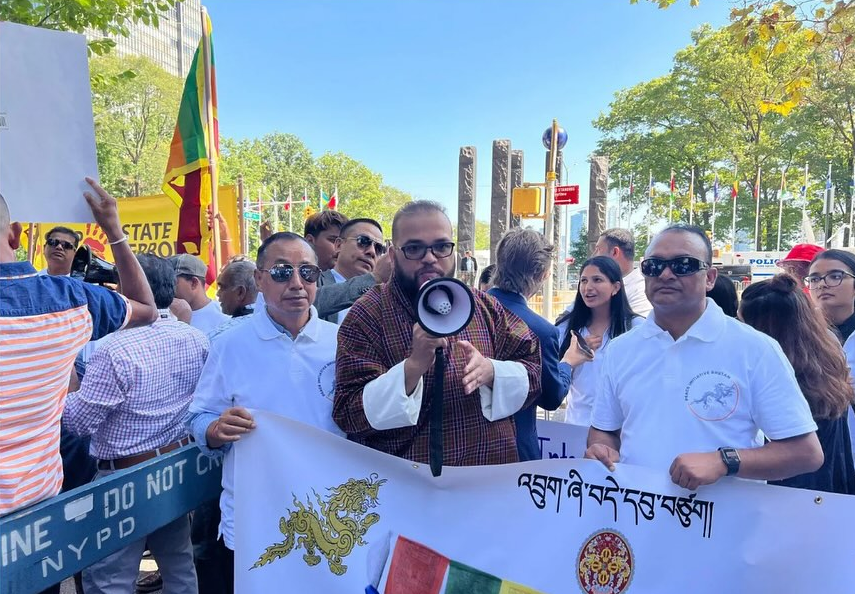
Suraj (center) has advocated for peace in Bhutan throughout his career

With his newfound confidence and vision, Suraj co-founded Bhutanese Community New Hampshire (BCNH), a non-profit dedicated to helping fellow Bhutanese refugees to integrate and thrive. He served briefly as the organization’s first executive director and then joined its board.  

“My first focus was learning to get grants,” Suraj says, and he still vividly remembers the story of his first submission, trudging through the rain to hand off his big envelope in-person, and then waiting months for a response. Finally, he heard back that he had won $6,000 for his mission. He was thrilled.  

With practice, he became more and more adept at grant writing, securing grants as large as $1 million.  

“I was able to hire 23 staff! Can you believe it?” 

Even more exciting was turning the funding into medical care, mental health services, and employment support for his community. BCNH formed a close partnership with IINE, who referred newly resettled Bhutanese clients for additional support. As it grew, BCNH expanded its mission to accept clients from additional countries and changed to its current name: Building Community New Hampshire.  

Feeling the Bern 

In 2016, Suraj was able to exercise his political science muscles when the presidential campaign of Vermont Senator Bernie Sanders opened a field office in New Hampshire.  

“It was my first time working on a campaign and I got the second-highest post for New Hampshire! That was my first opportunity to get to know Bernie, his team, and the people of New Hampshire. I was so privileged to work on his campaign and travel a lot across the state.” 
 
Suraj says that talking to people throughout the state had a profound effect on him. “I heard a lot of people’s often painful stories, and I could relate from when I was in a refugee camp…It’s not having money to pay rent; the cold; not enough food for the elderly who invested their life making America better, supported their kids growing up, when they were young and then paid taxes, and at the end of the life they have nothing to enjoy.” 

Suraj decided to tackle these issues head-on at the community level. His founded Bloom and Shine, LLC, a human services agency that provides in-home behavioral and physical healthcare to New Hampshire seniors. 
 
“I felt I needed to do something, and Bloom and Shine is something. Providing caregiver services to the elderly and disabled, it’s something I feel proud of.” 

Pursuing Peace 

While deepening his roots in his new community, Suraj was also studying international development, completing a master’s degree from Norwich University, and beginning a Ph.D. program at Saybrook University with a focus on conflict resolution. His research revealed clear historical patterns of opposing sides in ethnic conflicts becoming increasingly entrenched in their mutual opposition as suffering increased. 

“I saw that happen in Bhutan in the ‘90s. My Ph.D. is on how to find a solution. How can we transform that adversarial relationship into a conducive, friendly relationship? As I did more research on conflict resolution and negotiations, I found that there are peacebuilding and reconciliation methods that can bring two conflicting parties together.” 

Inspired by his research, he launched the Peace Initiative for Bhutan (PIB). 

“I talked to many young Bhutanese-Americans, college students, and other like-minded individuals, and they also had the same kind of idea. We came together to form this peace initiative. The approach is distinct from what our leaders did in the past. We are not doing this to win—to defeat the other side. We’re doing this to find common ground—to resolve through dialogue.” 

The goal of the initiative is to heal relations between the nation of Bhutan and its refugee diaspora. This reconciliation would allow Bhutanese refugees to return home in peace to reunite their loved ones.  

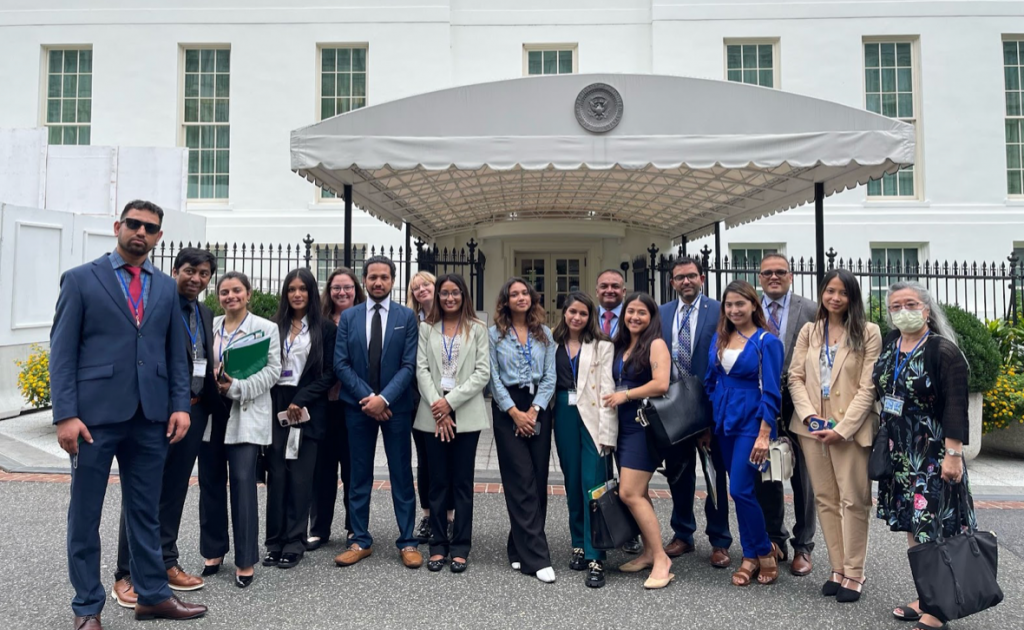
Members of the Peace Initiative Bhutan on the trip to D.C.

The first step for PIB was to draft their own peace plan and send it directly to the king of Bhutan. When they didn’t receive a response, they posted their plan online and alerted the press. Next, to draw further attention, they got the U.S. government involved. Suraj traveled to Washington D.C. and lobbied to get both the U.S. House of Representatives and the U.S. Senate to introduce resolutions calling for reconciliation.  

Bhutan began to listen. 

“We did a couple of rounds of informal dialogue with people inside Bhutan, also some parliamentarians,” Suraj says. “This has never happened before with other approaches. Our method is based on mutual respect, based on love to the other side.” 

The People’s House 

Suraj’s success with the Bernie Sanders campaign, his empathy for the struggles of working people in New Hampshire, and his progress with PIB all inspired him to make his own run for the State House of Representatives. His victory was a huge source of inspiration for fellow Bhutanese refugees. New Americans Magazine reported, “Suraj’s win quickly became a sensation on social media, sparking pride and celebration across the Bhutanese diaspora, which includes former refugees resettled across eight Western countries. Bhutanese-American social media platforms lit up with messages of pride, congratulatory posts, and reflections on the significance of this victory.” 

While ever hopeful, Suraj is learning about the challenges of belonging to a minority party in a state legislature. 

“We don’t have much say in any bills or regulations. We don’t have that power. We do share what we think, what we believe would bring positive change, but supporting the middle class or poor community is not what always gets attention. It feels painful when we see bills cutting support to the elderly, to the university system, to special education, and many others in New Hampshire.” 

Suraj is committed to speaking up for vulnerable constituents, but sometimes he worries about others’ misconceptions of his background and journey.  

“I testified in one of the committees against a bill, and I told them my success story. I came here as a refugee. 100 people work in my company. I’m going to college. I paid this much in taxes, etc…People may feel I’m taking their space. They see themselves working day and night, but I came here a few years ago, and now here I am running a company and a state representative. They may not understand the human side, the hard work, of what we as immigrants do here.”   

He wishes more people understood about his time working two jobs for minimum wage to build a foundation, missing many nights of sleep and the family he left behind at the refugee camp. 

But like his Peace Initiative, he sees his political work as an experiment and says that his political career is “just getting started.” In the arc of his career, it’s one more way to heed the calling he first heard back in the refugee camp in Nepal. 

“The international community, the United States and many other countries, they helped us a lot. We were not able to go to work outside of the camp, and we were fed and supported by many Western countries…We always feel we should give back for those many years we were given—and that’s the call—I always want to give back to the community. Whatever I’m doing now, being a State Representative or running this home health care business, it’s always supporting community, providing employment and uplift.”  

---

Refugiados e inmigrantes emprenden largos y difíciles viajes para huir de la violencia y rehacer sus vidas en Estados Unidos. Tú puedes darles la ayuda que necesitan. 

Atefa's Story

Atefa’s Story: With Ongoing Support, a Young Refugee Builds a Brighter Future

Atefa’s story is featured in our Spotlight Report: Who We Can Serve and How in a Rapidly Shifting Landscape. Click here to read the full Spotlight.

When the Taliban retook control of Afghanistan, Atefa, her mother, and three brothers escaped their home, resettling as refugees in Lowell in 2022. As the eldest sibling, Atefa quickly took on adult responsibilities. She became her family’s interpreter and spokesperson at doctor’s visits and school appointments – all while balancing learning an entirely new culture and language.  

At first, school was frustrating for Atefa. In Afghanistan, she had already begun college, but her high school transcripts were among the many possessions she had to leave behind, and without them, she had to begin her American education as a freshman at Lowell High School. Still, she stayed focused and determined. For support, she went to nearly every tutoring session provided by IINE’s Refugee Youth Mentoring program, bringing her brothers along to make sure they progressed as well. That year, Atefa earned honors recognition for her grades. 

During her junior year, Atefa began exploring the college application process. When IINE’s Youth team advised her to join extracurricular activities to stand out, she became a student ambassador, helping fellow newcomers adjust to life in Lowell. Her leadership and service led to her acceptance into the National Honor Society in her senior year.  

That summer, Atefa went back to her IINE mentors for guidance, and they suggested volunteer work. In addition to working at a grocery store, participating in school groups, and helping her family, she began giving back to support other IINE clients. She delivered fresh produce and packaged goods to families, provided interpretation, and peer-tutored fellow refugee youth.  

Atefa’s relentless dedication was rewarded when she was accepted to four colleges! She chose the University of Massachusetts Amherst, where she will study civil engineering starting in the fall of 2025. As she prepares for this next chapter, she continues to reach out to the IINE Youth Team for guidance on class selection, financial aid, and housing. 

---

Refugees and immigrants come to the U.S. after enduring unimaginable hardships. You can give them the help they need to rebuild their lives here. 

In New Hampshire, Investing in English Language Classes Makes Everyone’s Healthcare Better

A Healthcare Success Story

As in much of the country, if you live in New Hampshire and you need medical care, you’re likely to get help from some people who began their lives in other countries. Immigrants and refugees make up about 18% of the U.S. healthcare workforce. In New Hampshire, they make about 7% and are particularly prevalent in patient-facing roles, such as home healthcare aides, drivers, cleaners, and food preparers. They’re the people who help you feel comfortable, safe, and cared for when you’re at your most vulnerable.  

These are roles for which there are dangerous shortages in New Hampshire, a state with a rapidly aging population. It’s an urgent need that creates an opportunity for newcomers seeking entry-level jobs that may not require a local work history and more than basic English skills.  

“Matching newcomers with New Hampshire healthcare employers has been a real success story in general,” says Kayla Rossmeissl, IINE’s Director of Program Design and Evaluation. “Employers are getting fast-learning, resilient, highly motivated workers, who have the benefit of IINE to help support their orientation and development. Our clients often say they’re excited to be helping people in their times of need and giving back to the community that’s welcomed them.” 

A Desire for Investment

In 2019, Kayla helped develop LNA for Success—an IINE skills training program that combines English language instruction, vocational training, higher education partnerships, and apprenticeship, to help prepare immigrants and refugees for the job of Licensed Nursing Assistant. She says that in promoting this program over the next few years, IINE discovered a real desire for greater investment.  

“We had been doing a lot of community presentations and working closely with [LNA for Success partner] Manchester Community College. We started to discover a lot more partners who are looking for ways to help get refugees and immigrants more economically stable—career laddering, higher paying jobs, things like that.” 

She also found healthcare providers looking to invest in their immigrant employees. At one networking event, representatives from two local hospitals sought her out. 

“They were just like, ‘Kayla, I heard you set up these ESOL programs. Can we chat?’ From there, we were all brainstorming to come up with a program to help their workers.” 

Both hospitals were interested in paying their employees to deepen their English language skills during the workday, through on-site, workplace-focused English for Speakers of Other Languages (ESOL) classes. 

“Which is amazing,” Kayla says, “because a lot of families are juggling multiple part-time jobs and childcare, and wouldn’t otherwise have time to take classes.” 

Kayla wasted no time in developing a curriculum for a pilot “ESOL 4 Healthcare” program, conducting interviews with partners to learn about their goals and challenges.  

“They wanted to see people become more confident in speaking English, because even though they are in environmental services [maintenance], they do greet the patients in their rooms, and they interact with other staff in the hospital, like their supervisors. So, having more confidence in communication, being able to read and write emails, improving digital literacy skills, and navigating internal systems like clocking in and out—these were all things we could help with that could improve everyone’s experience.” 

Gaining Confidence

“I would say for me personally, what I see in the students, cohort after cohort, is confidence,” says Becky Marden, Director of Workforce Development at Elliot Hospital in Manchester.  
 
“In their evaluations, they’ll say things like, ‘I’ve gained the confidence to say hello to my manager in the morning, whereas before I might just have avoided eye contact,’ and things like that. And that’s what inspires me to keep pushing for this class and making it better every cohort.” 

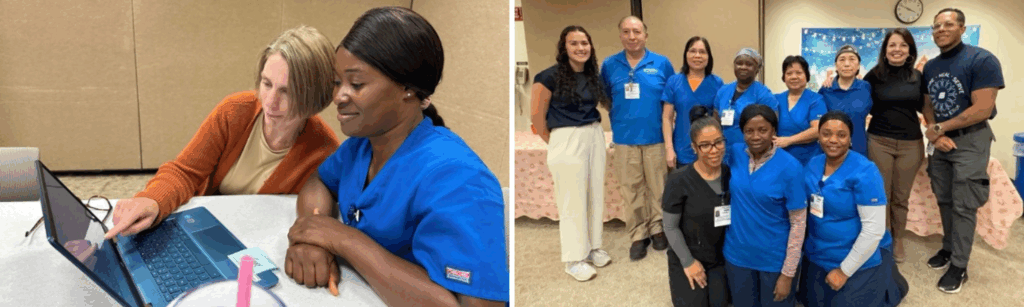
Having helped develop the concept, Elliot Hospital is now in its third year of ESOL 4 Healthcare. Becky says that she’s frequently blown away by the improvement that Elliot’s English language learners make in listening, reading, and writing skills over the course of a cohort—which spans two hours/day, six days/week for sixteen weeks, an impressive investment of staff time. In addition to the improvement in workplace communication and staff-patient relationships, she says that Elliot is gratified to be able to provide some meaningful support to some truly impressive people, which, in the most recent cohort, were six students from six different countries. 

“For me it’s also about the social contacts outside of work—they can use email or finally set up a bank account for the first time. These are some of the most resilient and hardworking employees we have. I could never go to another country and work someplace and not speak the language. I would just be so frustrated. And yet they’ve done it and they’re working in our community.” 

Becky says her CEO shares this feeling. After attending an ESOL 4 Healthcare graduation, he invited several of the recent graduates to a Board Meeting so that the hospital’s leadership could meet them, and they could showcase their new English skills. For Becky, the next step is developing apprenticeship programs within the hospital to help English language learners on staff to advance in their careers there.  

“Some of them have healthcare experience from their previous country. We had a nurse practitioner in one program. We had a labor and delivery nurse in another, and they just want to work in the healthcare field. Their credentials don’t come over, their education doesn’t come over, but here they are, sometimes cleaning toilets just so they can be in healthcare. How do we get them back to the bedside? ‘Cause that’s where we need them.” 

This is the Future

Elliot Hospital is currently one of nine IINE ESOL 4 Healthcare partners, and the number is growing quickly. They include providers offering mental health care, senior assisted living, and more. One new partner, Dartmouth Hitchcock Hospital, offers English classes remotely to reach student in more rural areas, and has developed apprenticeships in Phlebotomy and Lab Tech.  

“I’ve got five more in the queue!” says Kayla. “I really think this is the future. There’s a lot of interest in bridging the gap. There’s tremendous need here, from people who can really benefit from these kinds of jobs, and from employers who are always interested in a stable source of new staff members who come to them recommended and supported.” 

Investing in job training opportunities for refugees and immigrants creates a stronger workforce for us all. Help newcomers grow their careers and our economy by donating to IINE today.

Soccer blog

Shared Goals: How Refugees and Immigrants Bond Through Soccer

It’s the most popular sport in the world. You can play it in a schoolyard, a gym, a park, or even a refugee camp. You don’t need expensive equipment or to even agree if it’s called “soccer,”futbol,” or something else entirely. You just need a ball, a goal, and a group of fellow players. Once you start playing together, you tend to become friends. For these reasons, “the beautiful game” is providing some beautiful opportunities for IINE clients to connect with one another across backgrounds. 

A Clinic for Lowell Youth 

IINE Youth Program Manager Isabel Goes says she’s noticed a clear pattern: “Anytime we talk about sports when we first meet with clients, it’s like, ‘OK, well, does that mean like, soccer?!‘” Her clients are definitely fans. She remembers one showing up to a workshop in head-to-toe Cristiano Ronaldo gear, and the delight of clients unwrapping soccer gear at a holiday gift swap.  

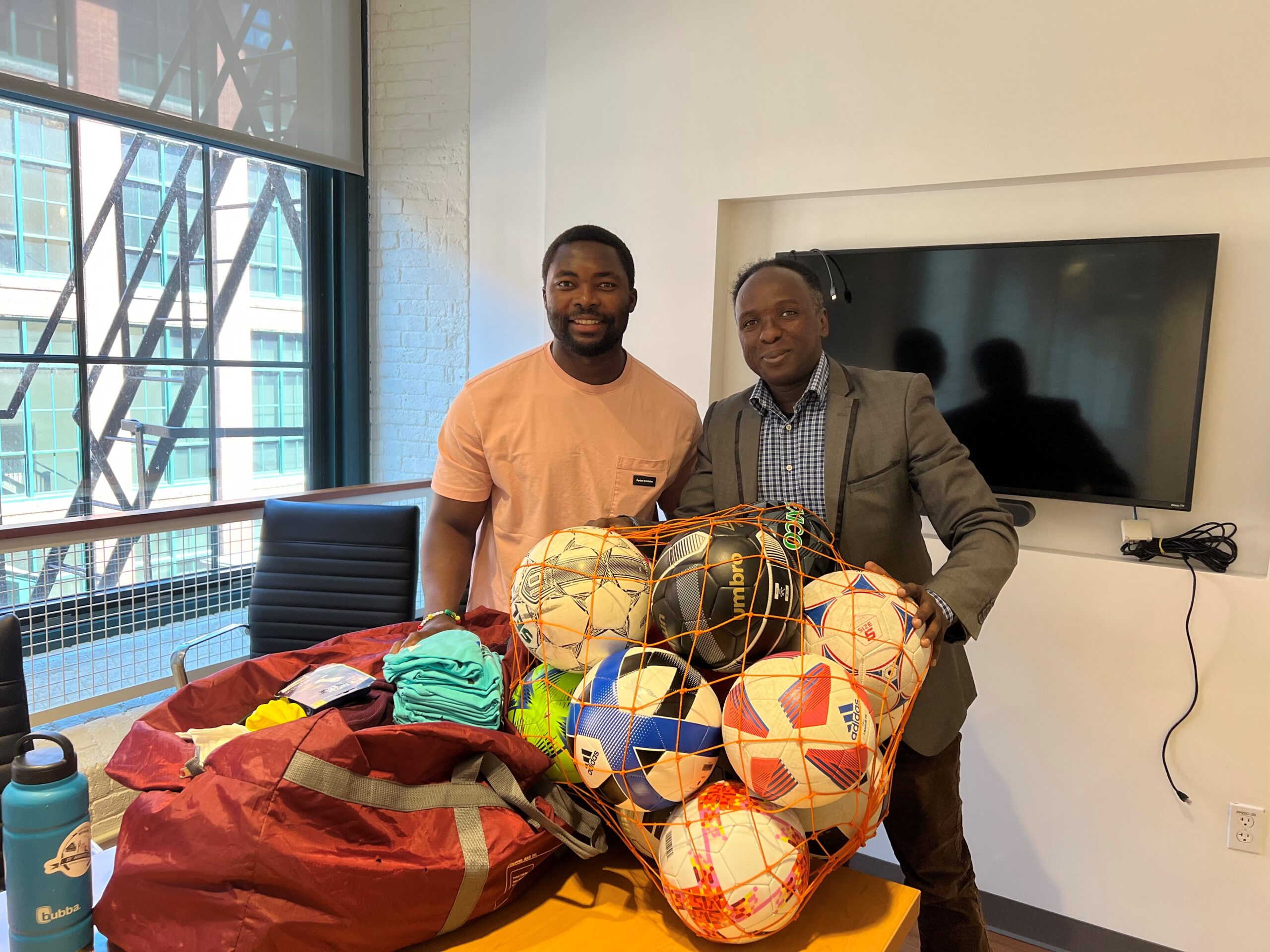
Olf (L) stopping by IINE’s offices to donate soccer equipment to refugee youth

When she decided to organize a youth soccer clinic last June, she knew she’d have plenty of support. Her first call was to Olf Mouyaka, a former refugee from the Democratic Republic of the Congo who grew up in Lowell after being resettled by IINE, and recently founded a soccer-based youth development program called the Football Leadership Organization. Olf had donated soccer equipment to IINE in the past and had experience running clinics.  

Next, to recruit participants, she turned to her colleague Yusuf Abdi. Yusuf’s official job is as IINE’s Career Services Manager, but after hours, he puts tremendous effort and passion into organizing community pick-up soccer games for IINE clients and other members of Lowell’s immigrant community.

“He was like, ‘I already have all these clients coming out for soccer,’ so I said, ‘OK, well, send them our way, have them join us for an official youth program!’” 

Yusuf did just that, and he showed up in his favorite jersey with his son in tow so they could both join in the fun. The clinic was a success, and for Yusuf, it was just the tip of the iceberg. 

“Everyone Show Up at the Park!”

“In the summer, I try to do it six days a week,” Yusuf says, “and I wash all the pinnies after each game!” That’s no small commitment, but he plans to keep it up “as long as I’m helping youth, doing something good, and making them feel a sense of social connection.” 

A former refugee from Somalia, Yusuf has been a passionate soccer fan all his life. As an adult living in Lowell, he joined an indoor recreational league organized by members of the local Cambodian community. He saw some familiar faces in the stands, and again at a regular game organized by member of the West African community: “The youth just came to watch, and I said, hey, they want to run around and play too…so I told them, ‘OK, I will bring the pinnies, soccer balls, and goal posts. Everyone show up at the park!'” 

Yusuf ordered the equipment and continued to recruit participants, including clients who he knew were between jobs and needed an outlet and some social connection.  

Yusuf (center) arranges regular soccer games for clients to have fun, grow their English skills, and build community

To organize meetups, he checked the availability of public parks and then created a Facebook group and a WhatsApp chat moderated by a refugee from the Democratic Republic of the Congo, who is able to translate messages into French and Portuguese.  

His meetups bring out people of all ages and backgrounds, “Each day the language changes some. You may hear a lot of Swahili, a lot of Portuguese, or a lot of Haitian Creole.”  

Together they play informal, tournament-style games. On Fridays, two local coaches, Coach Kwezi from Ghana and Coach Hugo from Guatemala, show up to offer instruction, run drills, and lead more structured games. Yusuf shares video clips of games in the WhatsApp channel, so players can celebrate their successes and learn from their mistakes. 

Though the language barrier can be challenging at first, everyone understands the basics.  

“Everyone can kick and everyone can try to score. Everyone is quiet when they arrive, but their faces are different when the game ends—happy smiles.” 

In fact, the games give players a great chance to practice their English skills without thinking about it too much, and players form bonds quickly.  

They chat, and some of them, they’re not able to communicate, but they try. You know, ‘Why’d you miss the ball?’ ‘You should pass to me.’ And some build confidence. You can see players become happier over time, come out of isolation. Their lives begin to change. That drives me.” 

Specifically, Yusuf says clients became inspired by friends they’ve met on the soccer field to follow their lead in steps like pursuing GEDs or higher education.  

Yusuf loves the mentorship, community, and social connection the sport offers – no matter a player’s age.   

“I’m in my 40s. I’m not like a youth of 18 or 20, but I’m still engaged. Soccer is a language that doesn’t require much talking, it’s more of action, and it builds trust. When I’m playing with a group from Ivory Coast, Cameroon, and Liberia who don’t know me, they get to know me, I become a friend of theirs. That’s how you get connected.” 

Balling in Boston

According to IINE Volunteer & Donations Specialist Emily Dionne, in Boston, the idea of convening some regular pick-up soccer in the park came from super-volunteer, Suraj Chaudhry of Newton South High School.  

“Suraj has been involved with a ton of different things. He suggested just doing a one-off game and then it just kind of grew from there with the Employment and Skills Training teams really taking it into their own hands to keep it going, which was really great.” 

Emily got Suraj together with some other volunteers to plan the first game. They circulated a flyer, Suraj borrowed pinnies and balls from his school, and Emily brought some pizzas for a post-game social. 

“A good 30-40 people came out, including staff, volunteers, and clients,” says Emily. “We were so surprised. It was a really fun gathering.” 

The one-off game quickly evolved into a weekly Saturday morning meetup. Games are kept informal with teams chosen by counting off, and consistent winners are often broken up to make contests more even.  

“It’s a really great way to build community and have people meet each other, especially in Boston, since everybody’s kind of separated across the city,” says Emily.  

“I think it’s a good way to have a bonding activity that isn’t necessarily based around things we do at IINE like having people work on resumes or attend workshops—it’s purely fun. It’s also a team mentality—everybody coming together for one goal.” 

Emily says the game has led to connections off the field, too. In the WhatsApp chat, between posting video clips of their game highlights, people have started organizing social outings throughout the city.  

When Suraj had to step away, Lead Career Navigator Gordon Parris gladly took over the organizing with the help of Career Navigator Luqman Alkhaneqeeni.  

Gordon (far right), Emily (second from right), and Luqman (kneeling) gather fellow IINE staff and clients weekly for a pick-up soccer game

A former refugee who has lived in Jordan, Iraq, and Turkey, Luqman has been playing soccer since he was four years old. It’s been a throughline for him as his life has continued to change. He couldn’t have been more excited to learn that his new workplace was hosting a regular game. “It’s one of my talents, let’s say,” he says with a smile. “When I learned about the game my first week on the job, I said, ‘Let’s go! I’m in!’”  

Luqman says he sees soccer as “a global phenomenon which unites millions of people. Also, back home it’s used as a cultural expression. Every time I’m playing, I see emotions, joy, that transcends all borders.” 

We have some kids who are 9, 10, 13 years-old that run circles around us,” Gordon adds,  “so when he says it transcends all borders, including ages, he’s being literal.” 

Gordon is originally from South Africa where he also grew up playing soccer. “We’re all there because there’s something that we kind of miss from home. It’s something that we all grew up doing in completely different ways. Everyone gets the goofy jokes of like, you know, looking one way, kicking the other way, that kind of thing. It’s a common language, and therefore, unifying.” 

Now in its second year, the pick-up game continues to go strong. So what’s next for the franchise?  

“We’re going to keep it simple,” says Emily. “We’re just going to keep playing soccer.” 

“The Most Lovely People”: A Volunteer Group’s Experience Supporting a Refugee Family from Nigeria

Boston Bound volunteer group members with Tani and her family

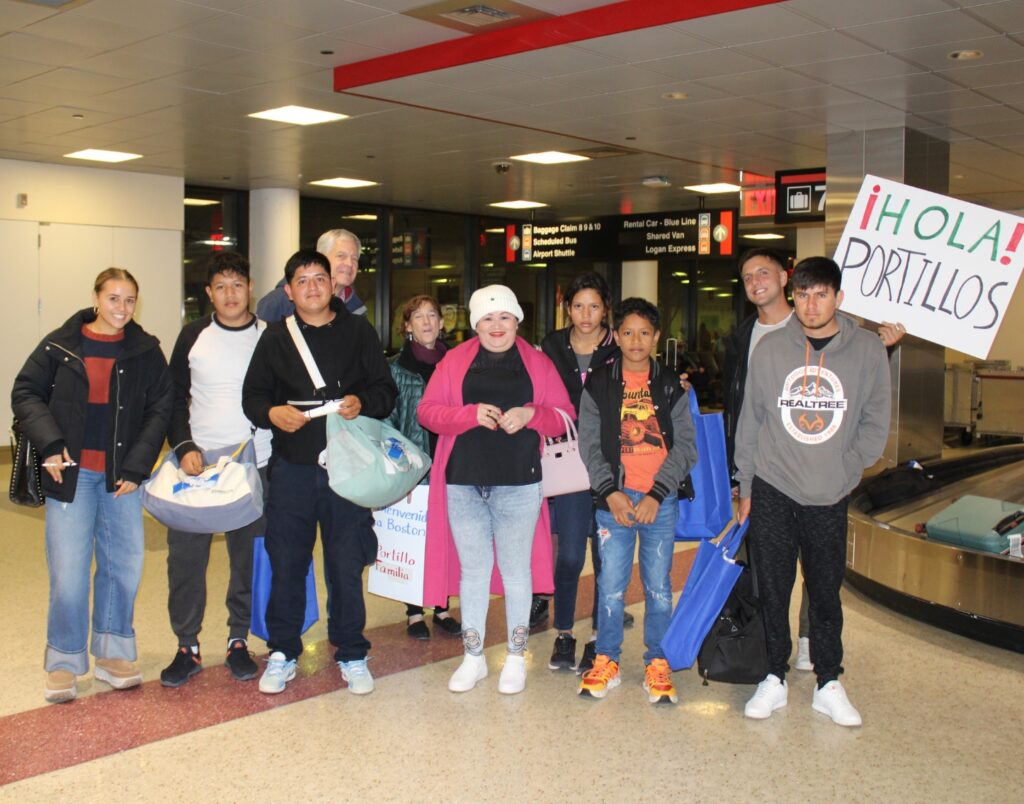
Tani and her six children were among the last refugees to arrive safely in Boston just before the indefinite suspension of the U.S. Refugee Admissions Program. In the weeks leading up to their arrival at Logan Airport, a group of friends from Boston and Brookline had been eagerly preparing to support them through IINE’s Resettle Together program

The volunteer group, who call themselves “Boston Bound,” is led by Jenny Miller. Jenny first learned about IINE when her daughter was looking for a community service project in the lead-up to her Bat Mitzvah. Through IINE, she was able to deliver food to local immigrant families and to donate books to refugee children after running a donation drive at her school.

Jenny remained on IINE’s volunteer email list, and when she learned about other opportunities to get involved, she was inspired. “These were things I could actually do. I work full-time [and am] crazy busy, but I had a few hours at night to go grocery shopping and bring food to a new family. Or I had a few hours on the weekend to help someone learn how to navigate the T,” she says.  

“IINE provided great support, and it was deeply satisfying, like disproportionately satisfying even when I never met the family. Dropping off groceries felt so tangible. At a time when it felt hard to find other ways [to help], it just felt really good to be able to do that.” 

She talked about the experience with her friends, a group of fellow parents of tweens. After the 2024 election, when they began sharing their fears over anti-immigrant policies taking hold in January, she proposed sponsoring a refugee family through Resettle Together as a concrete way to honor their values. 

Soon they all found themselves gathered around a dining room table in front of a large piece of paper, divvying up tasks from finding donated furniture, to apartment cleaning, to scheduling shopping trips for food and clothing.  
 
“When we started letting people know that we were doing this, it was amazing how many people wanted to help,” says Jenny, “Our kids did a drive for toiletries, soap, and detergent, and all that kind of kitchen stuff before Tani and her children arrived, and we got six months’ worth of stuff!” 

Eager to befriend Tani’s teenage children, the kids of Boston Bound also collected gifts, prepared a bracelet-making kit, and made a photobook with pictures of all the group members to show the new arrivals how many new friends they now had.  

When the family arrived, Boston Bound group members took turns hosting them for home-cooked West African-style meals, playing board games with their children, taking them to local parks and playgrounds and kicking around a soccer ball, going on shopping trips, helping them learn how to navigate public transportation, and more. They became close quickly. “They are the most lovely people,” Jenny says of Tani and her family. “They are a very close family, very warm, incredibly supportive of each other. I think what struck me was they came here with so much curiosity and eagerness to learn—also a love of their new home, and they really extended that to all of us. They have been so welcoming to all of us. Even with the language barrier, which, when they arrived was almost total. There was still so much warmth.” 

While IINE case workers helped the family enroll in ESOL classes, secure work authorizations, and become oriented to the U.S. workplace, Boston Bound helped make sure the family had access to food and healthcare, enrolled in school, got library cards, and practiced reading and speaking English. Meanwhile, a beautiful friendship formed. 

IINE Case Specialist Nijimbere Lahayiloyi shares more about what it means to welcome refugees, and how critical volunteer support is

“They’ve invited us to celebrate their birthdays at their home, and that’s been just wonderful—so joyful,” Jenny says. “They’ve taught us the songs that they sing for birthdays, and dances, and the music they listen to. They’ve also come to some of our houses for birthday celebrations or just for dinner, and that’s been really lovely too. Every time I visit, they try to send me home with food.”   

When IINE’s Employment team was able to get them job interviews, Boston Bound helped them practice and prepare. Now, all eligible family members have started jobs in food service. 

“Having this support has meant so much,” says Mariamu, one of Tani’s daughters. “We have been able to have people to practice English with and to help us with things we don’t yet understand. We are very grateful for their willingness to assist us.They have been with us since our first day in Boston. They help us understand the community we live in; they often visit us and make sure we are okay. They have done so much to help us in many ways. We appreciate them and pray that God blesses them in everything.” 

Jenny shares how Boston Bound came together and the “privilege and joy” of becoming close with Tani and her children

---

Refugiados e inmigrantes emprenden largos y difíciles viajes para huir de la violencia y rehacer sus vidas en Estados Unidos. Tú puedes darles la ayuda que necesitan. 

La historia de Prudence: Cómo una refugiada y humanitaria encontró en Estados Unidos un apoyo que le salvó la vida. 

Padre de cuatro hijos, Prudence ha dedicado su vida a trabajar por los derechos humanos y contra la corrupción gubernamental. Tras huir de su Burundi natal a Sudán, creó una fundación para defender a los niños y colaboró con varios organismos internacionales de desarrollo para apoyar a los refugiados.  

Cuando un cambio de régimen le hizo creer que estaba a salvo, Prudence regresó a Burundi decidida a ayudar a mejorar la vida allí. Puso en marcha iniciativas para empoderar a los habitantes de las comunidades rurales de difícil acceso del país, dándoles acceso a sistemas de pago digitales y medios de comunicación digitales. Por desgracia, estos avances llamaron la atención de quienes deseaban hacer un mal uso de ellos. Cuando el presidente de Burundi decidió presentarse a un tercer mandato -lo que no estaba permitido por la Constitución del país-, pidió a Prudence que difundiera el falso mensaje de que contaba con un amplio apoyo. Prudence se negó. Esto le llevó a convertirse en objeto de persecución política. Nuevas amenazas contra su vida obligaron a su familia a desplazarse, primero al Reino Unido y luego a Ruanda.  

Para empeorar las cosas, el hijo de Prudence, Joshua, había nacido con una peligrosa cardiopatía y necesitaba urgentemente una complicada intervención quirúrgica. Conseguir esta atención como refugiado no sería fácil, pero Prudence encontró esperanza cuando supo que se podía conseguir en el Boston Children's Hospital.  

Prudence tenía claro que la salud de su hijo y la seguridad de su familia dependían de encontrar acogida y apoyo en Massachusetts. Una extraordinaria relación con el padrino Steve Gross, de la Fundación Life is Good, y con el Instituto Internacional de Nueva Inglaterra, hizo realidad este sueño.  

Vea su historia a continuación: 

---

Refugiados e inmigrantes emprenden largos y difíciles viajes para huir de la violencia y rehacer sus vidas en Estados Unidos. Tú puedes darles la ayuda que necesitan. 

Ley de refugiados de 1980

5 cosas que hay que saber sobre la Ley de Refugiados de 1980

Comprender la finalidad y el impacto de la Ley de Refugiados en su 45º aniversario 

Hace cuarenta y cinco años, la Ley de Refugiados creó un proceso de admisión y reasentamiento de refugiados más justo, eficiente, seguro y estratégico. Desde entonces, ha salvado la vida de más de tres millones de personas de todo el mundo. Ayudar a los refugiados a integrarse en nuestras comunidades ha reforzado enormemente la cultura y la economía de nuestro país, así como nuestra posición en todo el mundo.

Hoy, cuando los desplazamientos se disparan a niveles récord en todo el mundo y empeoran por la creciente amenaza del cambio climático, la actual administración presidencial ha intentado cerrar unilateralmente la "puerta de oro" que abrió este programa.  

Es nuestra responsabilidad reavivar la esperanza que esta Ley creó y reanudar nuestro liderazgo como refugio de libertad y oportunidades. Con motivo de la celebración de su cuadragésimo quinto aniversario, he aquí 5 cosas que hay que saber sobre la Ley de Refugiados de 1980.

1) La Ley de Refugiados de 1980 definió oficialmente quién es un refugiado. 

La primera página de la Ley de Refugiados de 1980. Fuente: Archivos Nacionales.

Para las personas obligadas a huir de sus hogares, la definición de "refugiado" tiene implicaciones de vida o muerte. Ser incluido puede significar un nuevo lugar seguro donde vivir y el apoyo necesario para prosperar allí.

La Ley de Refugiados de 1980 adaptó la legislación estadounidense al lenguaje utilizado por las Naciones Unidas, definiendo como refugiado a toda persona que no pueda o no quiera regresar a su país de origen debido a "persecución o temor fundado de persecución" por motivos de raza, pertenencia a un determinado grupo social, opinión política, religión u origen nacional.

Es importante destacar que ésta ha sido nuestra definición más inclusiva hasta la fecha, eliminando las condiciones basadas en la nacionalidad de las personas, el momento de su desplazamiento o los países desde los que se vieron obligadas a buscar refugio.

2) Estableció un proceso uniforme de investigación de antecedentes, acogida y reasentamiento de refugiados. 

La Ley de Refugiados creó el Programa de Admisión de Refugiados de EE.UU. (USRAP) para examinar rigurosamente a los refugiados en el extranjero utilizando criterios coherentes, y la Oficina de Reasentamiento de Refugiados (ORR) para garantizar que los recién llegados reciban los servicios necesarios para ser autosuficientes lo antes posible. Se proporcionaron fondos para contratar a una red de agencias de base comunitaria, como IINE, examinadas y supervisadas, para que ofrecieran acogida, asistencia en materia de vivienda, conexión con prestaciones federales y servicios locales, formación en lengua inglesa, orientación cultural, apoyo profesional y servicios jurídicos. 

Antes de que se establecieran estas oficinas, las admisiones y reasentamientos de refugiados podían ser ad hoc e incoherentes, estar sujetas a debate durante una crisis activa y dar lugar a diferentes acuerdos para diferentes poblaciones. El USRAP y la ORR supusieron una inversión en equidad, mejor planificación y una integración más fluida. 

3)Definió una asociación entre el Presidente y el Congreso para fijar las cifras de admisiones.

El Presidente Carter firma la Ley de Refugiados de 1980

Aplicando controles y equilibrios al proceso, la Ley facultaba al Presidente para fijar un número máximo anual de admisiones de refugiados, pero sólo previa consulta con el Congreso. El Presidente estaba facultado para aumentar este número en situaciones de emergencia, con el requisito de que también debía remitirse una justificación al Congreso, que en última instancia controla el proceso presupuestario que financiaría el esfuerzo.  

4)Garantizaba el derecho a solicitar asilo.

La Ley de Refugiados no sólo estandarizó un proceso para solicitar refugio desde fuera de EE.UU., sino que también estandarizó un proceso a través del cual solicitar el estatus de protegido desde dentro de EE.UU. o en su frontera. Los solicitantes de asilo tendrían que demostrar que cumplen los mismos criterios establecidos para los refugiados: persecución o temor fundado de persecución que les impida regresar a su país. Los que lo lograsen tendrían los mismos derechos y ayudas que los refugiados que solicitan asilo desde el extranjero.  

Este proceso ha salvado la vida de millones de personas amenazadas, obligadas a huir rápidamente de sus hogares con pocos recursos, que podían llegar más fácilmente a la frontera que acceder al proceso de admisión de refugiados.  

5)Fue realmente bipartidista.

La Ley de Refugiados de 1980 fue aprobada por unanimidad en el Senado por 85 votos a favor y 0 en contra. Presentada por el "león liberal", el senador Edward Kennedy de Massachusetts, la ley contó con tres copatrocinadores republicanos, y fue notablemente ayudada por el acérrimo conservador Strom Thurmond, entonces miembro republicano de mayor rango del Comité Judicial de la Cámara de Representantes. El país se enfrentaba a la guerra de Vietnam, a la evolución de su papel en el mundo y a su responsabilidad con los desplazados. Ambos partidos consideraron que la Ley de Refugiados creaba un proceso más justo, ordenado y seguro para la inmigración por motivos humanitarios que reafirmaba nuestro compromiso con la causa de la libertad y mejoraba nuestra posición internacional.  

Refugiados e inmigrantes emprenden largos y difíciles viajes para huir de la violencia y rehacer sus vidas en Estados Unidos. Tú puedes darles la ayuda que necesitan. 

Rastreando nuestras raíces: Los líderes del IINE hablan del viaje de sus familias a EE.UU.

Rastreando nuestras raíces: Los líderes del IINE hablan del viaje de sus familias a EE.UU.

Con motivo de la celebración del Centenario de Boston -100años acogiendo y apoyando a refugiados e inmigrantes- recordamos que casi todos tenemos una historia de inmigración que contar, tanto si fuimos los primeros de nuestra familia en construir una vida en Estados Unidos como si fueron nuestros padres, abuelos o generaciones anteriores quienes emprendieron el valiente viaje a este país. 

Para nuestro blog, los miembros de nuestra Junta Directiva y nuestro Consejo de Liderazgo comparten cómo sus familias llegaron a llamar hogar a Estados Unidos. 

Carolina San Martín

Director Gerente, Responsable Global de Investigación en Inversión Sostenible, State Street Global Advisors; Miembro del Consejo de Administración del IINE

Río de Janeiro, 1976: Mi madre, una joven argentina con un don para los idiomas, se encuentra como madre soltera en un país extranjero. De niña, había soñado con dejar Argentina algún día, pero donde soñaba ir no era a Brasil, sino a Estados Unidos. Por inesperada y difícil que sea su situación, ahora es libre de perseguir ese sueño. Unos años más tarde, tiene su oportunidad. Su buen historial en una empresa estadounidense en vías de globalización le consigue un traslado a la sede de la empresa en Estados Unidos.

Smyrna, Georgia, 1979: Me encuentro instalada en el jardín de infancia. No hablo inglés, nadie a mi alrededor habla español o portugués. No entiendo lo que dice la maestra ni cómo funcionan las cosas, pero poco a poco me voy dando cuenta. En ese momento, veo mi situación como una desventaja. Soy el diferente, el extraño. Experimento todas las reacciones e inseguridades que cabría esperar de un niño en esa situación: cuando los niños se ríen y no les entiendo, me pregunto, ¿Se ríen de mí?? Cuando estamos aprendiendo reglas gramaticales y escribiendo en clase, pienso, ¿Cuánto retraso voy a tener, ya que todavía estoy aprendiendo inglés?

Boston, Massachusetts, 2025: Mirando hacia atrás, lo que yo pensaba que era un obstáculo -ser el inmigrante que era diferente- fue un inmenso regalo. Desde muy joven comprendí lo mucho que podía crecer si tenía la determinación de resolver las cosas. Era algo más que adaptarme: comprendía mi capacidad para aprender y lograr más de lo que parecía capaz, todo gracias a ser la diferente en aquella clase de parvulario.

Fereshtah Thornberg

Vicepresidente Ejecutivo, Jefe de Ventas y Gestión de Clientes, Norteamérica, State Street; Miembro del Consejo de Administración del IINE

Mi madre, tres de mis hermanos y yo dejamos Kabul (Afganistán) en 1989, rumbo a Nueva Delhi. Fue hacia el final de la invasión rusa, con la creciente preocupación por la influencia de los talibanes. Emigramos a Nueva Delhi como refugiados mientras mi padre buscaba la manera de salir de Kabul. Vivíamos en una habitación individual de alquiler en Nueva Delhi mientras nos instalábamos y trabajábamos en nuestro próximo objetivo de establecernos en Europa o Estados Unidos. Mi madre empezó a trabajar como voluntaria en el centro de refugiados y más tarde fue contratada a tiempo completo. Me esforcé por adquirir habilidades que me permitieran conseguir un empleo, mientras trabajaba a distancia para obtener mi título universitario. Empecé con clases de mecanografía y más tarde me apunté a un programa para estudiar informática.

Cuatro años después, recibimos la tarjeta verde y volamos a Nueva York, donde teníamos familia y un sistema de apoyo. Establecernos en Nueva York fue mucho más difícil que hacerlo en Nueva Delhi, y a menudo comento que ojalá hubiéramos tenido acceso a una organización como el Instituto Internacional de Nueva Inglaterra. 30 años después, vivimos una vida plena y llena de éxitos, y no hay semana en la que no recordemos nuestro viaje hasta aquí. 

Tuan Ha-Ngoc

Presidente y Consejero Delegado jubilado de AVEO Oncology; miembro de la Junta Directiva del IINE

Nací y crecí en Vietnam durante la guerra de Vietnam. En 1969, tuve la oportunidad de salir del país para cursar estudios superiores con la condición de que, tras graduarme, volvería a Vietnam para ayudar a construir el país a pesar de la guerra. Aterricé en la Universidad de París, donde me licencié en Farmacia. Había planeado volver a casa en el verano de 1975, cuando el país cayó en manos del régimen comunista en abril. Tenía dos opciones: volver y vivir bajo un gobierno comunista o quedarme en París y pedir asilo, que fue lo que hice. Aún conservo el documento expedido por ACNUR, que me consideraba "apátrida". Es una palabra que me ha acompañado hasta hoy. Tenía la sensación de no pertenecer a ninguna parte, de estar sola en un barco en un océano inmenso; no literalmente, por supuesto, aunque muchos de mis compatriotas experimentaron exactamente eso.  

Afortunadamente, mis padres y hermanos pudieron salir de Vietnam y reunirse conmigo en Francia. Allí permanecí dos años, durante los cuales obtuve un máster en Administración de Empresas por el INSEAD. En 1976, entré en una empresa estadounidense llamada Baxter Healthcare, en su sede europea de Bruselas. En 1978 ocurrieron dos cosas: me casé con mi bella esposa y mi empresa decidió trasladarme a su sede estadounidense de Chicago.  

Llegamos allí en noviembre con muy poco dinero, sin familia ni amigos en los que confiar, y con mi mujer hablando muy poco inglés. Así empezamos nuestra vida en EE.UU. En 1984, me contrató una de las primeras empresas de biotecnología, lo que nos trajo a Boston, donde estamos desde entonces.

Deborah Dunsire

Presidente de Neurvati Neurosciences; ex Consejero Delegado de H. Lundbeck A/S; Asesor Principal de Blackstone Life Sciences; Miembro del Consejo de Liderazgo del IINE.

Nací en Zimbabue de padres inmigrantes escoceses, y mi marido nació como el mayor de la tercera generación de familias mixtas inglesas y holandesas. Después de estudiar medicina y trabajar como médico de cabecera y mi marido como traumatólogo residente, me incorporé a la industria farmacéutica y me trasladaron a Suiza, donde mi marido se incorporó a la misma empresa. En 1994, ambos recibimos una oferta de trabajo independiente en la sede de EE.UU. en Nueva Jersey y emprendimos nuestra aventura de más de 30 años en EE.UU. Rápidamente aprendimos a amar la hospitalidad de corazón abierto y admiramos la cultura filantrópica que abunda aquí. También aprendimos que el inglés no es el mismo en todo el mundo.

Mi marido y yo nos nacionalizamos ciudadanos estadounidenses en 2004 y criamos aquí a nuestros dos hijos.

Wade Rubinstein 

Fundador y Presidente de The Bike Connector, Inc.; Miembro del Consejo de Administración del IINE

Soy hijo de inmigrantes. La familia de mi madre llegó a Boston en los años veinte huyendo de los pogromos rusos. Mi padre, que creció en una ciudad que ahora forma parte de Ucrania, sobrevivió al Holocausto. Durante la guerra, estuvo escondido tres años. Los soviéticos lo liberaron en la primavera de 1944. Huérfano después de la guerra, mi padre vivió en campos de desplazados en Checoslovaquia y Alemania. Fue introducido clandestinamente en Palestina en 1946 y llegó a Estados Unidos como refugiado a principios de la década de 1950 para reunirse con familiares que ya estaban aquí. 

La trayectoria de mis padres me ha marcado de manera fundamental. Gracias a su resiliencia y a su duro trabajo, tuve la oportunidad de convertirme en graduado universitario de primera generación.

Estudié informática en el Boston College. Después de la universidad, trabajé en Digital Equipment Corporation durante 10 años, antes de pasar a trabajar en varias nuevas empresas de telecomunicaciones. En 2003, dejé la informática y me licencié en educación primaria. Enseñé en West Newton durante un par de años. Después, decidí abrir una heladería, Reasons to Be Cheerful, que regenté durante ocho años. Vendí la tienda en 2018 y fundé The Bike Academy, que era un programa extraescolar de ciclismo en Lowell y se transformó en la organización sin ánimo de lucro que dirijo hoy: The Bike Connector.   

Siempre he pensado que la vida es demasiado corta para no perseguir tus intereses. Para mí ha sido la oportunidad de vivir el sueño americano, algo que sólo puedo hacer gracias a las decisiones y los sacrificios de mis padres.  

Örn Almarsson

Consejero delegado y cofundador de Axelyf; miembro del Consejo de Liderazgo del IINE

En 1989, dejé mi Islandia natal para cursar estudios de posgrado en Estados Unidos, lo que marcó el comienzo de un extraordinario viaje científico y personal. Con una profunda pasión por la química y la ciencia molecular, combinada con el deseo de contribuir positivamente a la salud humana, me embarqué en un programa de doctorado en química bioorgánica en la Universidad de California, sumergiéndome en la investigación avanzada en la intersección de la química orgánica y las ciencias biológicas. Mi éxito académico y mi impulso intelectual me llevaron a un puesto de investigación posdoctoral en el Instituto Tecnológico de Massachusetts (MIT), uno de los principales centros mundiales de innovación en ciencia y tecnología.

En el MIT perfeccioné mis conocimientos bajo la dirección de científicos e ingenieros de talla mundial y me orienté hacia las aplicaciones traslacionales de la química en la industria farmacéutica. Aquí forjé importantes relaciones científicas y profesionales que me ayudaron a lanzar mi carrera en la industria. Mi primer puesto en la industria farmacéutica fue en Merck, donde contribuí al descubrimiento y desarrollo de fármacos en un entorno de I+D dinámico y profundo, conocido por su rigor y excelencia científicos. Este puesto marcó el inicio de mi compromiso duradero con el avance de la terapéutica para la salud humana.

A lo largo de los años, mis contribuciones se han extendido a múltiples áreas terapéuticas, siendo una de las más notables mi trabajo en la formulación y el sistema de administración de Spikevax, la vacuna COVID-19 basada en ARNm de Moderna. Mi experiencia en la administración de fármacos, especialmente en sistemas basados en lípidos, desempeñó un papel importante en el éxito de la evaluación y el despliegue final de la vacuna durante una época de crisis mundial. Además de este logro tan visible, he trabajado en otros muchos productos farmacéuticos y tecnologías de administración que han mejorado la atención al paciente y los resultados terapéuticos en psiquiatría y tratamiento de infecciones, por ejemplo.

Mi viaje es también un viaje en familia, en colaboración y con un objetivo común. Mi esposa, Brynja, también de Islandia, ha sido una presencia constante a lo largo de este viaje, ofreciéndome su apoyo y construyendo un hogar cálido y bicultural en los EE.UU. Juntos hemos criado a tres hijos que han encontrado su propio camino en la atención sanitaria y farmacéutica, continuando el legado de investigación científica e impacto en la salud pública que define a nuestra familia. Ya sea en la investigación biológica, la biotecnología o la prestación de asistencia sanitaria y la educación, cada miembro de nuestra familia contribuye de forma única al campo, encarnando los valores de la educación, el servicio y la ciudadanía global.

De joven estudiante islandesa a líder científica que ayudó a dar forma a una de las intervenciones médicas más importantes del mundo, mi historia de inmigración es una historia de dedicación, resistencia y repercusión duradera. 

Jeffrey Thielman

Presidente y Consejero Delegado, Instituto Internacional de Nueva Inglaterra

Mi bisabuela, Antoinette, vino de Italia a Estados Unidos a principios del siglo XX. Vino en barco desde Nápoles. Un matrimonio concertado la trajo aquí. Tuvo siete hijos, uno de los cuales fue el padre de mi madre -mi abuelo-, a quien yo adoraba y que llegó a senador por Connecticut.  

Mi bisabuela tenía muy poco dinero y nunca aprendió bien el inglés. Le costó mucho adaptarse y aprender una nueva cultura, pero trabajó muy, muy duro para asegurarse de que sus hijos e hijas fueran ciudadanos activos de nuestro país. Me enorgullece honrarla con mi trabajo de hoy.

Durante el año de nuestro centenario, celebramos 100 años de apoyo a los refugiados e inmigrantes del área metropolitana de Boston, que han cambiado sus vidas, y nos preparamos para nuestro segundo siglo de servicio. Obtenga más información aquí: Centenario del IINE Boston.

Miniatura del blog de Bashir

 Bashir, refugiado somalí, persigue sus sueños en Boston

Bashir habla calurosamente de la cultura en la que creció.

"BashirLa cultura somalí se basa en la hospitalidad. Son una comunidad unida, una comunidad que se conecta entre sí. Viven como una familia. La cultura somalí se basa en quererse, en acoger a la gente". 

Trágicamente, a los dieciséis años tuvo que dejar atrás su querida comunidad de Somalia. "Dejé mi país por los combates", explica. "Por culpa de los grupos extremistas como Al-Shabaab, que mataron a dos miembros de mi familia delante de mí. Mi familia decidió enviarme a otro país porque podía ser el próximo objetivo de estas milicias."

En Etiopía, Bashir pasaría años en un campo de refugiados. Aunque nunca perdió la esperanza de un futuro mejor, el día a día era duro.

"No te lo puedes imaginar si no has estado allí", dice Bashir. "Ves que la gente no tiene agua potable, no tiene un refugio que sea suficiente para la familia; a veces ves una familia extensa de diez o más personas y están viviendo en una sola habitación".

Tras dos años, parecía que la oportunidad de Bashir había llegado cuando se le concedió oficialmente el estatuto de refugiado y la promesa de reasentamiento en Estados Unidos. Corría el año 2016. Entonces, una nueva administración presidencial entró en la Casa Blanca y, en menos de una semana, aprobó una prohibición general de la inmigración de nacionales de países predominantemente musulmanes. La puerta que finalmente se había abierto para Bashir ahora estaba cerrada.

A pesar de ello, Bashir estaba decidido a mantener una actitud positiva. Se dedicó a trabajar con organismos de ayuda para mejorar la vida en el campo. Bashir aprendió inglés y se convirtió en trabajador social para la Organización de Rehabilitación y Desarrollo, que ayuda a personas con discapacidad, y para el Comité Internacional de Rescate, a través del cual ayudó a educar a los miembros de la comunidad sobre el problema de la violencia sexual. También trabajó como profesor en lo que él describe como "mi propia mini escuela", ayudando a personas de todas las edades a aprender a leer y escribir.

Después de siete años, Estados Unidos había vuelto a ser más acogedor con los refugiados, y otra puerta se abrió para Bashir.

"En 2023 conseguí el destino de mis sueños. De joven, vi que venir a Estados Unidos sería una puerta para entrar en los sueños de mi vida de convertirme en lo que quiero: trabajar en un entorno pacífico, rehacer mi vida, ayudarme a mí mismo y a mi familia."

Bashir viajó solo a Estados Unidos. Cuando llegó, un equipo del IINE estaba allí para recibirle y llevarle a una habitación de hotel donde le habían preparado una comida caliente. Al cabo de una semana, el IINE ayudó a Bashir a mudarse a un apartamento completamente amueblado.

Estaba encantado de estar en su nuevo hogar, pero la adaptación le llevó tiempo.

"Cuando llegas a un entorno diferente al que has vivido toda tu vida, es un shock. Recuerdo que cuando llegué era marzo y hacía mucho frío en Boston. Yo venía de 70 grados Fahrenheit, y llegué aquí -tenía como 17 o 20- [¡fue] muy duro!".

"Sin tu familia y amigos, sin la gente que conoces que tiene la misma cultura, no es fácil", dice.

Con el tiempo, Bashir empezó a encontrar una comunidad. Sus compañeros de piso -tres refugiados- procedían todos de países diferentes, pero las barreras lingüísticas iniciales pronto se diluyeron para dar paso a una floreciente amistad. Bashir recuerda las horas que pasaban juntos en el salón y la cocina, ayudándose mutuamente a adaptarse. Mientras tanto, Bashir trabajaba con el IINE en todo tipo de tareas, desde aprender a moverse por Boston hasta completar la orientación laboral en Estados Unidos y solicitar trabajo.

Los estadounidenses son gente muy amable... Todo el mundo te pregunta: "¿De dónde eres?", y cuando se lo dices, te dicen: "¡Vaya, bienvenido!", e intentan ayudarte.

"Todo el mundo fue muy amable conmigo", recuerda, "mi gestor de casos, el gestor del centro, mi apoyo jurídico, todo el mundo me acogía cuando necesitaba reunirme con ellos".

Hoy, Bashir disfruta trabajando como conserje en un edificio residencial y como intérprete para una agencia que trabaja con escuelas y hospitales. En el IINE descubrió su pasión por la programación y se fijó el objetivo a largo plazo de convertirse en programador informático. IINE le ha puesto en contacto con un programa de formación en el que está aprendiendo desarrollo front-end.

Torneo de fútbol Bashir
Bashir (izquierda) celebra la victoria de su equipo de fútbol en un torneo, con el organizador del torneo (centro) y el entrenador de su equipo (derecha).

Cuando fue lo bastante independiente como para organizar su propia vida, Bashir encontró un apartamento en un barrio con una comunidad considerable de refugiados somalíes. Vive cerca de una mezquita, juega al fútbol y disfruta volviendo a formar parte de una comunidad somalí. Es una especie de hermoso reencuentro, pero Bashir dice que el sentimiento de aceptación y apoyo que ha recibido en Boston va mucho más allá de su barrio.

"El pueblo estadounidense es muy buena gente. Creo que todo el mundo sabe lo que significan los inmigrantes. Esta gente es realmente amable y acogedora. Todo el mundo dice, ¿de dónde eres? y cuando se lo dices, dicen, Vaya, ¡bienvenido! e intentan ayudarte".

Mientras trabaja, estudia y disfruta de su nueva vida, Bashir persigue otros de sus sueños estadounidenses. Dice que en los próximos dos años está ansioso por conseguir su primer coche, votar en sus primeras elecciones estadounidenses y "devolver algo a la comunidad estadounidense que realmente me ha ayudado mucho."

---

Refugiados e inmigrantes emprenden largos y difíciles viajes para huir de la violencia y rehacer sus vidas en Estados Unidos. Tú puedes darles la ayuda que necesitan. 

Bicicletas Blog Thumbnail

Ciclos virtuosos: Las bicicletas donadas ayudan a los refugiados a salir adelante 

Entre los muchos retos a los que se enfrentan los refugiados en Estados Unidos, el acceso al transporte puede resultar especialmente desalentador. Se tarda mucho tiempo en permitirse un coche y, como bien saben muchos viajeros de Nueva Inglaterra, el transporte público tiene sus limitaciones. Si los refugiados viven demasiado lejos de posibles empleos y recursos comunitarios, pueden sentirse atrapados.

La solución viene sobre dos ruedas. He aquí cómo los entusiastas filantrópicos de la bicicleta de tres comunidades están convirtiendo su pasión en un apoyo crucial para sus vecinos más recientes.

Queen City Bikes, Manchester, NH 

"El transporte es duro", dice Henry Harris, Director Gerente de la oficina de IINE en Manchester, New Hampshire. "Es difícil conseguir un coche cuando estás empezando de nuevo. No tienes crédito, y antes de tener trabajo, si tienes recursos, tienen que ir a parar a alimentos y artículos de primera necesidad. En muchos de los barrios donde viven nuestros clientes, no hay trabajo cerca y puede ser difícil incluso llegar a la tienda de comestibles. Tenemos un sistema de autobuses, pero básicamente dan vueltas en círculo sin llegar a ningún sitio. quieres quieres que vaya".

Para ayudar a mitigar este reto, IINE fomenta el uso compartido del coche y ofrece clases de educación vial dirigidas por voluntarios. Los clientes que reúnen los requisitos necesarios se inscriben en el programa de Cuentas de Desarrollo Individual (IDA), que enseña educación financiera, ayuda a los clientes a abrir cuentas de ahorro y proporciona fondos de contrapartida para compras importantes (como coches). Pero todas estas oportunidades son limitadas y, lo que resulta frustrante, recientemente se han propuesto varias leyes estatales nuevas que harían que más difícil o incluso prohibitivo a los refugiados e inmigrantes obtener licencias.

Henry considera que estas leyes son increíblemente contraproducentes para New Hampshire, ya que los empresarios quieren que los recién llegados puedan acceder a ellos para trabajar, los comerciantes quieren nuevos consumidores y el DMV quiere asegurarse de que cualquiera que circule por carretera ha recibido la formación adecuada.

"Trabajamos duro para intentar que los legisladores entiendan los perjuicios de estos cambios propuestos", dice Henry. "Ahora mismo creo que New Hampshire está como atrapado en el torbellino".

Mientras tanto, Queen City Bicycle Collective ha sido un salvavidas para muchos de los clientes de IINE en Manchester y para muchos otros habitantes de la ciudad que, de otro modo, no podrían permitirse el lujo de comprar y mantener bicicletas de calidad.

"Unos cien de nuestros clientes han conseguido bicicletas allí", dice Henry, "y muchos más lo harán. Cada bicicleta que ves en nuestra comunidad, si alguien la está montando, probablemente vino de allí".

Para que la ciudad se comprometa a ayudar a más residentes a pedalear, recogen donaciones de bicicletas de alta calidad de los residentes; las reacondicionan; ofrecen tiempo de taller abierto, herramientas y orientación para ayudar a otros a ponerse a punto; y venden paquetes de bicicletas asequibles, cascos, candados y servicios de mantenimiento continuo a precios muy asequibles.

Henry dice que los beneficios han sido enormes para los clientes de IINE e incluso han ofrecido algunos resultados positivos inesperados. "Tuvimos un cliente con problemas de salud persistentes que, al principio, sólo estaba agradecido por poder desplazarse y luego nos dijo que sus síntomas de diabetes habían mejorado drásticamente porque iba en bici a todas partes. Eso fue genial".

Abby Easterly, del colectivo de ciclistas Queen City

Abby Easterly, consultora de gestión empresarial jubilada, fundadora y tesorera de la junta de QCB, explica que la idea del colectivo surgió en realidad de su anterior trabajo como voluntaria en el IINE, donde primero apoyó a una oleada de refugiados somalíes y, años más tarde, a un numeroso grupo de afganos evacuados repentinamente de su país tras el resurgimiento de los talibanes en 2021. Desde entonces, Abby se había enterado de la existencia de colectivos de ciclistas en otras ciudades y consideró que el modelo era ideal para los refugiados.

"Los refugiados suelen llegar sin poder conducir, y sí necesitan ir a trabajar, y New Hampshire es penosamente malo en transporte público", explica. "Las bicis no sólo sirven para ir al trabajo. También te permiten ir al supermercado, a casa de amigos, quedar después del trabajo o ir a donde necesites."

Abby dice que uno de sus momentos de mayor orgullo con QCB ha sido contratar a uno de los clientes afganos de IINE. "Contratamos a Isatullah cuando era un joven mecánico y le formamos. Fue un gran mecánico para nosotros. De hecho, también fue muy útil porque podía ayudarnos con la interpretación".

Crear un espacio de compromiso comunitario entre los recién llegados y sus vecinos es una parte crucial de la misión.

"Me gustaría que hubiera más formas de que la gente conociera a los inmigrantes", dice Abby. "Realmente ese es el objetivo del colectivo, incluso más que poner a la gente en bici. Las bicis son un hilo conductor, y si puedes encontrar más hilos conductores que hagan que la gente trabaje y esté junta de forma natural, creo que no tienes que enseñar a a la gente sobre los refugiados, simplemente puedes crear situaciones geniales".

Rozzie Bikes, Roslindale, MA 

En el Gran Boston, todo parece volver a los problemas de la vivienda asequible, incluido el acceso a un transporte fiable.

"Tendemos a reasentar a los refugiados en un radio bastante amplio alrededor de Boston porque, obviamente, los alquileres son más baratos más lejos", explica Leslie Schick, Directora de Servicios Comunitarios del IINE, "pero eso tiene el inconveniente de que el transporte público no es tan bueno ni está tan disponible. Tengo un cliente que trabaja en la escuela pública de Sharon. El sistema escolar está cerrado en verano, por lo que necesita otro trabajo, pero eso requiere transporte, y Sharon simplemente no tiene un buen transporte público. Tengo otra clienta que coge el autobús para ir a trabajar, pero el autobús no llega hasta su casa. Es en momentos así cuando envío una llamada de socorro a Ron y Alan".

¿Quién es este dúo dinámico? Ron Beland y Alan Wright de Rozzie Bikes (abreviatura de Roslindale Bicycle Collective).

Leslie conectó con Alan en 2021 a través de su implicación mutua con la organización local sin ánimo de lucro Bikes Not Bombs. Por aquel entonces, Leslie publicaba en las redes sociales que IINE necesitaba bicicletas donadas, sobre todo para los refugiados afganos recién llegados, y las estaba recogiendo sin tener un buen sitio donde guardarlas. Muchas de las bicicletas donadas también llegaban muy necesitadas de una puesta a punto. Leslie conoció a Alan, un mecánico crack dispuesto a donar sus servicios. Lo que ella no sabía era que su conexión con la misión de IINE era muy profunda. Anteriormente, Alan había pasado mucho tiempo en un campo de refugiados en Tailandia. Allí había trabajado con refugiados Hmung que habían huido de Laos tras ser perseguidos por ayudar al ejército estadounidense durante la guerra de Vietnam. Ayudar a los refugiados a acceder a bicicletas de calidad combina dos de sus pasiones.

"En mi vida siempre he arreglado bicis para la gente y he regalado bicis cuando he tenido la oportunidad", dice. "Pero una vez que empezó la introducción a Leslie, entonces sí que despegó. Esos dos primeros años regalábamos al menos una bicicleta al mes, quizá dos o tres."

Rozzie Bikes es un colectivo de una treintena de entusiastas de la bicicleta (en su mayoría jubilados) dedicados a promover el uso de la bicicleta como solución ecológica y económica para los urbanitas, que, según observan, está infrautilizada en nuestra cultura en comparación con muchas otras del mundo. Recogen bicicletas usadas, las reparan y ponen a punto, las entregan a los clientes refugiados de IINE -y a otras personas necesitadas- y les ayudan a aprender a montar con seguridad.

Clientes de Boston en bicicleta
Gracias a la generosidad de Alan y Rozzie Bikes, los clientes del IINE Maryam, Jesús y su sobrino Roger recibieron sus propias bicicletas. Recientemente disfrutaron de una tarde explorando su nuevo hogar de Quincy y la playa cercana.

Para Leslie, la entrega personal a los clientes es especialmente importante: "Creo que significa mucho para ellos que venga alguien a entregarles todo, la bici, el casco, el candado y la luz, a enseñarles cómo usarla, etc., y así también establecen una conexión".

Estas conexiones también significan mucho para Alan. Recuerda una en particular.

"Había un grupo de tres chicos que vivían en Mattapan, habían llegado hacía sólo unas semanas y estaban ansiosos por salir a la ciudad, así que les llevé bicicletas a los tres. No sabían en qué parte de Boston se encontraban. Así que les dije, bueno, vamos a dar un paseo en bicicleta. Estaban a sólo unas manzanas del carril bici del río Neponset, que va desde Mattapan Square hasta South Dorchester. Así que nos fuimos, y estaban tan contentos de salir y ver el océano y el puerto, de ver un parque, de ver la línea de tranvía que recorre el río, de ver que podían salir a la ciudad en bicicleta. Fue como abrir la llave, por así decirlo. Fue un momento muy especial".

Conector para bicicletas, Lowell, MA 

Wade Rubenstein había dirigido un innovador programa extraescolar de bicicletas en Lowell que incluía el sistema "Gánate una bicicleta": si los alumnos aprendían a reparar bicicletas usadas, podían quedarse gratis con la bicicleta que habían arreglado. El programa tuvo tanto éxito y resultó tan satisfactorio que decidió ampliarlo y convertirlo en una tienda de bicicletas, un estudio de reparación y un colectivo de ciclistas que pudiera dar servicio a toda la ciudad: El Conector de Bicicletas.

En esa misma época, Wade trabajaba como voluntario en las aulas de ESOL del IINE cuando algo le llamó la atención.

El personal de Bike Connector recibe regularmente a jóvenes clientes de IINE para darles clases de seguridad y conducción de bicicletas.

"Me di cuenta de que muchos de los clientes de IINE iban en bicicleta. Había una clara necesidad: las bicicletas son un medio de transporte barato, no necesitan carné y son más rápidas que caminar. Pero a menudo, las bicicletas que montaban los inmigrantes eran inseguras; estaban rotas, eran de tamaño inadecuado y, a veces, literalmente arrancadas de los canales de la ciudad."

En uno de esos casos, conoció a Ungaye, un estudiante de la República Democrática del Congo extraordinariamente motivado que participaba en el programa de tutoría para jóvenes refugiados del IINE y que estaba trabajando para obtener el título de intérprete médico y matricularse en la universidad. Ungaye se había estado desplazando en una bicicleta que había recuperado de un canal, pero que perdió a manos de un ladrón porque no tenía candado.

Wade decidió donar una bicicleta a Ungaye. Sería el comienzo de algo especial.

"Empecé a donar bicicletas a los alumnos de ESOL y, con el tiempo, la relación entre nuestra organización y el IINE creció. Hemos dado bicicletas a inmigrantes haitianos, centroamericanos y sudamericanos, refugiados ucranianos y afganos. Los gestores de casos del IINE nos traen a sus clientes, y nosotros somos algunas de las primeras personas que conocen en este país. Además de proporcionarles bicicletas, les ayudamos a mantenerlas. También trabajamos estrechamente con los jóvenes refugiados clientes de IINE para enseñarles seguridad en bicicleta y las normas de circulación".

A medida que se estrechaba el vínculo entre Wade y Ungaye, éste le contrató para trabajar a tiempo parcial en Bicycle Connector. El año pasado, Wade fue presentado por Ungaye cuando fue homenajeado por el IINE en la celebración del Día Mundial del Refugiado. En su discurso, Wade reflexionó, "Ungaye fue la primera bicicleta que entregué a alguien aquí en Lowell. La semana pasada acabamos de entregar nuestra bicicleta número 5.000".

El año pasado, Wade se incorporó al Consejo de Administración del IINE. Su conexión con la misión del IINE es profunda. Él mismo es hijo de refugiados y ha dicho que los viajes de sus padres me han "moldeado de manera fundacional."

A medida que ha ido ampliando su apoyo a los clientes de IINE, Wade sigue conectando a refugiados, inmigrantes y otros habitantes de Lowelli necesitados con las bicicletas y, a través de ellas, con la independencia, el acceso a la comunidad y la libertad.

El trabajo de IINE sólo es posible con el apoyo de voluntarios dedicados y compasivos. Vea las oportunidades para participar. 

Es cosa de familia: Madre e hijas refugiadas descubren la profesión y el propósito de la enfermería

Escuchar el estallido de disparos cercanos formaba parte de la vida cotidiana de Nininahazwe y sus hijas en su país natal, Burundi. Tras huir a Kenia, pasaron diez largos años en un campo de refugiados, esperando una oportunidad para una vida mejor. Por fin llegó en 2021, cuando Nininahazwe y dos de sus tres hijas, Teta y Umyhoza, fueron admitidas en Estados Unidos a través del programa de refugiados y reasentadas en Nashua, New Hampshire, por el Instituto Internacional de Nueva Inglaterra.

"Es algo como nunca habías soñado", dijo Teta dijo a un periodista cuando llegó por primera vez, "era demasiado alto".

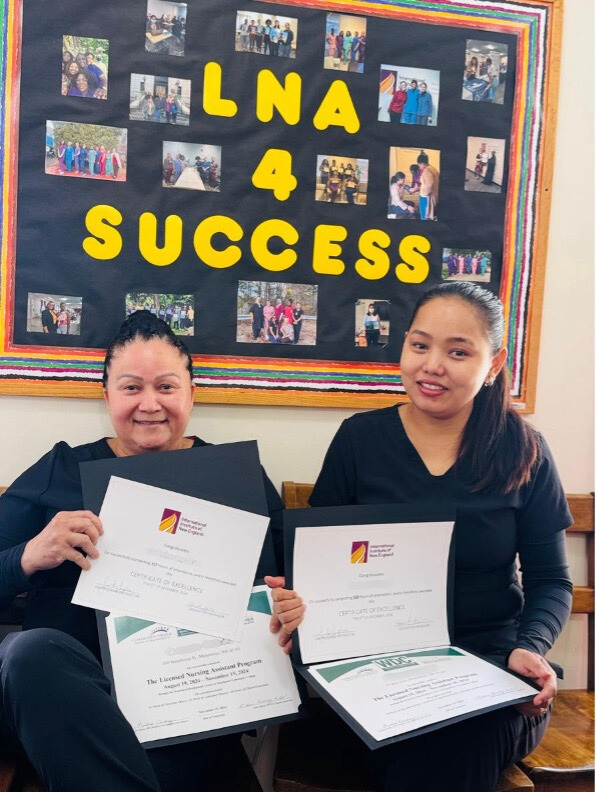
Cuando empezaron a echar raíces en New Hampshire, Teta y Umyhoza estaban ansiosas por empezar a trabajar, así que les encantó enterarse de una nueva oportunidad disponible a través de IINE: un programa gratuito de formación en habilidades laborales llamado LNA for Success, que prepara a las clientas para el muy demandado puesto de Asistente de Enfermería Licenciada.

"El programa de LNA ofrece una vía de acceso a la atención sanitaria a los estudiantes de inglés que trabajaban en el sector sanitario en su país de origen y desean volver a él o que quieren dedicarse a la atención sanitaria ahora que han llegado a Estados Unidos", explica Hannah Granock, responsable de educación del IINE.

"El programa está diseñado tanto para ayudar a los estudiantes a encontrar un empleo remunerado en un campo significativo y en crecimiento como para ayudar a aliviar la escasez de mano de obra sanitaria causada por el envejecimiento de la población activa de New Hampshire. Para ello, impartimos clases de inglés adaptadas a su formación de LNA, nos asociamos con el Manchester Community College para impartir formación práctica y ofrecemos servicios de apoyo integrales, que ayudan a eliminar las barreras a la participación de los estudiantes."

Ambas hermanas se matricularon menos de un mes después de su llegada y fueron alumnas ejemplares.

"Para mí, ser enfermera no es sólo un sueño o una pasión, es un compromiso", escribió Teta en un ensayo sobre por qué buscaba una carrera en el sector sanitario. "Dicen que todo el mundo tiene una vocación en la vida y estoy segura de que ésta es la mía. De pequeña veía a mi abuela luchando por ponerse en pie cuando mis padres estaban ocupados. Yo, de joven, solía ayudarla lo poco que podía. Me alegraba ver una sonrisa en su cara después de ayudarla. Hice el compromiso de mi vida de seguir un curso que me ayudara a ver más de esas mismas sonrisas".

En su ensayo, Umyhoza habla de su deseo de ayudar a ancianos y discapacitados y de sus recuerdos de cómo superó una quemadura que sufrió de niña para empatizar con sus clientes. "Sinceramente, no se me ocurre nada más importante que ser enfermera de larga duración. Siento que lo haré con todo mi corazón. Me encantaría desafiarme a mí misma siendo y dando lo mejor al mundo".

Tras completar el curso, Teta y Umyhoza aprobaron rápidamente sus exámenes para obtener la licencia. Con la ayuda del equipo de empleo del IINE, ambas consiguieron puestos de nivel inicial en el sector sanitario, y Teta se matriculó en la escuela de enfermería para continuar su carrera y obtener la licencia de enfermera práctica.

Nininahazwe se sintió profundamente inspirada por el empuje y el éxito de sus hijas. Aunque tenía menos estudios formales, decidió esforzarse por entrar en el programa de LNA para seguir sus pasos. Se matriculó en clases de inglés y de preparación laboral, estudió capítulos del libro de texto de LNA y empezó a trabajar como auxiliar sanitaria a domicilio. Mientras tanto, Mushimiyamana, la tercera hija de Nininahazwe, fue admitida en EE.UU. a través del programa de refugiados y, con su propia hija a cuestas, se reunió alegremente con su familia en New Hampshire. Un orientador profesional del IINE ayudó a Mushimiyamana a encontrar una guardería para que ella y su madre pudieran matricularse juntas en LNA.

La familia de graduados de LNA for Success: Teta (arriba a la izquierda), U (arriba a la derecha), N (abajo a la izquierda), (abajo a la derecha)
La familia de los graduados de LNA for Success: Teta (arriba a la izquierda), Umyhoza (arriba a la derecha), Nininahazwe (abajo a la izquierda) y Mushimiyamana (abajo a la derecha).

"Quiero ser LNA porque me gusta ayudar a la gente". escribió Nininahazwe en su ensayo de solicitud. De niña soñaba con ser médico, un deseo que crecía cada vez que veía a un miembro de su familia enfermar y luchar por recibir la atención que necesitaba. Cuando tuvo edad suficiente para empezar sus estudios, había perdido a toda su familia en la guerra y se había convertido en madre soltera. Aun así, su sueño nunca murió.

"En aquel momento no pude ser médico", escribió. "Ahora [tengo] la oportunidad. Pienso terminar el instituto [e] ir a la universidad. No renuncio a mis sueños. Necesito formación y experiencia adecuadas para ayudar a los demás de la forma correcta, porque me siento feliz ayudando a otra persona que lo necesita."

En su cohorte de LNA, Nininahazwe y Mushimiyamana eran conocidas por ayudar a sus compañeras con el trabajo del curso. Ambas son ahora graduadas de LNA for Success empleadas como Auxiliares de Enfermería Licenciadas en New Hampshire.

"Creo que los éxitos de Nininahazwe y sus hijas han demostrado lo que la esperanza, el trabajo duro, la dedicación y la familia pueden conseguir", dice Hannah. "Se vieron obligadas a huir de su hogar en Burundi sin tener culpa alguna, pero decidieron no dejar que eso las definiera y hacer todo lo posible por seguir viviendo. Ahora están en Estados Unidos, han rehecho sus vidas y trabajan en una profesión que les encanta. Su familia es un gran ejemplo de que las circunstancias no tienen por qué definirte".

Aunque es único que cuatro mujeres de dos generaciones de una misma familia entren en el campo de la enfermería gracias a LNA For Success, Hannah dice que gran parte de esta historia es familiar.

"Me encanta trabajar en este programa porque he visto cómo no sólo ha supuesto una gran diferencia para nuestros estudiantes, sino que también ha abierto muchas puertas a sus familias. Les ayuda a superar barreras, desde los costes financieros de la formación hasta el proceso de admisión, pasando por el transporte, y muchas de estas estudiantes son madres, por lo que el programa no solo capacita a la estudiante, sino también a sus hijos. Tener un trabajo estable en un campo en el que pueden crecer prepara a sus hijos para una vida mejor. El programa también enseña a nuestros clientes a desenvolverse en el sistema educativo estadounidense, lo que es muy importante cuando intentan ayudar a sus propios hijos."

La necesidad de asistencia sanitaria no hace más que crecer, y New Hampshire tiene suerte de contar con Nininahazwe y sus compasivas y motivadas hijas.

IINE se compromete a mejorar la experiencia de reasentamiento de las mujeres y niñas refugiadas eliminando las barreras que impiden su acceso a la educación sanitaria, la seguridad y el empleo. Más información sobre esta labor y nuestro Fondo WILLOW.