metapixel
تخطي إلى المحتوى الرئيسي

بوسطن
2 شارع بويلستون، الطابق الثالث
بوسطن، ماساتشوستس 02116
617.695.9990

Lowell
585 Middlesex St.
Lowell, MA 01851
978.459.9031

مانشستر
470 شارع باين 470، الطابق السفلي
مانشستر، NH 03104
603.647.1500

اتصل بنا
info@iine.org info@iine.org
iine.org

للتواصل مع وسائل الإعلام
comms@iine.org

تابعنا


تبرع

المؤلف: دانييل غوتييه

Why They Give: Donor Profile

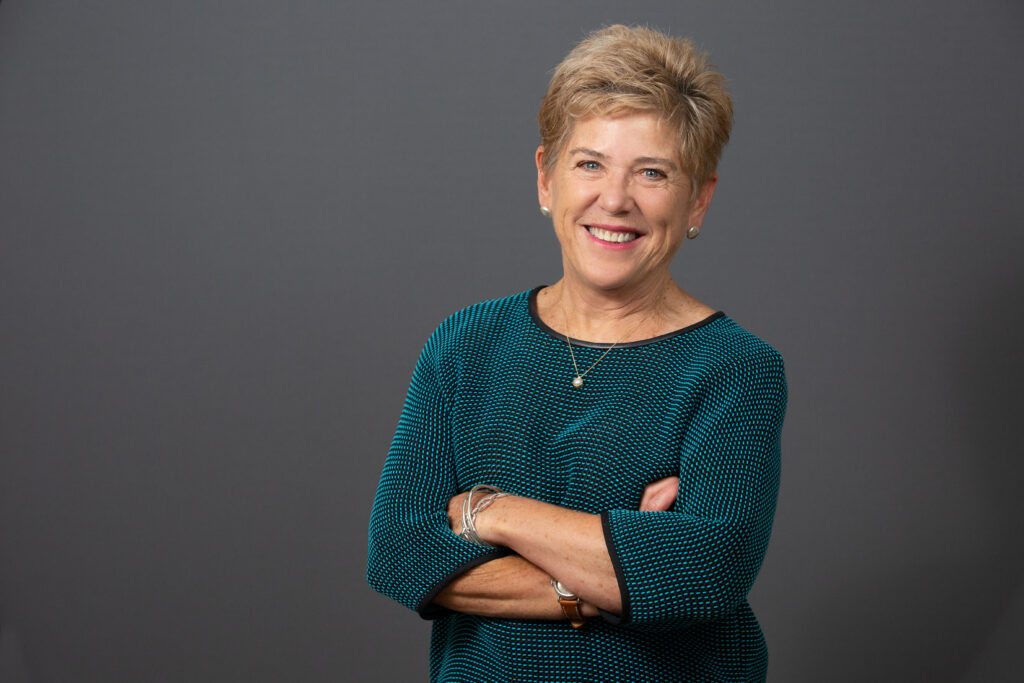
Why They Give: An Interview with IINE Donor Leigh Bivings

Our donors help ensure that refugees and immigrants receive the support they need to find stability, learn English, secure jobs, and pursue their dreams in our communities. In our Why They Give series, we talk with them to learn more about their connection to our mission and what inspires their support. 

In our latest installment, Leigh Bivings, a generous supporter of IINE and member of our Leadership Council, shares how she first became involved with the International Institute of New England, her experience supporting a family from Cameroon, and how she finds purpose in giving back to the immigrant community.  

هل يمكنك مشاركة القليل عن نفسك؟

I grew up in Arizona and completed most of my undergraduate and graduate degrees in California. I then spent a few years abroad, including in Latin America, where I volunteered with the Peace Corps, and in London, where I met my husband.  

When I was accepted to Stanford University to complete a PhD in Economics, I headed back to California, this time with my husband in tow. I graduated in 1992 and accepted a job in Boston, and we have been living in the South End of the city ever since.  

My career has had essentially three chapters – I worked as a management consultant at The Monitor Group, which has since been acquired by Deloitte, I did due diligence work for private equity firms at a firm called Stax, and then I started a wealth management firm called Artemis. I sold the firm to Beacon Pointe at the end of last year, and so I am finishing up this chapter.  

In my free time, I love reading history, being outdoors, traveling domestically and internationally, and playing tennis.  

ما أهمية العمل الخيري بالنسبة لك؟

I have been very fortunate in my life in most dimensions. I feel that because I have the time, energy, and capacity to give back, it’s important that I do.  

I’ve been able to provide financial support to several organizations, and I also served on the board of the Boston YWCA for many years, and both of these opportunities have allowed me to make an impact.  

I’ve also volunteered as a Big Sister with Big Brothers Big Sisters of America, and I’ve served as a mentor to young women through Year Up, a nonprofit focused on providing workforce training. These experiences taught me that I truly enjoy providing direct support when I can – which ultimately led me to IINE. 

On that note, how did you become involved with IINE?

It was August of 2022, and I had some time on my hands (no one wants to talk to their financial advisor in the summer!). I had been following the coverage of Russia’s invasion of Ukraine, and I was really searching for a way to help. My husband and I own a 5-story brownstone and live on the top three floors. At the time the war broke out, we didn’t have anyone on the bottom two floors, and I remember thinking, “We have this great one-bed apartment and not a soul living there!”  

I began reading about the United 4 Ukraine program, which was looking for volunteers to provide housing and support to newly arriving Ukrainian refugees. My husband and I signed up to help through Welcome.US, and we were matched with a lovely Ukrainian family. Ultimately, the family, who are Russian speakers, ended up resettling in Estonia where there’s a large Russian-speaking community, but we have stayed in touch with them ever since.  

Around the same time that we learned the family wouldn’t end up coming to the U.S., a friend of mine reached out about joining a group of IINE volunteers to help welcome a Cameroonian family—two women and one of their sons. I said yes, and I joined their Resettle Together group in December of 2023.  

It wasn’t an easy adjustment for the family, but they are doing well now. The women are settled in a nice apartment, they both have full-time jobs, and they’re learning English. We helped enroll the young boy in school when they arrived, and this past summer, all of the members of our volunteer group chipped in so he could attend summer camp. It’s been a very rewarding experience to see the family progress, and to help play a role.  

What advice would you give to someone who is interested in learning more about welcoming and supporting refugees and immigrants?

I would say it’s very rewarding because it’s so tangible. These days, I’m thinking a lot about what I can do to help the populations who are being disproportionately affected by the current presidential administration. I can write checks, I can support lawyers and advocates, I can attend protests, and through organizations like IINE, I can have a direct impact – that feels important.  

I would also say be prepared to learn a lot, including how hard it is to be poor in this country. The high cost of living; challenges in accessing public benefits, healthcare, and public transportation; the need to work multiple jobs to make ends meet – this is not an easy place to resettle. Accompanying the family throughout their first year in the U.S., I saw how resilient and determined you have to be.  

Last question – do you have a personal connection to IINE’s mission that inspires your support? 

I do. My mother was born in Britain, and she and her parents were living in southern France when there was news of the Germans coming during the war.  My mother and grandmother were sent to a relocation camp for several months, but ultimately were released because my grandmother had American citizenship. They were able to escape to Portugal and then make their way to New York, where they had family members living.  

I think of their journey, and how grateful I am to be here, and that inspires my desire to help immigrants.  

لا يستطيع معهد IINE تقديم الخدمات التي تشتد الحاجة إليها للاجئين والمهاجرين إلا بفضل دعم المتبرعين الأسخياء. هناك العديد من الطرق المختلفة للتبرع. اعرف المزيد هنا: تبرع بالأموال

“I Always Want to Give Back”: Suraj Budathoki’s Journey from a Refugee Camp to the NH Statehouse 

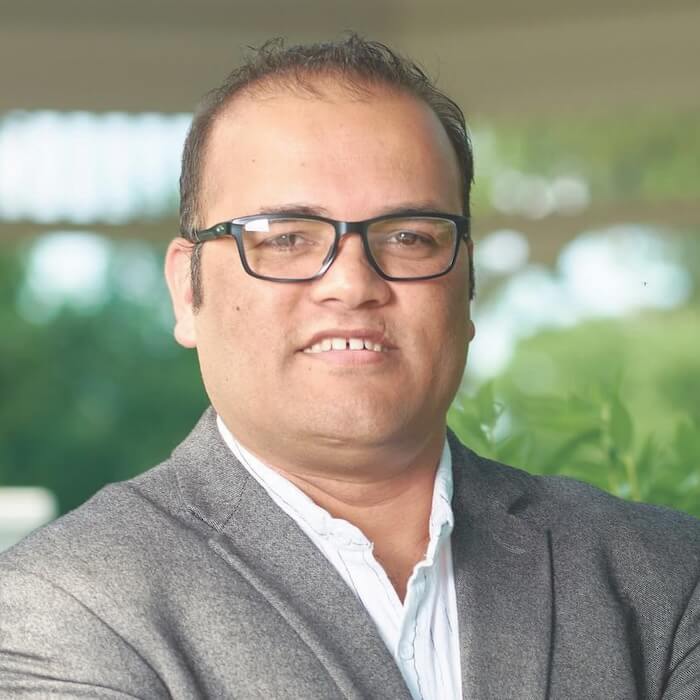
In November of 2024, Suraj Budathoki was elected to represent Hillsborough County District 40 in the New Hampshire State House, becoming the first Bhutanese-American State Representative in U.S. history. In his acceptance speech, Suraj said his victory was “the culmination of 16 years of dedication, resilience, and commitment to this community.” 

 In a recent interview, Suraj spoke to IINE about this journey. 

Learning Resilience 

Suraj became a refugee at the age of nine when the Bhutanese government suddenly stripped members of the Nepalese-speaking Lhotshampa minority of their citizenship and drove them from their homes. He spent the next nearly twenty years of his life in a refugee camp in Nepal.  

Suraj says his time there “taught me a lot; the resilience, the continuity to do things and not give up.”  

When he finally arrived in the U.S. after decades of waiting, he landed in Atlanta, Georgia. He recalls seeing a group of people at the airport handing out gifts to arriving children. “There is compassion for immigrants and refugees here,” he remembers thinking.   

Still, life was far from easy. Suraj arrived with a bachelor’s degree and a nearly-completed master’s degree but soon found himself working two full-time jobs for minimum wage—a day shift at a fast-food restaurant followed by an overnight shift stocking grocery shelves. It was difficult to save or build a social life.  

Work and Welcome in Manchester 

Suraj was excited when a friend from home told him about his life up north in Manchester, New Hampshire, where he had been resettled by the International Institute of New England. Manchester was smaller and easier to navigate. Jobs there offered better starting pay, and through IINE, Suraj could train to become a Licensed Nursing Assistant within a month.  

He was sold. In 2009, Suraj moved to Manchester, “and that’s what I did! I finished the Licensed Nursing Assistant program and then within two months, I got my license! The Employment team helped me get a job and after that I’ve been working with IINE for many, many years.” 

Suraj took to New Hampshire right away. “The mountains and the green vegetation resemble my small town in Bhutan,” he says, and compared to the sprawl of Atlanta, the compactness of Manchester was closer to the life he knew in Nepal. As in Atlanta, he took on two full-time jobs, but these he found more meaningful and in line with his goals. One was at a rehabilitation center for adults with traumatic brain injuries. The second one was to train adults who hadn’t completed high school to create resumes and help them find jobs.  

These early jobs helped Suraj build up his English skills. He soon went back to school at Manchester Community College and then transferred to Southern New Hampshire University to study Political Science.  

“Then life took off.” 

Building Community 

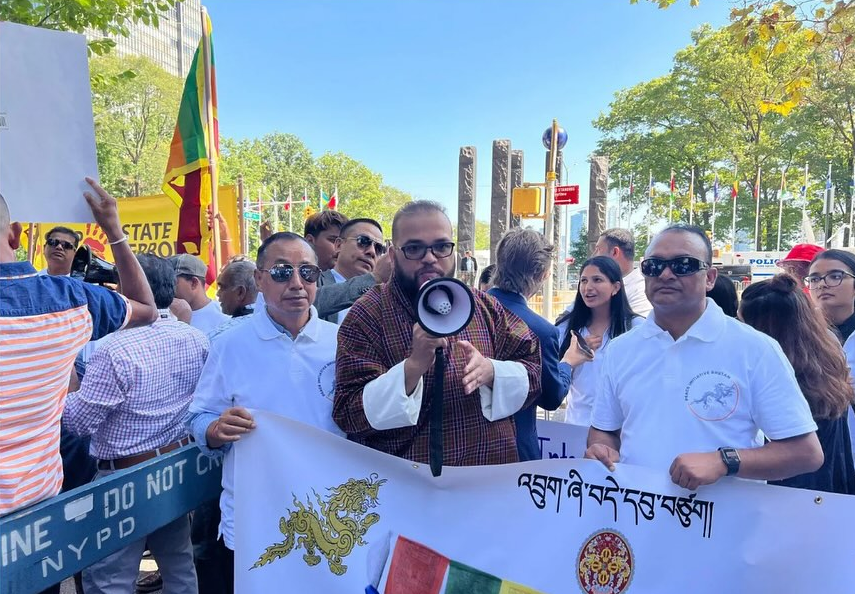
Suraj (center) has advocated for peace in Bhutan throughout his career

With his newfound confidence and vision, Suraj co-founded Bhutanese Community New Hampshire (BCNH), a non-profit dedicated to helping fellow Bhutanese refugees to integrate and thrive. He served briefly as the organization’s first executive director and then joined its board.  

“My first focus was learning to get grants,” Suraj says, and he still vividly remembers the story of his first submission, trudging through the rain to hand off his big envelope in-person, and then waiting months for a response. Finally, he heard back that he had won $6,000 for his mission. He was thrilled.  

With practice, he became more and more adept at grant writing, securing grants as large as $1 million.  

“I was able to hire 23 staff! Can you believe it?” 

Even more exciting was turning the funding into medical care, mental health services, and employment support for his community. BCNH formed a close partnership with IINE, who referred newly resettled Bhutanese clients for additional support. As it grew, BCNH expanded its mission to accept clients from additional countries and changed to its current name: Building Community New Hampshire.  

Feeling the Bern 

In 2016, Suraj was able to exercise his political science muscles when the presidential campaign of Vermont Senator Bernie Sanders opened a field office in New Hampshire.  

“It was my first time working on a campaign and I got the second-highest post for New Hampshire! That was my first opportunity to get to know Bernie, his team, and the people of New Hampshire. I was so privileged to work on his campaign and travel a lot across the state.” 
 
Suraj says that talking to people throughout the state had a profound effect on him. “I heard a lot of people’s often painful stories, and I could relate from when I was in a refugee camp…It’s not having money to pay rent; the cold; not enough food for the elderly who invested their life making America better, supported their kids growing up, when they were young and then paid taxes, and at the end of the life they have nothing to enjoy.” 

Suraj decided to tackle these issues head-on at the community level. His founded Bloom and Shine, LLC, a human services agency that provides in-home behavioral and physical healthcare to New Hampshire seniors. 
 
“I felt I needed to do something, and Bloom and Shine is something. Providing caregiver services to the elderly and disabled, it’s something I feel proud of.” 

Pursuing Peace 

While deepening his roots in his new community, Suraj was also studying international development, completing a master’s degree from Norwich University, and beginning a Ph.D. program at Saybrook University with a focus on conflict resolution. His research revealed clear historical patterns of opposing sides in ethnic conflicts becoming increasingly entrenched in their mutual opposition as suffering increased. 

“I saw that happen in Bhutan in the ‘90s. My Ph.D. is on how to find a solution. How can we transform that adversarial relationship into a conducive, friendly relationship? As I did more research on conflict resolution and negotiations, I found that there are peacebuilding and reconciliation methods that can bring two conflicting parties together.” 

Inspired by his research, he launched the Peace Initiative for Bhutan (PIB). 

“I talked to many young Bhutanese-Americans, college students, and other like-minded individuals, and they also had the same kind of idea. We came together to form this peace initiative. The approach is distinct from what our leaders did in the past. We are not doing this to win—to defeat the other side. We’re doing this to find common ground—to resolve through dialogue.” 

The goal of the initiative is to heal relations between the nation of Bhutan and its refugee diaspora. This reconciliation would allow Bhutanese refugees to return home in peace to reunite their loved ones.  

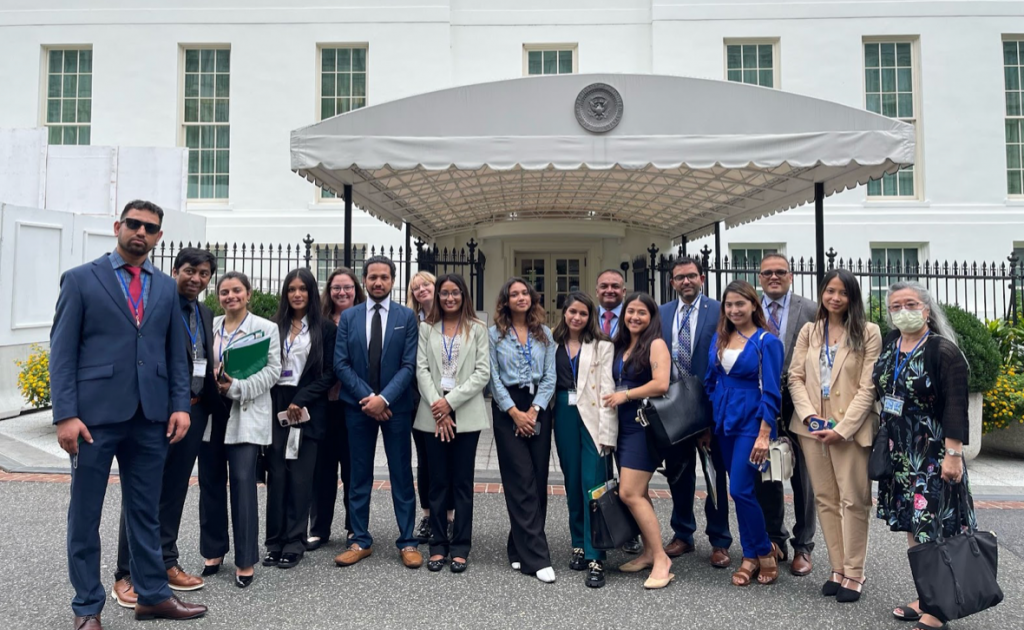
Members of the Peace Initiative Bhutan on the trip to D.C.

The first step for PIB was to draft their own peace plan and send it directly to the king of Bhutan. When they didn’t receive a response, they posted their plan online and alerted the press. Next, to draw further attention, they got the U.S. government involved. Suraj traveled to Washington D.C. and lobbied to get both the U.S. House of Representatives and the U.S. Senate to introduce resolutions calling for reconciliation.  

Bhutan began to listen. 

“We did a couple of rounds of informal dialogue with people inside Bhutan, also some parliamentarians,” Suraj says. “This has never happened before with other approaches. Our method is based on mutual respect, based on love to the other side.” 

The People’s House 

Suraj’s success with the Bernie Sanders campaign, his empathy for the struggles of working people in New Hampshire, and his progress with PIB all inspired him to make his own run for the State House of Representatives. His victory was a huge source of inspiration for fellow Bhutanese refugees. New Americans Magazine reported, “Suraj’s win quickly became a sensation on social media, sparking pride and celebration across the Bhutanese diaspora, which includes former refugees resettled across eight Western countries. Bhutanese-American social media platforms lit up with messages of pride, congratulatory posts, and reflections on the significance of this victory.” 

While ever hopeful, Suraj is learning about the challenges of belonging to a minority party in a state legislature. 

“We don’t have much say in any bills or regulations. We don’t have that power. We do share what we think, what we believe would bring positive change, but supporting the middle class or poor community is not what always gets attention. It feels painful when we see bills cutting support to the elderly, to the university system, to special education, and many others in New Hampshire.” 

Suraj is committed to speaking up for vulnerable constituents, but sometimes he worries about others’ misconceptions of his background and journey.  

“I testified in one of the committees against a bill, and I told them my success story. I came here as a refugee. 100 people work in my company. I’m going to college. I paid this much in taxes, etc…People may feel I’m taking their space. They see themselves working day and night, but I came here a few years ago, and now here I am running a company and a state representative. They may not understand the human side, the hard work, of what we as immigrants do here.”   

He wishes more people understood about his time working two jobs for minimum wage to build a foundation, missing many nights of sleep and the family he left behind at the refugee camp. 

But like his Peace Initiative, he sees his political work as an experiment and says that his political career is “just getting started.” In the arc of his career, it’s one more way to heed the calling he first heard back in the refugee camp in Nepal. 

“The international community, the United States and many other countries, they helped us a lot. We were not able to go to work outside of the camp, and we were fed and supported by many Western countries…We always feel we should give back for those many years we were given—and that’s the call—I always want to give back to the community. Whatever I’m doing now, being a State Representative or running this home health care business, it’s always supporting community, providing employment and uplift.”  

---

يقوم اللاجئون والمهاجرون برحلات طويلة وصعبة للهروب من العنف وإعادة بناء حياتهم في الولايات المتحدة . 

Atefa's Story

Atefa’s Story: With Ongoing Support, a Young Refugee Builds a Brighter Future

Atefa’s story is featured in our Spotlight Report: Who We Can Serve and How in a Rapidly Shifting Landscape. Click here to read the full Spotlight.

When the Taliban retook control of Afghanistan, Atefa, her mother, and three brothers escaped their home, resettling as refugees in Lowell in 2022. As the eldest sibling, Atefa quickly took on adult responsibilities. She became her family’s interpreter and spokesperson at doctor’s visits and school appointments – all while balancing learning an entirely new culture and language.  

At first, school was frustrating for Atefa. In Afghanistan, she had already begun college, but her high school transcripts were among the many possessions she had to leave behind, and without them, she had to begin her American education as a freshman at Lowell High School. Still, she stayed focused and determined. For support, she went to nearly every tutoring session provided by IINE’s Refugee Youth Mentoring program, bringing her brothers along to make sure they progressed as well. That year, Atefa earned honors recognition for her grades. 

During her junior year, Atefa began exploring the college application process. When IINE’s Youth team advised her to join extracurricular activities to stand out, she became a student ambassador, helping fellow newcomers adjust to life in Lowell. Her leadership and service led to her acceptance into the National Honor Society in her senior year.  

That summer, Atefa went back to her IINE mentors for guidance, and they suggested volunteer work. In addition to working at a grocery store, participating in school groups, and helping her family, she began giving back to support other IINE clients. She delivered fresh produce and packaged goods to families, provided interpretation, and peer-tutored fellow refugee youth.  

Atefa’s relentless dedication was rewarded when she was accepted to four colleges! She chose the University of Massachusetts Amherst, where she will study civil engineering starting in the fall of 2025. As she prepares for this next chapter, she continues to reach out to the IINE Youth Team for guidance on class selection, financial aid, and housing. 

---

Refugees and immigrants come to the U.S. after enduring unimaginable hardships. You can give them the help they need to rebuild their lives here. 

In New Hampshire, Investing in English Language Classes Makes Everyone’s Healthcare Better

A Healthcare Success Story

As in much of the country, if you live in New Hampshire and you need medical care, you’re likely to get help from some people who began their lives in other countries. Immigrants and refugees make up about 18% of the U.S. healthcare workforce. In New Hampshire, they make about 7% and are particularly prevalent in patient-facing roles, such as home healthcare aides, drivers, cleaners, and food preparers. They’re the people who help you feel comfortable, safe, and cared for when you’re at your most vulnerable.  

These are roles for which there are dangerous shortages in New Hampshire, a state with a rapidly aging population. It’s an urgent need that creates an opportunity for newcomers seeking entry-level jobs that may not require a local work history and more than basic English skills.  

“Matching newcomers with New Hampshire healthcare employers has been a real success story in general,” says Kayla Rossmeissl, IINE’s Director of Program Design and Evaluation. “Employers are getting fast-learning, resilient, highly motivated workers, who have the benefit of IINE to help support their orientation and development. Our clients often say they’re excited to be helping people in their times of need and giving back to the community that’s welcomed them.” 

A Desire for Investment

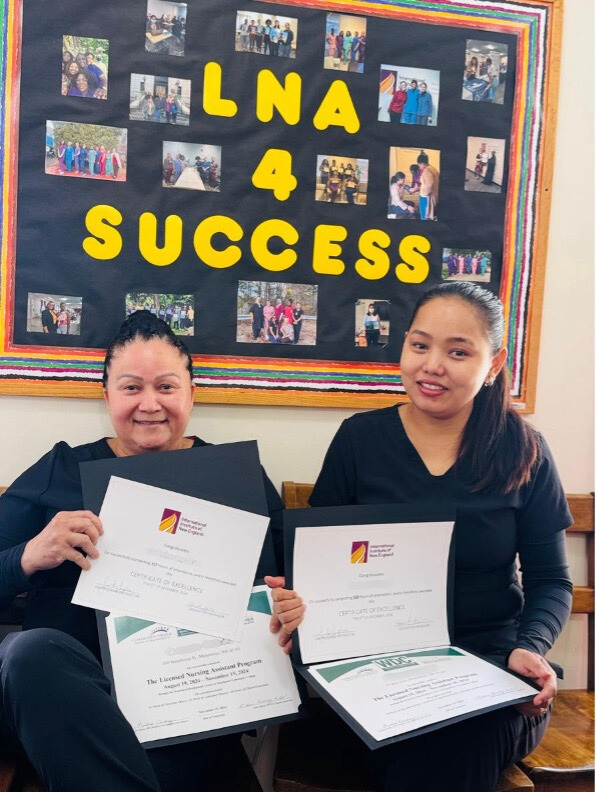
In 2019, Kayla helped develop LNA for Success—an IINE skills training program that combines English language instruction, vocational training, higher education partnerships, and apprenticeship, to help prepare immigrants and refugees for the job of Licensed Nursing Assistant. She says that in promoting this program over the next few years, IINE discovered a real desire for greater investment.  

“We had been doing a lot of community presentations and working closely with [LNA for Success partner] Manchester Community College. We started to discover a lot more partners who are looking for ways to help get refugees and immigrants more economically stable—career laddering, higher paying jobs, things like that.” 

She also found healthcare providers looking to invest in their immigrant employees. At one networking event, representatives from two local hospitals sought her out. 

“They were just like, ‘Kayla, I heard you set up these ESOL programs. Can we chat?’ From there, we were all brainstorming to come up with a program to help their workers.” 

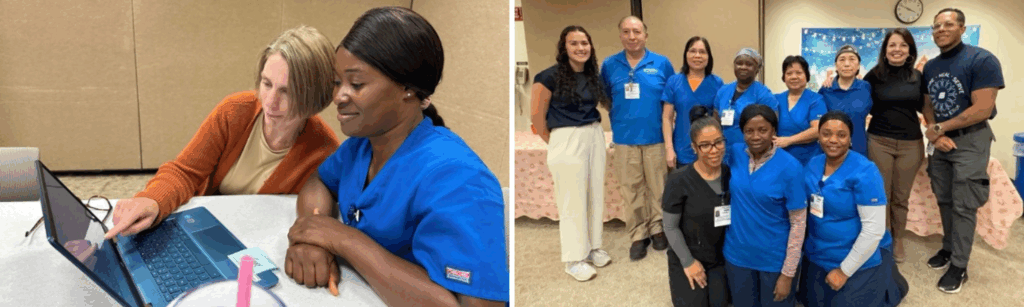
Both hospitals were interested in paying their employees to deepen their English language skills during the workday, through on-site, workplace-focused English for Speakers of Other Languages (ESOL) classes. 

“Which is amazing,” Kayla says, “because a lot of families are juggling multiple part-time jobs and childcare, and wouldn’t otherwise have time to take classes.” 

Kayla wasted no time in developing a curriculum for a pilot “ESOL 4 Healthcare” program, conducting interviews with partners to learn about their goals and challenges.  

“They wanted to see people become more confident in speaking English, because even though they are in environmental services [maintenance], they do greet the patients in their rooms, and they interact with other staff in the hospital, like their supervisors. So, having more confidence in communication, being able to read and write emails, improving digital literacy skills, and navigating internal systems like clocking in and out—these were all things we could help with that could improve everyone’s experience.” 

Gaining Confidence

“I would say for me personally, what I see in the students, cohort after cohort, is confidence,” says Becky Marden, Director of Workforce Development at Elliot Hospital in Manchester.  
 
“In their evaluations, they’ll say things like, ‘I’ve gained the confidence to say hello to my manager in the morning, whereas before I might just have avoided eye contact,’ and things like that. And that’s what inspires me to keep pushing for this class and making it better every cohort.” 

Having helped develop the concept, Elliot Hospital is now in its third year of ESOL 4 Healthcare. Becky says that she’s frequently blown away by the improvement that Elliot’s English language learners make in listening, reading, and writing skills over the course of a cohort—which spans two hours/day, six days/week for sixteen weeks, an impressive investment of staff time. In addition to the improvement in workplace communication and staff-patient relationships, she says that Elliot is gratified to be able to provide some meaningful support to some truly impressive people, which, in the most recent cohort, were six students from six different countries. 

“For me it’s also about the social contacts outside of work—they can use email or finally set up a bank account for the first time. These are some of the most resilient and hardworking employees we have. I could never go to another country and work someplace and not speak the language. I would just be so frustrated. And yet they’ve done it and they’re working in our community.” 

Becky says her CEO shares this feeling. After attending an ESOL 4 Healthcare graduation, he invited several of the recent graduates to a Board Meeting so that the hospital’s leadership could meet them, and they could showcase their new English skills. For Becky, the next step is developing apprenticeship programs within the hospital to help English language learners on staff to advance in their careers there.  

“Some of them have healthcare experience from their previous country. We had a nurse practitioner in one program. We had a labor and delivery nurse in another, and they just want to work in the healthcare field. Their credentials don’t come over, their education doesn’t come over, but here they are, sometimes cleaning toilets just so they can be in healthcare. How do we get them back to the bedside? ‘Cause that’s where we need them.” 

This is the Future

Elliot Hospital is currently one of nine IINE ESOL 4 Healthcare partners, and the number is growing quickly. They include providers offering mental health care, senior assisted living, and more. One new partner, Dartmouth Hitchcock Hospital, offers English classes remotely to reach student in more rural areas, and has developed apprenticeships in Phlebotomy and Lab Tech.  

“I’ve got five more in the queue!” says Kayla. “I really think this is the future. There’s a lot of interest in bridging the gap. There’s tremendous need here, from people who can really benefit from these kinds of jobs, and from employers who are always interested in a stable source of new staff members who come to them recommended and supported.” 

Investing in job training opportunities for refugees and immigrants creates a stronger workforce for us all. Help newcomers grow their careers and our economy by donating to IINE today.

Immigrants in the U.S. Workforce

Quiz: Immigrants in the U.S. Workforce

Test your knowledge of the role immigrants play in the U.S. workforce with this quiz.  

1 / 5

According to the U.S. Bureau of Labor Statistics, in 2024, what percentage of the U.S. workforce were immigrants? 

2 / 5

What percentage of the total U.S. healthcare workforce are immigrants?

3 / 5

Besides healthcare, which of the following roles are significantly filled by immigrants in the U.S.?

4 / 5

All immigrants residing in the U.S. contribute to the U.S. tax base. About how much tax revenue did immigrants generate in 2023?

5 / 5

When immigrants lose their work authorization or are forced to leave the country, what typically happens to the jobs they leave behind?

Your score is

The average score is 59%

0%

Soccer blog

Shared Goals: How Refugees and Immigrants Bond Through Soccer

It’s the most popular sport in the world. You can play it in a schoolyard, a gym, a park, or even a refugee camp. You don’t need expensive equipment or to even agree if it’s called “soccer,”futbol,” or something else entirely. You just need a ball, a goal, and a group of fellow players. Once you start playing together, you tend to become friends. For these reasons, “the beautiful game” is providing some beautiful opportunities for IINE clients to connect with one another across backgrounds. 

A Clinic for Lowell Youth 

IINE Youth Program Manager Isabel Goes says she’s noticed a clear pattern: “Anytime we talk about sports when we first meet with clients, it’s like, ‘OK, well, does that mean like, soccer?!‘” Her clients are definitely fans. She remembers one showing up to a workshop in head-to-toe Cristiano Ronaldo gear, and the delight of clients unwrapping soccer gear at a holiday gift swap.  

Olf (L) stopping by IINE’s offices to donate soccer equipment to refugee youth

When she decided to organize a youth soccer clinic last June, she knew she’d have plenty of support. Her first call was to Olf Mouyaka, a former refugee from the Democratic Republic of the Congo who grew up in Lowell after being resettled by IINE, and recently founded a soccer-based youth development program called the Football Leadership Organization. Olf had donated soccer equipment to IINE in the past and had experience running clinics.  

Next, to recruit participants, she turned to her colleague Yusuf Abdi. Yusuf’s official job is as IINE’s Career Services Manager, but after hours, he puts tremendous effort and passion into organizing community pick-up soccer games for IINE clients and other members of Lowell’s immigrant community.

“He was like, ‘I already have all these clients coming out for soccer,’ so I said, ‘OK, well, send them our way, have them join us for an official youth program!’” 

Yusuf did just that, and he showed up in his favorite jersey with his son in tow so they could both join in the fun. The clinic was a success, and for Yusuf, it was just the tip of the iceberg. 

“Everyone Show Up at the Park!”

“In the summer, I try to do it six days a week,” Yusuf says, “and I wash all the pinnies after each game!” That’s no small commitment, but he plans to keep it up “as long as I’m helping youth, doing something good, and making them feel a sense of social connection.” 

A former refugee from Somalia, Yusuf has been a passionate soccer fan all his life. As an adult living in Lowell, he joined an indoor recreational league organized by members of the local Cambodian community. He saw some familiar faces in the stands, and again at a regular game organized by member of the West African community: “The youth just came to watch, and I said, hey, they want to run around and play too…so I told them, ‘OK, I will bring the pinnies, soccer balls, and goal posts. Everyone show up at the park!'” 

Yusuf ordered the equipment and continued to recruit participants, including clients who he knew were between jobs and needed an outlet and some social connection.  

Yusuf (center) arranges regular soccer games for clients to have fun, grow their English skills, and build community

To organize meetups, he checked the availability of public parks and then created a Facebook group and a WhatsApp chat moderated by a refugee from the Democratic Republic of the Congo, who is able to translate messages into French and Portuguese.  

His meetups bring out people of all ages and backgrounds, “Each day the language changes some. You may hear a lot of Swahili, a lot of Portuguese, or a lot of Haitian Creole.”  

Together they play informal, tournament-style games. On Fridays, two local coaches, Coach Kwezi from Ghana and Coach Hugo from Guatemala, show up to offer instruction, run drills, and lead more structured games. Yusuf shares video clips of games in the WhatsApp channel, so players can celebrate their successes and learn from their mistakes. 

Though the language barrier can be challenging at first, everyone understands the basics.  

“Everyone can kick and everyone can try to score. Everyone is quiet when they arrive, but their faces are different when the game ends—happy smiles.” 

In fact, the games give players a great chance to practice their English skills without thinking about it too much, and players form bonds quickly.  

They chat, and some of them, they’re not able to communicate, but they try. You know, ‘Why’d you miss the ball?’ ‘You should pass to me.’ And some build confidence. You can see players become happier over time, come out of isolation. Their lives begin to change. That drives me.” 

Specifically, Yusuf says clients became inspired by friends they’ve met on the soccer field to follow their lead in steps like pursuing GEDs or higher education.  

Yusuf loves the mentorship, community, and social connection the sport offers – no matter a player’s age.   

“I’m in my 40s. I’m not like a youth of 18 or 20, but I’m still engaged. Soccer is a language that doesn’t require much talking, it’s more of action, and it builds trust. When I’m playing with a group from Ivory Coast, Cameroon, and Liberia who don’t know me, they get to know me, I become a friend of theirs. That’s how you get connected.” 

Balling in Boston

According to IINE Volunteer & Donations Specialist Emily Dionne, in Boston, the idea of convening some regular pick-up soccer in the park came from super-volunteer, Suraj Chaudhry of Newton South High School.  

“Suraj has been involved with a ton of different things. He suggested just doing a one-off game and then it just kind of grew from there with the Employment and Skills Training teams really taking it into their own hands to keep it going, which was really great.” 

Emily got Suraj together with some other volunteers to plan the first game. They circulated a flyer, Suraj borrowed pinnies and balls from his school, and Emily brought some pizzas for a post-game social. 

“A good 30-40 people came out, including staff, volunteers, and clients,” says Emily. “We were so surprised. It was a really fun gathering.” 

The one-off game quickly evolved into a weekly Saturday morning meetup. Games are kept informal with teams chosen by counting off, and consistent winners are often broken up to make contests more even.  

“It’s a really great way to build community and have people meet each other, especially in Boston, since everybody’s kind of separated across the city,” says Emily.  

“I think it’s a good way to have a bonding activity that isn’t necessarily based around things we do at IINE like having people work on resumes or attend workshops—it’s purely fun. It’s also a team mentality—everybody coming together for one goal.” 

Emily says the game has led to connections off the field, too. In the WhatsApp chat, between posting video clips of their game highlights, people have started organizing social outings throughout the city.  

When Suraj had to step away, Lead Career Navigator Gordon Parris gladly took over the organizing with the help of Career Navigator Luqman Alkhaneqeeni.  

Gordon (far right), Emily (second from right), and Luqman (kneeling) gather fellow IINE staff and clients weekly for a pick-up soccer game

A former refugee who has lived in Jordan, Iraq, and Turkey, Luqman has been playing soccer since he was four years old. It’s been a throughline for him as his life has continued to change. He couldn’t have been more excited to learn that his new workplace was hosting a regular game. “It’s one of my talents, let’s say,” he says with a smile. “When I learned about the game my first week on the job, I said, ‘Let’s go! I’m in!’”  

Luqman says he sees soccer as “a global phenomenon which unites millions of people. Also, back home it’s used as a cultural expression. Every time I’m playing, I see emotions, joy, that transcends all borders.” 

We have some kids who are 9, 10, 13 years-old that run circles around us,” Gordon adds,  “so when he says it transcends all borders, including ages, he’s being literal.” 

Gordon is originally from South Africa where he also grew up playing soccer. “We’re all there because there’s something that we kind of miss from home. It’s something that we all grew up doing in completely different ways. Everyone gets the goofy jokes of like, you know, looking one way, kicking the other way, that kind of thing. It’s a common language, and therefore, unifying.” 

Now in its second year, the pick-up game continues to go strong. So what’s next for the franchise?  

“We’re going to keep it simple,” says Emily. “We’re just going to keep playing soccer.” 

“The Most Lovely People”: A Volunteer Group’s Experience Supporting a Refugee Family from Nigeria

Boston Bound volunteer group members with Tani and her family

Tani and her six children were among the last refugees to arrive safely in Boston just before the indefinite suspension of the U.S. Refugee Admissions Program. In the weeks leading up to their arrival at Logan Airport, a group of friends from Boston and Brookline had been eagerly preparing to support them through IINE’s Resettle Together program

The volunteer group, who call themselves “Boston Bound,” is led by Jenny Miller. Jenny first learned about IINE when her daughter was looking for a community service project in the lead-up to her Bat Mitzvah. Through IINE, she was able to deliver food to local immigrant families and to donate books to refugee children after running a donation drive at her school.

Jenny remained on IINE’s volunteer email list, and when she learned about other opportunities to get involved, she was inspired. “These were things I could actually do. I work full-time [and am] crazy busy, but I had a few hours at night to go grocery shopping and bring food to a new family. Or I had a few hours on the weekend to help someone learn how to navigate the T,” she says.  

“IINE provided great support, and it was deeply satisfying, like disproportionately satisfying even when I never met the family. Dropping off groceries felt so tangible. At a time when it felt hard to find other ways [to help], it just felt really good to be able to do that.” 

She talked about the experience with her friends, a group of fellow parents of tweens. After the 2024 election, when they began sharing their fears over anti-immigrant policies taking hold in January, she proposed sponsoring a refugee family through Resettle Together as a concrete way to honor their values. 

Soon they all found themselves gathered around a dining room table in front of a large piece of paper, divvying up tasks from finding donated furniture, to apartment cleaning, to scheduling shopping trips for food and clothing.  
 
“When we started letting people know that we were doing this, it was amazing how many people wanted to help,” says Jenny, “Our kids did a drive for toiletries, soap, and detergent, and all that kind of kitchen stuff before Tani and her children arrived, and we got six months’ worth of stuff!” 

Eager to befriend Tani’s teenage children, the kids of Boston Bound also collected gifts, prepared a bracelet-making kit, and made a photobook with pictures of all the group members to show the new arrivals how many new friends they now had.  

When the family arrived, Boston Bound group members took turns hosting them for home-cooked West African-style meals, playing board games with their children, taking them to local parks and playgrounds and kicking around a soccer ball, going on shopping trips, helping them learn how to navigate public transportation, and more. They became close quickly. “They are the most lovely people,” Jenny says of Tani and her family. “They are a very close family, very warm, incredibly supportive of each other. I think what struck me was they came here with so much curiosity and eagerness to learn—also a love of their new home, and they really extended that to all of us. They have been so welcoming to all of us. Even with the language barrier, which, when they arrived was almost total. There was still so much warmth.” 

While IINE case workers helped the family enroll in ESOL classes, secure work authorizations, and become oriented to the U.S. workplace, Boston Bound helped make sure the family had access to food and healthcare, enrolled in school, got library cards, and practiced reading and speaking English. Meanwhile, a beautiful friendship formed. 

IINE Case Specialist Nijimbere Lahayiloyi shares more about what it means to welcome refugees, and how critical volunteer support is

“They’ve invited us to celebrate their birthdays at their home, and that’s been just wonderful—so joyful,” Jenny says. “They’ve taught us the songs that they sing for birthdays, and dances, and the music they listen to. They’ve also come to some of our houses for birthday celebrations or just for dinner, and that’s been really lovely too. Every time I visit, they try to send me home with food.”   

When IINE’s Employment team was able to get them job interviews, Boston Bound helped them practice and prepare. Now, all eligible family members have started jobs in food service. 

“Having this support has meant so much,” says Mariamu, one of Tani’s daughters. “We have been able to have people to practice English with and to help us with things we don’t yet understand. We are very grateful for their willingness to assist us.They have been with us since our first day in Boston. They help us understand the community we live in; they often visit us and make sure we are okay. They have done so much to help us in many ways. We appreciate them and pray that God blesses them in everything.” 

Jenny shares how Boston Bound came together and the “privilege and joy” of becoming close with Tani and her children

---

يقوم اللاجئون والمهاجرون برحلات طويلة وصعبة للهروب من العنف وإعادة بناء حياتهم في الولايات المتحدة . 

قصة برودنس: كيف وجدت لاجئة ومساعدة إنسانية الدعم المنقذ للحياة في الولايات المتحدة 

كرس برودنس، وهو أب لأربعة أطفال، حياته للعمل من أجل حقوق الإنسان ومكافحة الفساد الحكومي. بعد فراره من بلده بوروندي إلى السودان، أنشأ مؤسسة لمناصرة الأطفال وعمل مع العديد من وكالات التنمية الدولية لدعم اللاجئين.  

عاد برودنس إلى بوروندي وهو مصمم على المساعدة في تحسين الحياة هناك بعد تغيير النظام. وأطلق مبادرات لتمكين الناس الذين يعيشون في المجتمعات الريفية التي يصعب الوصول إليها في البلاد من خلال منحهم إمكانية الوصول إلى أنظمة الدفع الرقمية ووسائل الإعلام الرقمية. ولسوء الحظ، لفتت هذه التطورات انتباه أولئك الذين يرغبون في إساءة استخدامها. عندما قرر رئيس بوروندي الترشح لولاية ثالثة - وهو أمر غير مسموح به بموجب دستور البلاد - طلب من برودنس نشر رسالة كاذبة مفادها أنه يحظى بدعم واسع النطاق. رفض برودنس. أدى ذلك إلى أن يصبح هدفًا للاضطهاد السياسي. وتوالت التهديدات الجديدة ضد حياته مما جعل أسرته تتنقل، أولاً إلى المملكة المتحدة ثم إلى رواندا.  

وما زاد الطين بلة أن ابن برودنس جوشوا وُلد بحالة خطيرة في القلب، وكان بحاجة ماسة إلى عملية جراحية معقدة. لم يكن الحصول على هذه الرعاية كلاجئ أمراً سهلاً، لكن برودنس وجد الأمل عندما علم أنه يمكن تحقيق ذلك في مستشفى بوسطن للأطفال.  

أصبح من الواضح لبرودنس أن صحة ابنه وسلامة أسرته تتوقف على إيجاد الترحيب والدعم في ماساتشوستس. وقد جعلت العلاقة الرائعة مع الراعي ستيف جروس من مؤسسة الحياة طيبة ومع المعهد الدولي في نيو إنجلاند الجديدة هذا الحلم حقيقة واقعة.  

شاهد قصتهم أدناه: 

---

يقوم اللاجئون والمهاجرون برحلات طويلة وصعبة للهروب من العنف وإعادة بناء حياتهم في الولايات المتحدة . 

من مكتب الرئيس التنفيذي تصوُّر مستقبل أفضل للهجرة الإنسانية

بقلم جيف ثيلمان، الرئيس والمدير التنفيذي للمعهد الدولي في نيو إنجلاند

بينما أمضينا العام الماضي ونحن نحتفل بمرور 100 عام على دعم اللاجئين والمهاجرين في بوسطن الكبرى، وجدنا في تاريخنا الكثير من الإلهام. فعلى مدار قرن من الزمان، عملنا مع مجتمعاتنا لجعل وطننا مكاناً لبدايات جديدة. وعلى الرغم من التحديات والنكسات، فقد رحبنا بأجيال من الأشخاص الشجعان الصامدين الذين فروا من الاضطهاد في دول أخرى، وجعلوا هذا المكان مكاناً أفضل لنا جميعاً.

على طول الطريق، لطالما دعونا إلى نظام أكثر عدلاً للهجرة الإنسانية. واليوم، غالبًا ما تجبرنا التغييرات المتكررة في السياسات على أن نكون تفاعليين ودفاعيين في دعوتنا، ولكن من المهم أن نتصور ما نناضل من أجله من أجله وكذلك ضده.

كيف سيبدو نظام الهجرة الذكي والاستراتيجي والإنساني؟ 

1) من شأنه أن يتجاوز السياسة الحزبية.

الرئيس كارتر يوقع على قانون اللاجئين لعام 1980 ليصبح قانونًا

عندما قانون اللاجئين لعام 1980 تم تمريره بأغلبية كبيرة من الحزبين الجمهوري والديمقراطي في مجلس النواب وتصويت بالإجماع في مجلس الشيوخ. واتفق الأمريكيون من مختلف الأطياف السياسية على أن الأمة التي تتسم بالتزامها بحرية الإنسان يجب أن ترحب بالفارين من اضطهاد الطغاة والإرهابيين، وأن الكونغرس يجب أن يكون له دور في اتخاذ القرار المهم بشأن عدد الأشخاص الذين يجب الترحيب بهم، وأنه يجب أن يكون لدينا نظام موحد ومدعوم بشكل جيد لإعادة توطين ودمج العائلات والأفراد في مجتمعاتنا.

وفي السنوات الأخيرة، تم التخلي إلى حد كبير عن هذا النهج الإنساني والمنطقي والثنائي الحزبين. فخلال فترتي ولايته، اتخذ الرئيس ترامب قرارات أحادية الجانب بموجب أمر تنفيذي بشأن عدد الأشخاص الذين ينبغي منحهم حق اللجوء ومن أين. وقد خانت التخفيضات الضخمة دون مدخلات من الكونغرس في قبول اللاجئين السنوي الحلفاء وتخلت عن المحتاجين وحالت دون التخطيط طويل الأجل من قبل الولايات حول أفضل السبل للترحيب بأفراد المجتمع الجديد ودمجهم. كما استخدمت إدارات ترامب أيضًا ممارسات تمييزية مثل حظر السفر استنادًا إلى الأصل القومي والدين، وإعطاء الأولوية مجموعة واحدة مجموعة واحدة على جميع المجموعات الأخرى.

إن GRACE قانون, من شأن أحد الإصلاحات المحتملة التي اقترحها سيناتور ماساتشوستس إدوارد ماركي أن يُلزم الولايات المتحدة بقبول 125,000 لاجئ كحد أدنى كل عام. وهذا من شأنه أن يساعد على إبعاد السياسة عن قرارات قبول اللاجئين وخلق الاستقرار اللازم لتحسين استعدادنا لدعم العائلات والأفراد القادمين.

2) ستكون تعاونية على كل المستويات.

تعترف سياسة الهجرة الذكية بأن العالم مترابط وتوازن بين احتياجات الأشخاص المتنقلين واحتياجات المجتمعات المضيفة.

على المستوى الدولي، يمكن أن يشمل ذلك التعاون على غرار ما نص عليه الميثاق العالمي للاجئين. الميثاق العالمي بشأن اللاجئينالعمل مع الدول المجاورة من أجل

  • منع أسباب النزوح,
  • مكافحة الاتجار بالبشر عبر الحدود,
  • مشاركة البيانات ذات الصلة بأمان عن السكان المتنقلين,
  • تقاسم مسؤولية إعادة التوطين,
  • التخطيط المسبق لحالات الطوارئ، و
  • ضمان المعاملة الإنسانية لأولئك الذين يعبرون الحدود طلبًا للجوء.
يجتمع أعضاء المجلس الاستشاري للاجئين التابع للمعهد الدولي للهجرة لمناقشة كيفية تحسين تجربة إعادة التوطين

داخل الولايات المتحدة، من شأن السياسة الجيدة أن تحترم الحاجة إلى لم شمل العائلات والسماح للأشخاص بإعادة التوطين في أماكن تضم مجتمعات مهاجرين قائمة يمكنها أن توفر لهم الدعم المجتمعي. كما أنها ستسمح بتوجيه اللاجئين نحو المناطق التي تحتاج إلى زيادة عدد سكانها وتلبية احتياجات القوى العاملة.

سيتم توفير الدعم والتوجيه الموجه للمجتمعات التي تستقبل أعداداً كبيرة من الناس في أوقات الطوارئ. وسيشمل ذلك موارد لأولئك الذين يوفرون السكن والتعليم والرعاية الصحية والنقل والتوظيف.  

وبمجرد وصولهم، سيتمكن اللاجئون من تقديم مدخلات في استراتيجيات الاندماج الفعالة من خلال نماذج مثل المجلس الاستشاري للاجئين في نيو هامبشاير التابع للمعهد الدولي للهجرة - وهي مجموعة تجتمع لمناقشة الاحتياجات والتحديات وتقديم ملاحظات للمشرعين.  

3) ستكون آمنة وفعالة.

بعد أن أجبروا على الفرار من بلدانهم الأصلية بسبب الاضطهاد والتهديدات بالعنف، ينتظر اللاجئون في "بلدان ثالثة" حتى تتم معالجة طلباتهم وفحصها من قبل الولايات المتحدة قبل أن يتم منحهم وضع اللاجئ ودخول البلاد. وقد يقبعون لسنوات في مخيمات اللاجئين، ويعيشون في خيام ويعتمدون على وكالات الإغاثة للحصول على الغذاء والماء والدعم الصحي.

زار موظفو المعهد الدولي للهجرة الحدود بين الولايات المتحدة والمكسيك في صيف عام 2024 لفهم الظروف الخطيرة التي يواجهها طالبو اللجوء بشكل أفضل.

غالبًا ما يقوم أولئك الذين لا يستطيعون التقدم بطلب للحصول على وضع اللاجئ برحلات طويلة وخطيرة إلى الولايات المتحدة لتقديم طلب اللجوء على الحدود الأمريكية. خلال فترة إدارة بايدن، كان بإمكانهم تحديد مواعيد اللجوء عبر تطبيق حكومي على الهاتف المحمول - لكن فترات الانتظار كانت تصل في المتوسط إلى تسعة أشهر. وأثناء الانتظار، كان مقدمو الطلبات عرضة لجرائم العنف والسرقة. وبمجرد وصولهم إلى الولايات المتحدة، كان مقدمو الطلبات يعيشون في خوف وعدم يقين أثناء انتظارهم ست سنوات في المتوسط للبت في طلبات لجوئهم.  

لقد أصبح نظام المسارات القانونية للدخول إلى الولايات المتحدة غير فعال عن قصد. فعلى مدار سنوات، عمل معارضو الهجرة على خفض التمويل وإعاقة النظام. يجب على الولايات المتحدة تحسين كفاءة عمليات التدقيق لدينا وتمويل نظامنا القانوني للهجرة بشكل كافٍ للحفاظ على سلامة الباحثين عن الحرية.

4) سيكون ذلك منصفًا.

نظرًا لأن عملية فحص اللاجئين قد تستغرق سنوات، فقد تم استحداث أوضاع هجرة إنسانية أخرى منقذة للحياة للسماح لمجموعات كبيرة من الأشخاص الذين أصبحت أوطانهم فجأة غير صالحة للعيش بدخول الولايات المتحدة على أساس مؤقت والبقاء هنا حتى تصبح بلدانهم الأصلية آمنة. وعادةً ما يتم منحهم تأشيرات لمدة عامين، وبعد ذلك يتم تجديد إقامتهم أو إنهاؤها بناءً على الظروف في بلدانهم الأصلية.  

لا يتم توفير التمويل لهؤلاء الأفراد، ولا لوكالات دعم المهاجرين، لمساعدتهم على تأمين سكن آمن. في بعض الحالات، يعتمد قبولهم على تأمين كفلاء في الولايات المتحدة يلتزمون بتوفير سكن أولي لهم. وفي حالات أخرى، وفي ظل عدم وجود مكان آخر يلجأون إليه، قد ينتهي بهم المطاف ببدء حياتهم في الولايات المتحدة في الشارع أو في ملاجئ المشردين. وخلافاً لحاملي صفة لاجئ، فإن تأشيراتهم لا تمنحهم تلقائياً الإذن بالانضمام إلى القوى العاملة. يجب أن يتقدموا بطلب - وهو تحدٍ بالنسبة لأولئك الذين لا يتحدثون الإنجليزية ولا يعرفون القواعد - ويمكن أن تستغرق عملية الموافقة شهوراً.  

وبفضل الدعم، يساهم الوافدون الجدد بشكل كبير في مجتمعاتهم الجديدة. في السنوات الأخيرة، ساعدت منظمة IINE الآلاف من المهاجرين في هذا الوضع، وتمكنوا من المشاركة الكاملة في الحياة الأمريكية - الانضمام إلى القوى العاملة، وتسجيل أطفالهم في المدارس، والذهاب إلى أماكن العبادة المحلية، والمساعدة في جعل أحيائهم أماكن أفضل للعيش. وفي الوقت نفسه، فإن المواعيد النهائية لتأشيراتهم معلقة فوق رؤوسهم، وهم تحت رحمة القرارات التي غالباً ما تستند إلى السياسة بدلاً من واقع سلامة بلدهم. وبفضل الدعم، يمكنهم التقدم بطلب اللجوء، ولكن العملية بطيئة ومكلفة للغاية، والنجاح غير مضمون على الإطلاق.  

إن وجود نظام عادل من شأنه أن يستثمر الدعم في هؤلاء السكان عند وصولهم بما يعود بالنفع على الجميع، وإبقائهم خارج ملاجئ الطوارئ وإدخالهم في القوى العاملة بأسرع وقت ممكن. كما سيوفر لهم مسارات أكثر قابلية للتحقيق للحصول على الإقامة الدائمة والمواطنة. وبالإضافة إلى ذلك، فإن الاستثمار في الموظفين والمعالجة اللازمة لإغلاق التراكم الهائل الذي استمر لسنوات في الفصل في طلبات اللجوء من شأنه أن يقلل من فترات انتظار البت في طلبات اللجوء لمقدمي الطلبات الذين يتم رفض طلباتهم في نهاية المطاف، مما يقلل من الحاجة إلى الاحتجاز لفترات طويلة، ومداهمات وكالة إنفاذ قوانين الهجرة والجمارك، ومطاردات المهاجرين غير الحاصلين على وضع قانوني، ويخلق نظام هجرة أكثر استقرارًا وقابلية للتنفيذ. 

5) ستستجيب للتهديدات الجديدة. 

في عالم يشهد بالفعل نزوحًا قياسيًا، يعد التغير المناخي سببًا متطرفًا وسريع النمو، ومن المتوقع أن يتفاقم في السنوات القادمة. فالاحتباس الحراري يؤثر على إمدادات الغذاء والمياه، ويقلل من الأراضي الصالحة للعيش، ويخلق كوارث طبيعية مدمرة، ويزيد من تفاقم ظروف الندرة والتوترات التي طالما تسببت في النزوح.  

لدى الولايات المتحدة تاريخ حافل بالترحيب بضحايا الكوارث الطبيعية للانضمام إلى أمتنا. ومع ذلك، لا توجد حاليًا أي مسارات قانونية للنازحين بسبب المناخ في جميع أنحاء العالم لإعادة توطينهم في الولايات المتحدة. وهذا يهيئنا لأزمة محتملة. نحن نعلم أن أعدادًا متزايدة من الناس سوف تنزح حتمًا، وسيأتي الكثير منهم إلى الولايات المتحدة. وكما هو الحال مع أي حدث نزوح جماعي، قد يؤدي ذلك إلى صراع ومعاناة رهيبين. ومع ذلك، بالتعاون والتخطيط الاستراتيجي، يمكننا إنقاذ ملايين الأرواح، وإقامة شراكات دولية جديدة قوية، وتقوية بلدنا بشكل كبير.

بتأييد من الشبكة الدولية للمعلومات البيئية (IINE)، اقترح سيناتور ماساتشوستس إدوارد ماركي وسيناتور نيويورك نيديا فيلاسكيز قانون المشردين بسبب المناخ. ومن بين التدابير الأخرى اللازمة، سيخلق القانون مسارًا إنسانيًا جديدًا للنازحين بسبب المناخ.

6) سيعترف باللاجئين باعتبارهم كنوزًا وطنية. 

فبدلاً من التركيز على القيود والحصص، سيركز نظام هجرة إنساني أفضل على الترحيب حقًا على الترحيب بالآخرين، مما يضمن أن تكون الولايات المتحدة معقلاً للحرية والفرص والإنصاف يجذب الباحثين عن الحرية إلى شواطئنا، ويحتضن التعددية الثقافية، ويشكل مثالاً ساطعًا للعالم.

وكما كتبت المؤلفة أميلا كولودر: "اللاجئ هو شخص نجا من الموت ويستطيع أن يصنع المستقبل". فاللاجئون بطبيعتهم هم أشخاص يتمتعون بمرونة لا تصدق ودوافع لا تصدق ويختارون الولايات المتحدة وطناً لهم، وهم يميلون إلى أن يكون حبهم لهذا البلد لا مثيل له. عندما نسأل عملاءنا عن أهدافهم للمستقبل، يخبروننا أنهم يريدون رد الجميل للبلد الذي أعطاهم الكثير. من الناحية الاقتصادية البحتة على المدى البعيد، فإن الاستثمار في اللاجئين يجلب على المدى الطويل المليارات من الإيرادات أكثر مما ينفق على إعادة توطينهمكما أن المساهمات التي يقدمونها لثقافتنا ومجتمعاتنا لا تُحصى.

لقد أغلقت الإدارة أبواب بلادنا أمام اللاجئين، ولكن عملنا لا يتوقف ولا يمكن أن يتوقف. نحن نركز على حماية عملائنا وتثقيفهم بشأن حقوقهم؛ وتقديم المزيد من الدعم المكثف للاجئين والمهاجرين الموجودين بالفعل في مجتمعاتنا؛ والدعوة إلى سياسات هجرة أكثر إنسانية على مستوى المدينة والولاية والمستوى الفيدرالي. يرجى النظر في دعم هذا العمل الهام اليوم.

قانون اللاجئين لعام 1980

5 أشياء يجب معرفتها عن قانون اللاجئين لعام 1980

فهم الغرض من قانون اللاجئين وأثره في الذكرى السنوية الخامسة والأربعين لإصداره 

منذ خمسة وأربعين عاماً، أوجد قانون اللاجئين عملية أكثر عدالة وكفاءة وأماناً واستراتيجية لقبول اللاجئين وإعادة توطينهم. ومنذ ذلك الحين، أنقذ القانون حياة أكثر من 3 ملايين شخص من جميع أنحاء العالم. وقد عززت مساعدة اللاجئين على الاندماج في مجتمعاتنا بشكل كبير ثقافة بلدنا واقتصادنا، فضلاً عن تعزيز مكانتنا في جميع أنحاء العالم.

واليوم، مع ارتفاع معدلات النزوح إلى مستويات قياسية في جميع أنحاء العالم، وتفاقمها بسبب التهديد المتصاعد لتغير المناخ، حاولت الإدارة الرئاسية الحالية إغلاق "الباب الذهبي" الذي فتحه هذا البرنامج من جانب واحد.  

تقع على عاتقنا مسؤولية إحياء الأمل الذي خلقه هذا القانون واستئناف ريادتنا كملاذ للحرية والفرص. وبينما نحتفل بالذكرى السنوية الخامسة والأربعين لهذا القانون، إليك 5 أشياء يجب أن تعرفها عن قانون اللاجئين لعام 1980.

1) حدد قانون اللاجئين لعام 1980 رسمياً من هو اللاجئ. 

الصفحة الأولى من قانون اللاجئين لعام 1980. المصدر: الأرشيف الوطني.

بالنسبة للأشخاص الذين أُجبروا على الفرار من ديارهم، فإن تعريف "اللاجئ" له آثار على الحياة أو الموت. فقد يعني إدراجهم في القائمة الحصول على مكان جديد آمن للعيش فيه والدعم اللازم للازدهار هناك.

واءم قانون اللاجئين لعام 1980 قانون الولايات المتحدة مع اللغة التي تستخدمها الأمم المتحدة، حيث عرّف اللاجئ بأنه أي شخص غير قادر أو غير راغب في العودة إلى وطنه بسبب "الاضطهاد أو الخوف المبرر من الاضطهاد" بسبب العرق أو الانتماء إلى مجموعة اجتماعية معينة أو الرأي السياسي أو الدين أو الأصل القومي.

والأهم من ذلك، كان هذا التعريف الأكثر شمولاً حتى الآن، حيث أزلنا الشروط القائمة على جنسيات الأشخاص أو توقيت نزوحهم أو البلدان التي أجبروا على اللجوء منها.

2) أنشأت عملية موحدة لفحص اللاجئين والترحيب بهم وإعادة توطينهم. 

أنشأ قانون اللاجئين برنامج الولايات المتحدة لقبول اللاجئين (USRAP) لفحص اللاجئين في الخارج بدقة باستخدام معايير متسقة، ومكتب إعادة توطين اللاجئين (ORR) لضمان تزويد الوافدين الجدد بالخدمات اللازمة لتحقيق الاكتفاء الذاتي في أسرع وقت ممكن. وقد تم توفير التمويل للتعاقد مع شبكة من الوكالات المجتمعية التي تم فحصها ومراقبتها مثل IINE لتوفير الترحيب والمساعدة في السكن، والربط بالمزايا الفيدرالية والخدمات المحلية، والتدريب على اللغة الإنجليزية، والتوجيه الثقافي، والدعم الوظيفي، والخدمات القانونية. 

قبل إنشاء هذه المكاتب، كان قبول اللاجئين وإعادة توطينهم قبل إنشاء هذه المكاتب يمكن أن يكون مخصصاً وغير متناسق، وخاضعاً للنقاش أثناء الأزمات النشطة ويؤدي إلى ترتيبات مختلفة لمختلف السكان. كان مكتب إعادة توطين اللاجئين في الولايات المتحدة ومكتب إعادة التوطين استثماراً في الإنصاف والتخطيط الأفضل والاندماج السلس. 

3)حدد شراكة بين الرئيس والكونجرس في تحديد أعداد المقبولين.

الرئيس كارتر يوقع على قانون اللاجئين لعام 1980 ليصبح قانونًا

ومن خلال تطبيق الضوابط والتوازنات في العملية، خوّل القانون الرئيس سلطة تحديد عدد أقصى سنوي لقبول اللاجئين، ولكن بعد التشاور مع الكونغرس فقط. وقد مُنح الرئيس سلطة زيادة هذا العدد في أوقات الطوارئ مع اشتراط إرسال مبرر لذلك إلى الكونجرس، الذي يتحكم في نهاية المطاف في عملية وضع الميزانية التي ستمول هذا الجهد.  

4)ضمنت الحق في تقديم طلب اللجوء.

لم يقتصر قانون اللاجئين على توحيد عملية طلب اللجوء من خارج الولايات المتحدة فحسب، بل قام أيضًا بتوحيد عملية تقديم طلب الحصول على وضع الحماية من داخل الولايات المتحدة أو على حدودها. سيحتاج طالبو اللجوء إلى إثبات أنهم يستوفون نفس المعايير الموضوعة للاجئين - الاضطهاد، أو الخوف المبرر من الاضطهاد، الذي يمنعهم من العودة إلى ديارهم. ومن ينجح منهم سيحصل على نفس الحقوق والدعم الذي يحصل عليه اللاجئون المتقدمون من الخارج.  

لقد أنقذت هذه العملية حياة الملايين من الأشخاص المهددين الذين أجبروا على الفرار بسرعة من ديارهم مع قلة الموارد، والذين كان بإمكانهم الوصول إلى الحدود بسهولة أكبر من الوصول إلى عملية قبول اللاجئين.  

5)لقد كان حقًا من الحزبين.

أقر مجلس الشيوخ قانون اللاجئين لعام 1980 بالإجماع بأغلبية 85 صوتاً مقابل لا شيء. كان القانون الذي قدمه "الأسد الليبرالي"، السيناتور إدوارد كينيدي من ماساتشوستس، قد شارك في تقديمه ثلاثة جمهوريين من رعاة القانون، وساعده بشكل ملحوظ المحافظ القوي ستروم ثورموند الذي كان آنذاك العضو الجمهوري البارز في اللجنة القضائية في مجلس النواب. كانت البلاد تحاسب نفسها على حرب فيتنام، ودورها المتطور في العالم، ومسؤوليتها تجاه النازحين. وقد اعتبر كلا الحزبين قانون اللاجئين على أنه يخلق عملية أكثر عدلاً وتنظيمًا وأمانًا للهجرة لأسباب إنسانية تؤكد التزامنا بقضية الحرية وتحسن من مكانتنا الدولية.  

يقوم اللاجئون والمهاجرون برحلات طويلة وصعبة للهروب من العنف وإعادة بناء حياتهم في الولايات المتحدة . 
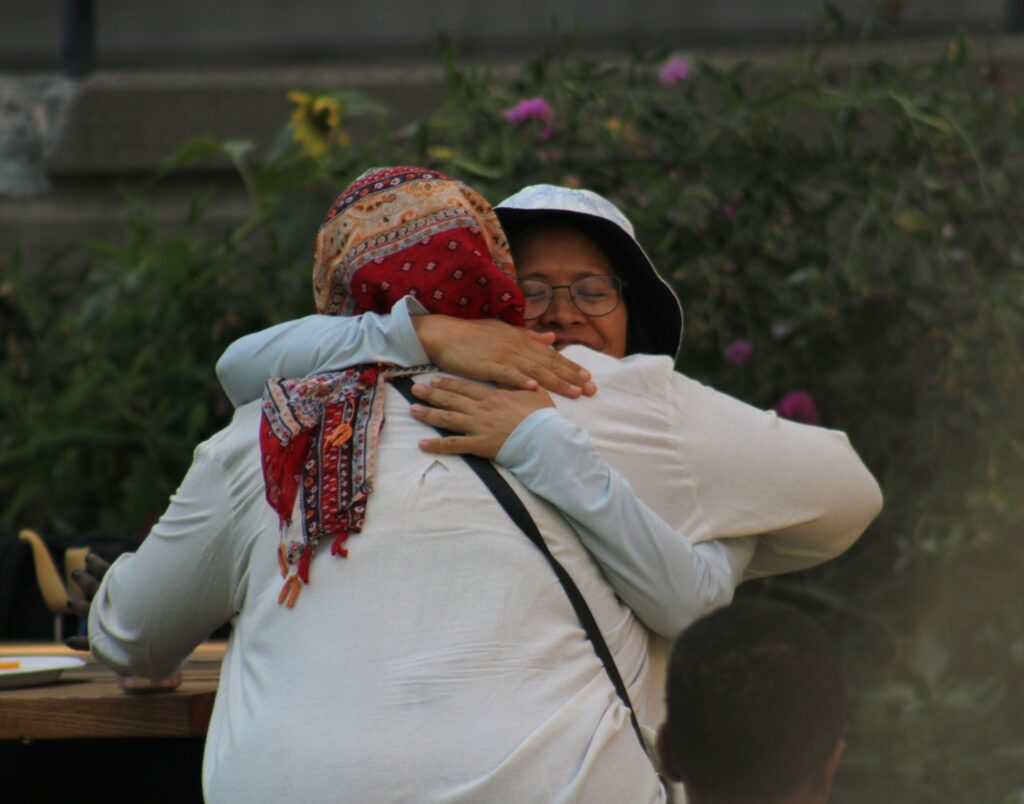
وكالات إعادة التوطين في ماساتشوستس تشيد بالقيادة التشريعية لاستثمارها 5 ملايين دولار في صندوق الدفاع القانوني للمهاجرين

وكالات إعادة التوطين في ماساتشوستس تشيد بالقيادة التشريعية لاستثمارها 5 ملايين دولار في صندوق الدفاع القانوني للمهاجرين

بوسطن - 9 يونيو 2025 - تشيد وكالات إعادة التوطين الثماني العاملة في جميع أنحاء الكومنولث بمجلس نواب ماساتشوستس لإدراج 5 ملايين دولار أمريكي في تمويل جديد لصندوق الدفاع القانوني للمهاجرين في ميزانيته للسنة المالية 26.

في الوقت الذي تعاني فيه الموارد المالية للولاية من ضائقة مالية، وفرص الاستثمارات الجديدة محدودة، واضطراب التمويل الفيدرالي الذي حث على توخي الحذر في إنفاق الولاية، فإن إنشاء هذا الصندوق الجديد يؤكد التزام مجلس النواب وتفانيه في حماية حقوق جميع المقيمين في ماساتشوستس. سيوفر هذا الاستثمار الهام الدعم القانوني للآلاف من سكان ماساتشوستس الذين يخوضون إجراءات الهجرة المعقدة - حيث يواجه العديد منهم خطر الاحتجاز أو الترحيل دون الحصول على مستشار قانوني. تثني وكالات إعادة التوطين على قيادة مجلس النواب وأعضائه لإدراكهم أن الإجراءات القانونية الواجبة والتمثيل القانوني ضروريان لنظام هجرة عادل وإنساني.

وقال جيف ثيلمان، الرئيس التنفيذي للمعهد الدولي لنيو إنجلاند الجديدة: "في الوقت الذي تشهد فيه مجتمعاتنا حاجة متزايدة وحالة من عدم اليقين المتزايدة، فإن هذا التمويل يبعث برسالة مهمة مفادها أن ماساتشوستس تقف بقوة لدعم جيراننا ومجتمعاتنا من المهاجرين". "إن إنشاء صندوق الدفاع القانوني للمهاجرين وسط هذه الأوقات العصيبة يبعث برسالة إلى هذه المجتمعات التي تواجه استهدافًا ظالمًا: مجلس النواب والهيئة التشريعية في ماساتشوستس يقفان خلفكم."

قال الحاخام جيمس غرين، الرئيس التنفيذي لخدمة الأسرة اليهودية في غرب ماساتشوستس: "إن توفير الاستشارات القانونية الكافية يفيد جميع السكان". "سيساعد هذا الصندوق المهاجرين - الذين يعززون قوتنا العاملة وقاعدتنا الضريبية واقتصادنا كل يوم والذين يثرون الحياة الثقافية لمجتمعاتنا - على البقاء في الولاية."

تشكر وكالات إعادة التوطين على وجه التحديد الزعيم فرانك موران ورئيس مجلس النواب ديف روجرز على دعم طلب التمويل هذا، ورئيس مجلس النواب رون ماريانو ورئيس مجلس النواب للطرق والوسائل آرون ميشلويتز وقيادة مجلس النواب لإدراجها في ميزانية الطرق والوسائل في مجلس النواب. نحن ممتنون أيضًا لالتزام ودعم مجلس الشيوخ وإدارة هيلي منذ فترة طويلة، ونتطلع إلى العمل على ضمان إدراج هذا التمويل في الميزانية النهائية للسنة المالية 26. نحن ممتنون لقيادة مسؤولينا المنتخبين في الكومنولث.

IINE Statement on the Travel Ban

IINE Statement on the Travel Ban

The recently enacted travel ban will divide families, endanger the lives of those seeking safety in the U.S., and forsake our nation’s humanitarian legacy. The ban is predicated on the claim that the selected ountries have a “large-scale presence of terrorists,” when in reality, the individuals seeking to leave these nations are doing so to save their lives and their families. 

The International Institute of New England condemns this ban, which is another attempt to dismantle legal pathways to immigration and villainize innocent individuals and families seeking safety and stability.  

More than 90% of IINE’s current clients come from nations included in the travel ban, particularly Haiti and Afghanistan. These immigrants have endured rigorous vetting and screening, long journeys, and unimaginable trauma to find peace and safety in the U.S. The travel ban will cause irreparable human harm and hurt U.S. communities – who rely heavily on their talent and economic and cultural contributions.  

موهبة مثل إفدجين، التي أُجبرت على مغادرة منزلها في هايتي، حيث كانت تكمل فترة إقامتها بعد تخرجها من كلية الطب. لطالما تطلعت إفدجين إلى أن تصبح طبيبة، وفي العام الماضي، تخرجت من برنامج مساعد تمريض معتمد (CNA) في المعهد الدولي للتعليم الطبي، مما جعلها تقترب خطوة واحدة من تحقيق هدفها.  

كما يعني الحظر أيضًا التفريق بين العائلات التي أمضت بالفعل سنوات من الفراق ولا تريد شيئًا أكثر من لم شملها. 

فالكثيرون من الدول المحظورة هم أصدقاؤنا وجيراننا، وفي حالة أفغانستان، هم إخوة وأخوات في السلاح. عندما سيطرت حركة طالبان على كابول، اضطرت صابيرا وزوجها إلى الفرار بسبب عمله السابق في دعم القوات المسلحة الأمريكية؛ والآن، هما في ماساتشوستس وحدهما، يحلمان باليوم الذي سيريان فيه عائلتيهما مرة أخرى.  

The devastation the travel ban will cause is immense. We hope the ban will be successfully challenged in court, and ultimately lead to further action around the need for comprehensive immigration reform.