metapixel
Ir al contenido principal

Autor: Danielle Gauthier

Miniatura del blog de Katie Bruno

Por qué dan: Entrevista con Katie Bruno, donante del IINE 

Our donors play a critical role in ensuring that every refugee and immigrant who comes to our doors finds the safety and support they need to start fresh in our communities. In our Why They Give series, we talk with our donors to learn more about their connection to our mission and commitment to philanthropy.

For our first installment, we spoke with Katie Bruno. Katie and her husband Mike have been donating to IINE monthly since 2017 as part of our Sustainer program. Katie shares what compelled her to get involved and how donating helps her make an impact on a cause about which she cares deeply.

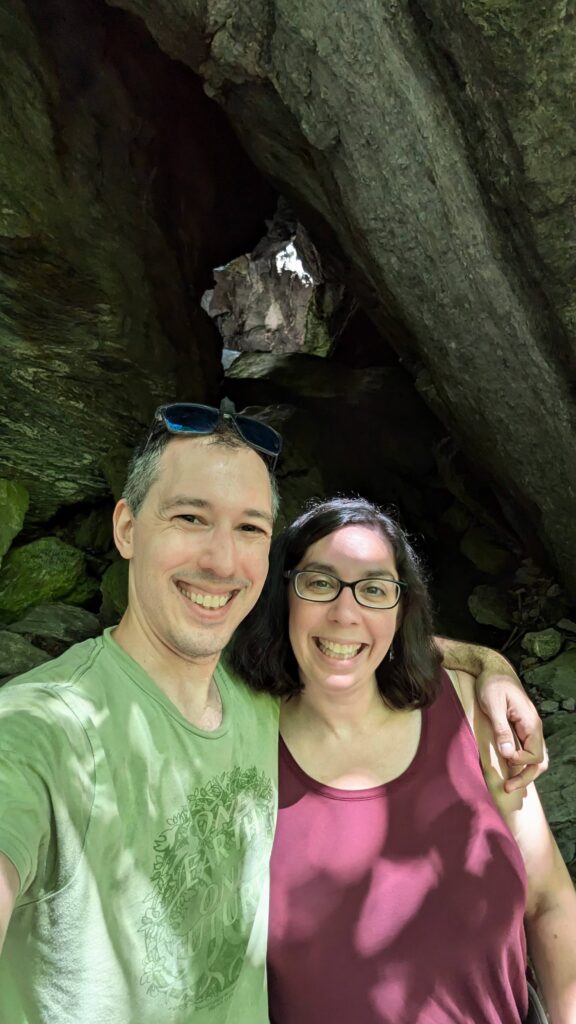
Mike and Katie Bruno

Tell us a bit about you.

I live in Andover, Massachusetts with my husband, Mike, and our two young kids—a 6-year-old and a 3-year-old. Mike grew up in Providence, Rhode Island, and I grew up west of Boston, so we have spent all our lives in New England.  

I’m an elementary school teacher, and a big part of my job is teaching my students the importance of helping others, having empathy, and being mindful of how we impact each other. It’s something I think about a lot in the classroom and at home.  

¿Por qué es importante para usted la filantropía?

Mike and I have been incredibly fortunate to have our parents support us through major financial milestones. Because of them, we don’t have any college loans, and they helped us purchase our house. We have been lucky financially, and we know that’s not the case for everyone. It’s important to us to give back to others who don’t have as much, simply because of how the world works. We feel we have more than we need, and so we have to help.  

Also, this might sound cheesy, but I grew up as a big fan of Mr. Rogers, and his philosophy always stuck with me: in any disaster, look for the helpers. I want to have helpers if I’m ever in a scary situation, and I want to be a helper for others.  

How did you first learn about the International Institute of New England?

After the 2016 presidential election, I lost a lot of faith. I wanted to figure out how I could help people whose safety would be impacted by the new president.  

Mike and I had recently moved to Andover, and I started looking for organizations supporting vulnerable communities. One of my close friends told me about IINE. Mike and I immediately knew it was a cause we wanted to support.  

What connection do you feel to IINE’s mission of creating opportunities for refugees and immigrants?

My maternal grandfather escaped France during World War II and immigrated to New York. So, with my family history, and as someone who is half-Jewish, I’ve always had an awareness of the horrible circumstances that might cause people to flee their homes.  

I also think that, as I’ve become more aware of humanitarian crises across the world, my desire to help has grown, too. There are so many people in dangerous situations who are seeking to leave to find opportunity and safety elsewhere, and they need support.  

At this moment in my life, I spend all my time either with my students or at home with my family, so my time is limited. I am grateful that I can make a difference by donating. That’s how I can be a helper.  

El IINE sólo puede prestar los servicios que tanto necesitan los refugiados y los inmigrantes gracias al apoyo de nuestros generosos donantes. Hay muchas maneras diferentes de donar. Obtenga más información aquí: Donar fondos.

WRD 2024 Miniatura

El IINE celebra el Día Mundial de los Refugiados 2024

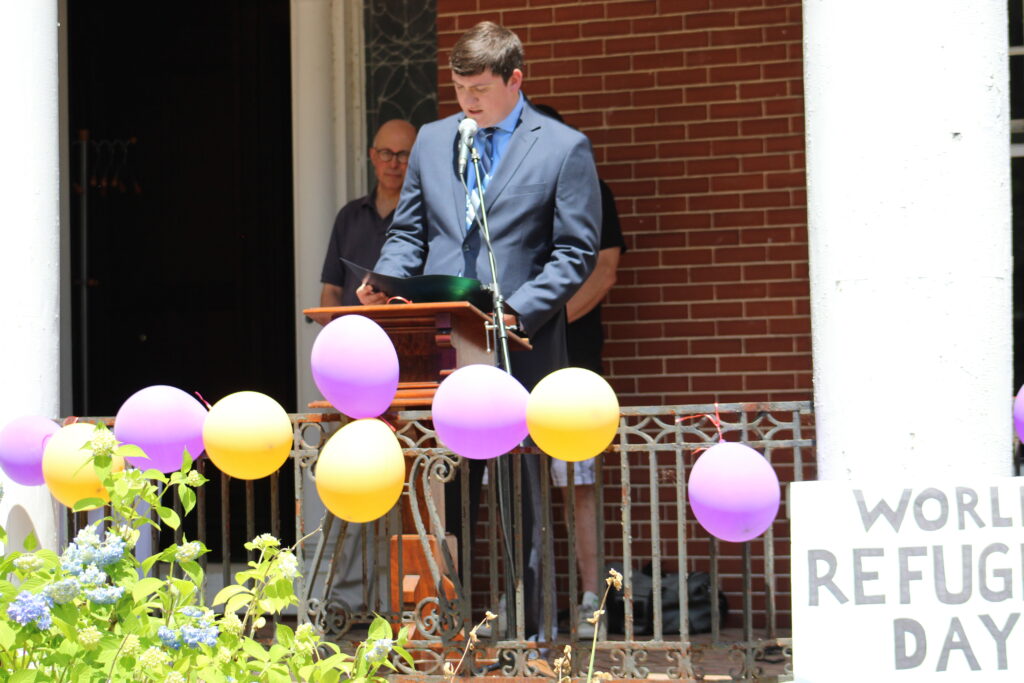
El 20 de junio de cada año se celebra el Día Mundial de los Refugiados (DMR), una conmemoración internacional que rinde homenaje a la fuerza, el valor y las contribuciones culturales de quienes se han visto obligados a huir de sus países de origen para escapar de conflictos y persecuciones. Las Naciones Unidas lo lanzaron oficialmente como celebración mundial en 2001 para conmemorar el 50 aniversario de la Convención sobre el Estatuto de los Refugiados de 1951.

Para el IINE, el Día Mundial del Refugiado es una oportunidad para reconocer los logros de los refugiados a los que servimos y dar las gracias a quienes les apoyan. Este año lo celebramos durante toda la semana con múltiples actos en nuestras tres oficinas de Boston y Lowell (Massachusetts) y Manchester (New Hampshire).

Manchester celebra los logros de sus clientes con una ceremonia, comida y premios

Blog Collage - WRD Manchester

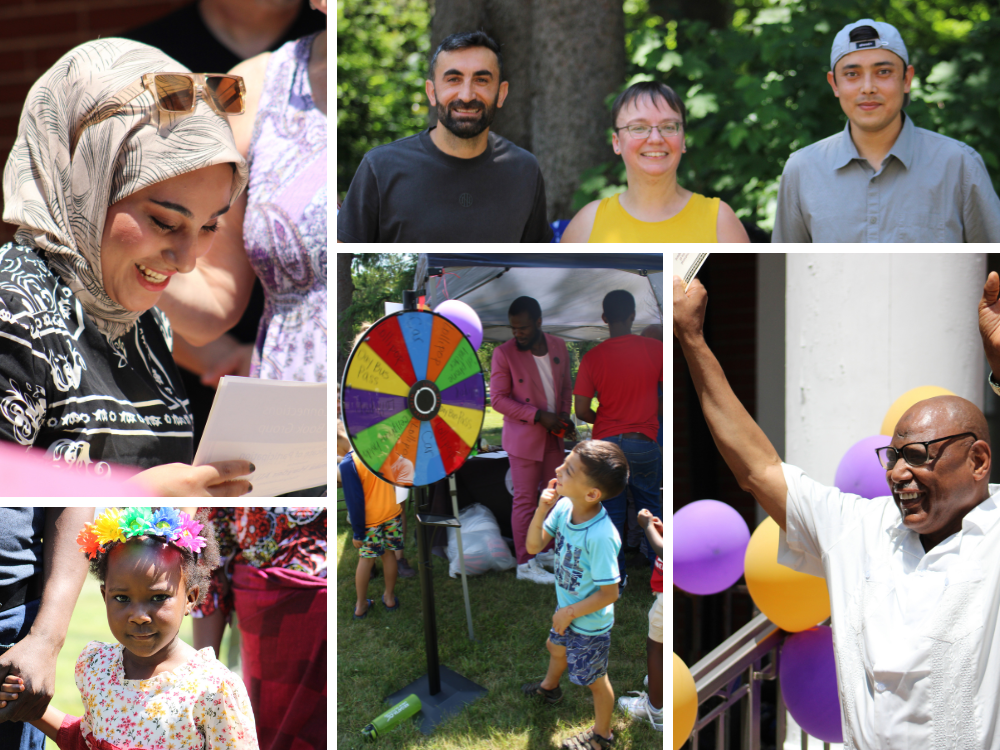
Onterior de nuestras oficinas en la iglesia de Brookside, 94 estudiantes de nuestro programa de inglés para hablantes de otros idiomas (ESOL) recibieron certificados en reconocimiento de sus horas totales de aprendizaje durante el año, y nuestros instructores reconocieron a sus alumnos con premios especiales premios por perseverancia, compromiso, tutoría, y otras distinciones. También se entregaron certificados a participantes en el programa de alfabetización y distribución de libros por nuestro socio, NH Humanidades; a los voluntarios de nuestra comunidad por su apoyo a las tutoríasy a la página recientes graduados de nuestra LNA (Asistente de Enfermería Licenciada) por un representante del Manchester Community College. Mientras tanto, los hijos de nuestros clientes visitaron algunos tiempo de juego de calidad en un "castillo hinchable". Las familias visitaron girar una rueda de premios creada por nuestros voluntarios de AmeriCorps para ganar transporte y coches de regalo.ds, y una rifa resultó en dos hijos de clientes con sus propias bicicletas.

La comunidad de Lowell se reúne para dar un paseo en bicicleta, hacer un picnic y recibir un homenaje especial 

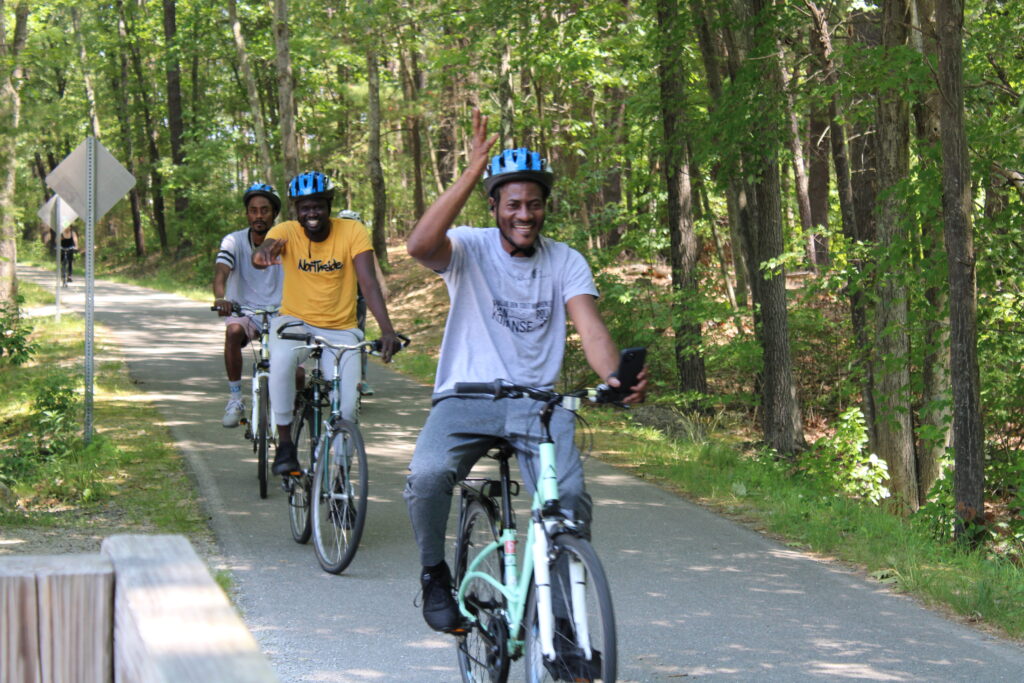
34 jóvenes clientes y personal acompañante celebraron la ocasión con un paseo en bicicleta WRD de Bruce Freeman Trail a Heart Pond, donde se detuvieron para disfrutar de un picnic y tomar fotos. Bibicicletas se proporcionaron para quienes las necesitaban por nuestro socio comunitario, El Conector de Bicicletas, una tienda de bicicletas sin ánimo de lucro gestionada por nuevo IINE IINE Wade Rubensteinque ha proporcionado gratuitamente bicicletas, instrucciónccióny recientemente, empleo, a nuestros clientes actuales y antiguos.

---

Más de 50 clientes y 20 empleados se reunieron en a proyecto artístico festivo: coloren banderas de sus países de origenrías. También juegan ened juegos y disfrutaroned pizza, fruta y bebidas. El personal compartió el tema oficial del DDía Mundial del Refugiado en varios idiomas: "Nuestro hogardesde los lugares donde nos reunimos para compartir las comidas hasta nuestro hogar colectivo, el planeta tierra: todos está invitado a celebrar lo que Nuestro Hogar significa para ellos. El hogar puede ser un lugar de refugio, un sentimiento o un estado de ánimo.

---

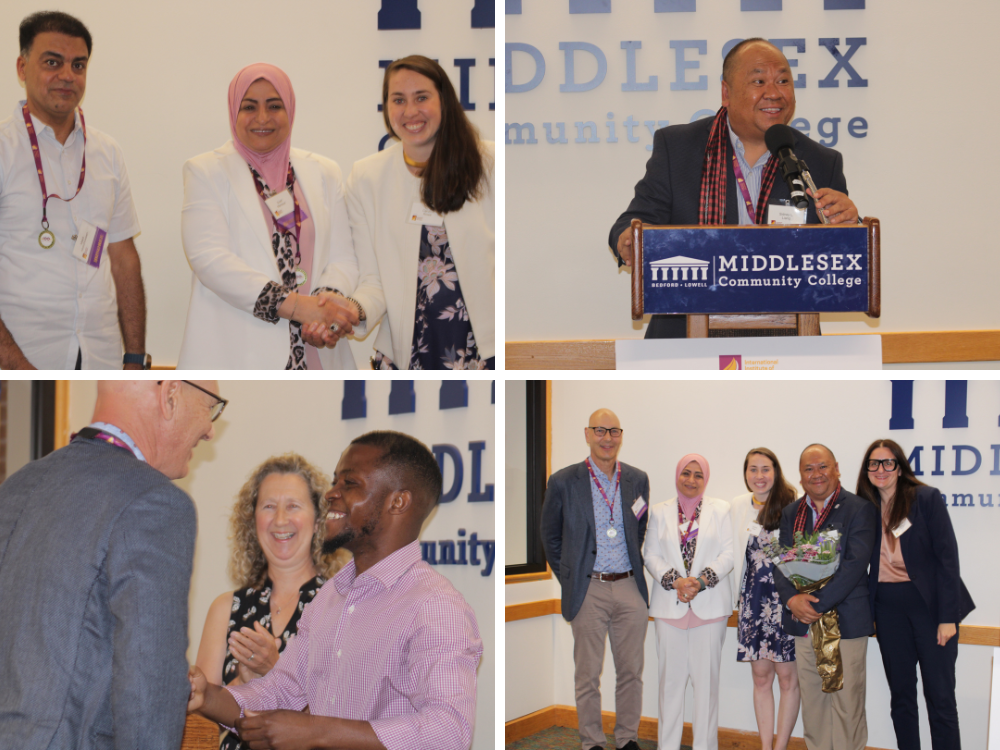
Los miembros de la comunidad se reunieron en el Cowan Center del Middlesex Community College para celebrar a nuestros clientes y homenajear a quienes han realizado enormes esfuerzos para acogerlos en el Gran Lowell. Incorporamos a cinco nuevos miembros a Lowell 100, un grupo de líderes que han realizado importantes contribuciones a las comunidades de inmigrantes de la ciudad:

  • Majid Abdulhussien y Suad Mansour (arriba a la izquierda), antiguos clientes del IINE que sirven de chóferes e intérpretes a los refugiados recién llegados. Abudulhussien y Mansour son famosos en nuestra oficina de Lowell por responder a la llamada en cuanto se les avisa para recibir a los refugiados en el aeropuerto, darles la bienvenida a Estados Unidos y llevarlos a los apartamentos amueblados que les han conseguido nuestros coordinadores de vivienda, sus primeros hogares en Estados Unidos. "Quiero que la gente me ayude, así que ahora me toca a mí ayudar a la gente que lo necesita", dice Mansour. dijo Mansour. "A mí me divierte... Hay que ver en sus caras cuando les dices que vienes a ayudar y que todo el mundo sabe que vienen".
  • Sidney L. Liang (arriba a la derecha), Director Principal del Centro de Salud Metta, Centro de Salud Comunitario de Lowell con el que el IINE comparte edificio de oficinas y colabora estrechamente. Liang es un antiguo refugiado que huyó de los Jemeres Rojos en Camboya. Elogiando a los muchos otros antiguos refugiados que ahora prestan servicios a los recién llegados tanto en Metta como en el IINE, Liang dijo: "Vivieron experiencias similares, pero se han vendado las heridas. Han vendado sus heridas y ahora están listos para devolver".
  • Wade Rubenstein (abajo a la izquierda), Presidente y Fundador de Bike Connector, nuevo miembro del Consejo de Administración del IINE, e hijo de antiguos refugiados de Ucrania. Wade fue presentado por Ungaye Izaki, un antiguo cliente del IINE cuya historia de recuperar una bicicleta de un canal para poder llegar a su nuevo trabajo inspiró a Wade para fundar el Conector de Bicicletas, donde ahora también trabaja Izaki. "Ungaye fue la primera bicicleta que concedí a alguien aquí en Lowell", dijo dijo Rubinstein. "La semana pasada acabamos de entregar nuestra bicicleta número 5.000".
  • Kelle Doyle Directora de Área de la agencia de empleo WeStaff, que ha puesto en contacto a miles de clientes del IINE con sus primeras oportunidades de empleo en EE.UU. Doyle ha dicho de su experiencia con los clientes del IINE, "acaban siendo los mejores empleados... Lo bueno es que somos un trampolín para que amplíen sus conocimientos lingüísticos, ganen algo de dinero, se establezcan, obtengan licencias y empiecen una vida aquí".

Tras la emotiva ceremonia, los asistentes disfrutaron de comida de todo el mundo y de una degustación de café cortesía de Starbucks, que patrocinó generosamente el acto y nuestra celebración de Manchester. Gracias, Starbucks, por tu apoyo constante.

Representantes municipales se unen a la graduación de Boston ESOL para hablar con los inmigrantes y el personal de IINE

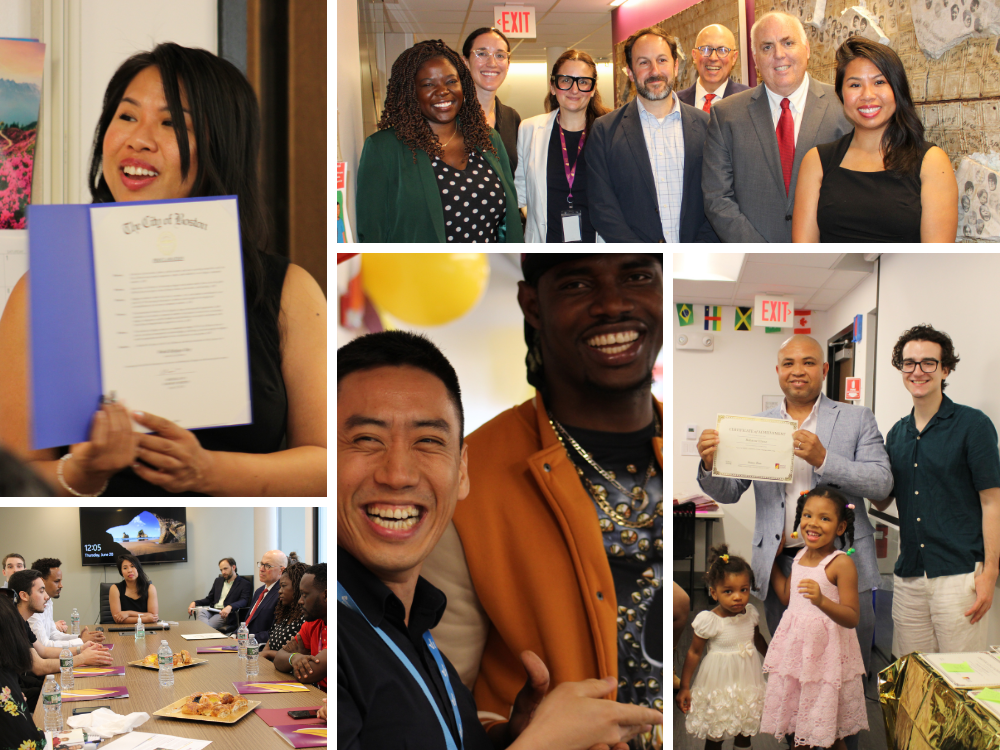
El 20 de junio en Bostonla Oficina del Alcalde para para el Progreso de los Inmigrantes Monique Nguyen se unió a una celebración de nuestros graduados de ESOL para leer una proclama del alcalde Wu declarando el 20 de junio Día Mundial del Refugiado en Boston. Presidente del Consejo de la Ciudad de Boston Ruthzee Louijeune y los miembros del Consejo Municipal Benjamin Weber y Edward Flynn asistieron para compartir su apoyo a los estudiantes inmigrantes. Louijeune Louijeune se dirigió a los estudiantes en inglés y criollo haitiano, subrayando la importancia de la educación y el papel de los inmigrantes en la sociedad. jugar un papel activo en apoyaren el aprendizaje de sus hijos. Asistieron a la celebración más de 200 alumnos, familiares y miembros del personal.

---

A lo largo de la semana y en todos nuestros sitioss, la comunidad del IINE se unió con alegría y orgullo, y se sintió realmente inspirada por las historias y logros de las personas a las que servimos y junto a, que han perseverado a través de dificultades increíbles, y son ahora igual de motivados para triunfar y devolver.

Crear el cambio en la cúpula: abogar por los refugiados y los inmigrantes

Desde el escritorio del CEO: Crear el cambio en la cumbre: defender a los refugiados y los inmigrantes

Por Jeff Thielman, Presidente y Director General del Instituto Internacional de Nueva Inglaterra

Advocating for local, state, and federal government funding, and for policies that welcome refugees and immigrants to New England, has been a critical part of IINE’s work since our founding in 1918. Our clients look to us to speak to decision-makers on their behalf, and with our knowledge of policy, the work on the ground, and our clients’ unique needs and strengths, our voice and community leadership can create real and needed change. 

Learn about our advocacy throughout history in our Boston Centennial blog series.

We have already had some big successes this year, and we know we’re looking at some battles ahead. To manage our growing efforts, we have recently welcomed Bill Gillett as our Director of Public Policy and Advocacy. An attorney, former dean of two business schools, and former Chair of our Board of Directors, Bill brings a great passion for our work, deep expertise in immigration policy, and broad reach particularly within New Hampshire’s service community and political sphere.  

During this critical year for advocacy before the presidential election, here’s an overview of IINE’s recent successes and continuing efforts. 

Massachusetts: Securing resources to address an affordable housing crisis

WRD Boston 2024
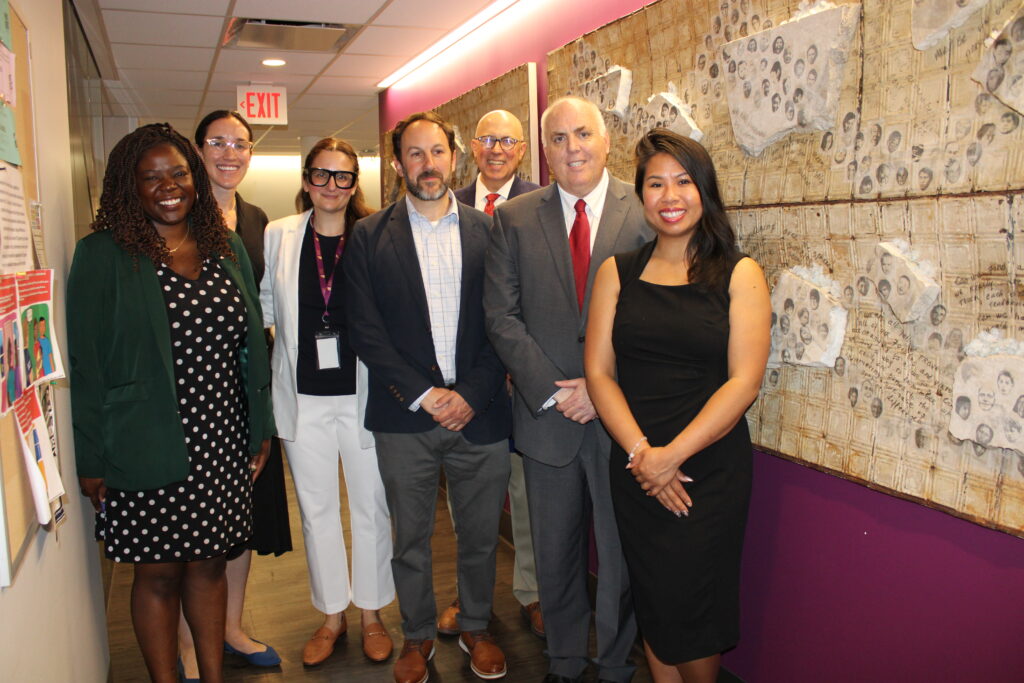
Boston City Council President Ruthzee Louijeune, City Council Members Ed Flynn and Ben Weber, and Mayor’s Office of Immigrant Advancement Director Monique Nguyen recently met with IINE staff to learn more about our programming and impact

IINE regularly meets with members of Massachusetts Governor Maura Healey’s administration and with leaders in the state legislature. Our recent efforts have focused on allocating adequate funding to address the housing crisis affecting new arrivals.  

IINE leads a statewide coalition of eight refugee resettlement providers, which secured $10.5 million from the state legislature in late 2023 to prevent refugee and parolee families from entering the emergency shelter system, and to help immigrant families who are currently in emergency shelters to exit quickly, safely, and permanently.  

Highlighting the need for efficient shelter exiting, we successfully advocated for an additional $7 million in the Massachusetts supplemental budget adopted in April of 2024 to enable refugee and immigrant service providers to give families in shelters access to English classes, and housing and employment support.  

Within the $10.5 million allocation, IINE received:  

  • $1,000,000 from the Massachusetts Resettlement Rehousing Program to move 50 families out from emergency shelter and into permanent housing, while providing 12 months of case management including employment support. 
  • $391,631 from the Massachusetts Resettlement Support Program (MRSP) to provide rental assistance and other direct support for refugees. 

We are currently advocating for a $300,000 allocation in the 2025 state budget to support case management staff who refer clients to mental health providers. 

IINE is also a founding member of the Massachusetts Immigrant and Refugee Advocacy Coalition (MIRA) (and IINE’s Chief Advancement Officer Xan Weber is a member of MIRA’s Advisory Council), and a contributor to many of its campaigns, including #CourageToWelcome, a social media effort sharing people’s personal reasons for welcoming refugees and immigrants to the Commonwealth.

New Hampshire: Battling anti-immigrant legislation that hurts us all

A member of U.S. Senator Jeanne Shaheen’s Office congratulates our clients on their dedication and hard work during our annual World Refugee Day celebration in Manchester, New Hampshire

This campaign season, immigration is a hot button issue in New Hampshire and we’re seeing an increase in anti-immigrant legislation boosted by misinformation and fearmongering. IINE is working closely with local refugee and immigrant service providers and political officeholders and candidates to counter negative messaging and defeat hostile and divisive bills.  

Last month IINE helped advocate for the defeat of HB 1118, which would have required “non-resident aliens” (people who don’t have a Green Card or who haven’t been in the country for 183 or more consecutive days) from securing a driver’s license. The bill would have created confusion among our clients, made it difficult for them to get to work in a state that lacks sufficient public transportation, and hindered their ability to contribute to the New Hampshire economy. It has now been “relegated for further study,” which essentially tables it indefinitely.  

We’re now working against Senate Bill 358, which would make it illegal for undocumented immigrants with valid licenses in other states to drive in New Hampshire. Such legislation is discriminatory and would be devastating to many families in our care, including clients in IINE’s Unaccompanied Children’s Program

Contact your senators to speak out against Senate Bill 358.

Federal Advocacy: Pushing to expand resources and streamline processes

Our clients get much-needed support from the federal government, but we’re also feeling the strain of a federal immigration system that is under-resourced, lacks inter-agency coordination, and is often gridlocked by politics. We’re seeing laws enacted that curtail the right to apply for asylum, clients who braved impossible journeys here to escape persecution threatened with visa expirations, and the storm clouds of many proposed anti-refugee and anti-immigrant policies looming ahead. We will continue to speak out. 

IINE often advocates through the national network of which we are an affiliated member, the U.S. Committee for Refugees and Immigrants (USCRI). Among other efforts, IINE has recently signed letters put forth by USCRI calling on our federal government to extend Temporary Protected Status for Haitian immigrants and other clients in our services and to create pathways to citizenship for Afghan evacuees and Ukrainians nationals. 

Members of IINE’s leadership also recently traveled to Washington, D.C., meeting with a White House official, staffers of all four U.S. Senators representing Massachusetts and New Hampshire, and the senior leaders from the federal Office of Refugee Resettlement (ORR), the primary source of much of our federal funding. In eight substantive policy meetings, we had the chance to explain the challenges we’re facing and the support we need as we serve the highest number of refugees, humanitarian parolees, and unaccompanied children in our recent history.  

DC Trip
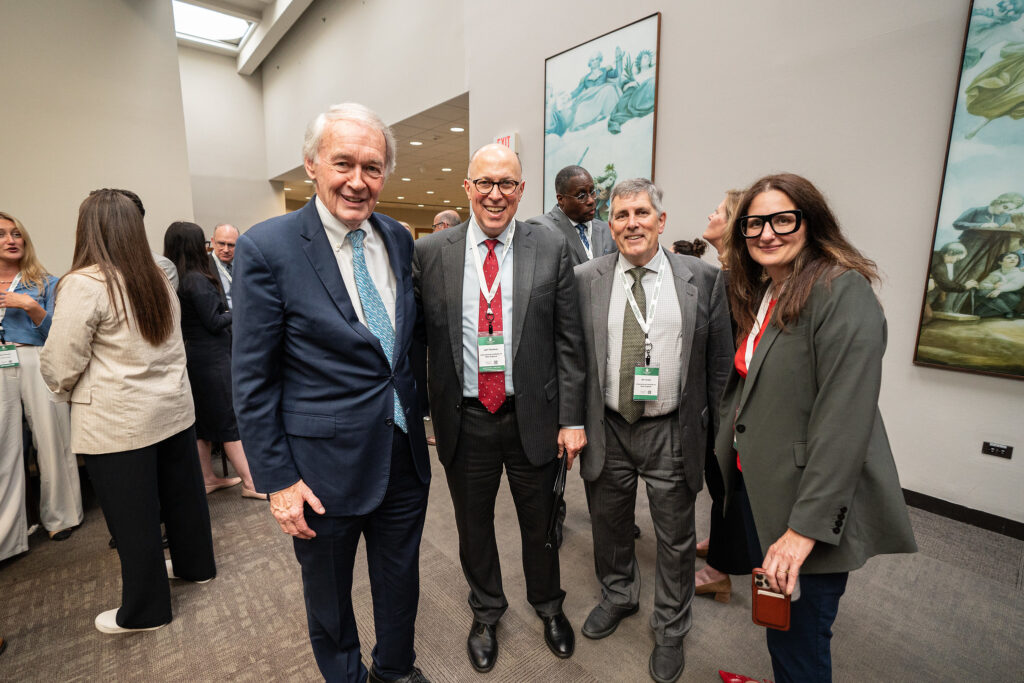
U.S. Senator Ed Markey speaks with IINE President and CEO Jeff Thielman, Director of Public Policy and Advocacy Bill Gillett, and Chief Advancement Officer and Senior Vice President Xan Weber during a New England Council event

We were gratified to see our input incorporated when, shortly after our visit, Massachusetts Senators Elizabeth Warren and Ed Markey sent a letter to the Senate Appropriations Committee’s Homeland Security Subcommittee asking for a new $500 million Destination Reception Fund to provide federal support for housing, health care, workforce development, and legal assistance as new arrivals work to transition out of emergency shelters. 

Advocating Together

As a supporter of IINE who shares a belief in our mission, we also need your help advocating for refugees and immigrants. Through our blog, newsletters, and social media, we will continue to help keep you informed about the perspectives of our clients, the misinformation that targets them, and policies that affect them. We need your help to spread the word in your own networks. When you support IINE you are helping to amplify immigrant voices at all levels. Thank you for all that you do.   

"Nunca me sentí sola": Maydelyn, refugiada y madre soltera de Guatemala, encuentra una comunidad y un nuevo comienzo en Massachusetts.

Llegar llenos de esperanza

Maydelyn con sus hijos, Xavier, de 11 años, y Pablo, de 9, que llegaron a Estados Unidos como refugiados procedentes de Guatemala.

Tras una elección imposible y un viaje difícil, Maydelyn, antigua maestra de escuela, refugiada de Guatemala y madre soltera, llegó al aeropuerto internacional Logan de Boston con su hijo de 11 años, Xavier, y su hijo de nueve, Pablo, el pasado agosto. Los tres estaban ansiosos por empezar de cero.

Su nuevo hogar estaría en Quincy, Massachusetts. Los coordinadores de vivienda del IINE habían encontrado y amueblado un apartamento para la familia en el suburbio de Boston, en una zona con una gran comunidad hispanohablante. Una vez que Maydelyn y sus hijos se mudaron, los gestores de casos del IINE se pusieron rápidamente manos a la obra para matricular a los niños en la escuela, ayudar a la familia a solicitar prestaciones públicas y concertar citas médicas. En septiembre, Xavier y Pablo dijeron a sus gestores de casos que estaban disfrutando de sus clases y que ya habían hecho amigos con otros estudiantes de origen guatemalteco.

Perseguir su sueño

Madelyn tenía muchas ganas de aprender inglés e incorporarse al mercado laboral en su nueva comunidad.. En a su especialista de empleo de IINE que sus objetivos eran alcanzar inglés, ser profesora de español y ser propietaria de una casa. ser propietaria de una vivienda. Comprendiendo que el camino sería largo, se rápidamente un trabajo en una agencia local de limpieza. Wn pocos meses, y con la ayuda del IINE, Maydelyn fue contratada como ama de llaves en el Hotel Charles de Harvard Square.. Aunque se había matriculado en clases de ESOL, su horario de trabajo y sus desplazamientos le dificultaban asistir a ellas. El IINE la puso en contacto con un voluntario para que le diera clases particulares. Madelyn rememse siente realmente bendecida por estar en camino hacia sus objetivos.

"A pesar de empezar una vida desde cero sin conocer el idioma y sin saber por dónde empezar, nunca me sentí sola. My Case Manager no sólo me ayudó a resolver todos y cada uno de los trámites importantes sino que además me hizo sentir bienvenida por el cariño con el que siempre me trató. Me sentí apoyada en todo momento. Sin el IINE la adaptación hubiera sido muy difícil".

Una amistad incomparable

Maydelyn y sus hijos recibieron un apoyo especial del equipo madre-hija formado por Anna y Rosie Glastra. Anna había empezado a trabajar como voluntaria en el IINE el mes de abril anterior a la llegada de Maydelyn. Como inmigrante, Anna estaba deseosa de ayudar a otros recién llegados a encontrar su camino en un nuevo país, y de poner en práctica sus conocimientos de español.

Al principio, Anna se apuntó para ofrecer apoyo de transporte, llevando a los clientes de IINE a sus citas y clases y ayudándoles a hacer recados. Cuando llegaron Maydelyn y sus hijos, Anna se convirtió en una de las primeras "Mentoras comunitarias" de IINE.

Xavier y Pablo en el espíritu de Halloween

Similar a IINE Reasentarnos juntos los mentores comunitarios se emparejan con familias o personas refugiadas en su primera fase de reasentamiento y se convierten en sus guías, apoyos y -como fue el caso de Anna y Maydelyn- sus primeros amigos en Estados Unidos.

Anna y su hija Rosie empezaron a trabajar con Maydelyn cuando llegó en agosto. Fue Anna quien avisó al IINE de que Maydelyn necesitaría un método alternativo de enseñanza de ESOL, lo que le llevó a conseguir un tutor. En otoño, Anna estaba ayudando a Xavier y a Pablo a prepararse para una primera experiencia muy emocionante. Escribió a la coordinadora de voluntarios del IINE, "El miércoles pasado, Maydelyn y yo pasamos una tarde estupenda con los chicos, visitando y disfrutando de la tienda de Halloween para conseguir un traje. Estaban muy emocionados de poder celebrar Halloween por primera vez. Su colegio organiza una fiesta de Halloween mañana por la tarde, y después irán a pedir caramelos por el barrio con Maydelyn. El resto de la tarde de la semana pasada jugamos al minigolf y comimos algo. Fue una tarde encantadora".

En noviembre llegó el momento de otra emocionante tradición de Nueva Inglaterra. Anna compartió, "Los llevé a recoger manzanas, lo que fue un gran éxito. Toda la familia disfrutó muchísimo. Creo que cada uno de los chicos se comió al menos 6 manzanas mientras recogían :). Se subieron a todas las escaleras para coger la manzana más alta disponible del árbol y se fueron a casa con dos bolsas llenas de manzanas y una calabaza."

Las voluntarias Anna (izquierda) y Rosie (centro) con Maydelyn y sus hijos, disfrutando de una excursión vespertina al manzanar local.

Maydelyn se sintió orgullosa de poder devolver el favor a finales de mes, invitando a Anna y a Rosie a su apartamento de Quincy para celebrar una fiesta de cumpleaños. Anna escribiócocinó deliciosos platos guatemaltecos para nosotras y horneó una tarta de tres leches (receta de su madre). Estaba muy contenta de compartir su encantador apartamento con invitados por primera vez en EE.UU.".

De su amistad con Anna, Maydelyn dice: "Estoy agradecida por tener la conexión entre Anna y nosotros, ya que ella y su familia nos han dado a mis hijos y a mí momentos inolvidables y, lo que es más importante, una amistad y un afecto incomparables."

Un futuro prometedor

Casi un año después, segura en su casa y en su trabajo, y avanzando en sus conocimientos de inglés, Maydelyn es autosuficiente. Anna se reunió con su en primavera y informó, "Xavier y Pablo están muy bien en escuela. Ambos tienen bastante algunos amigos y participan en deportes: baloncesto y fútbol. Han hecho progresos asombrosos con el inglés. Maydelyn me contó que hace poco tuvo una reunión de padres y profesores en la que el profesor dijo que los dos chicos son excelentes estudiantes, lo que la hizo muy feliz. muy feliz y orgullosa."

Aunque no fue nada fácil dejar atrás su país y viajara una nueva tierra como madre soltera, tracias a su valentía y empujela positividad de su familia, el apoyo del IINE, y la amistad de Anna y Rosie, Maydelyn y sus hijos están construyendo una vida mejor y llena esperanzaen Nueva Inglaterra.

---

Los voluntarios son esenciales para el trabajo que hacemos para acoger y reasentar a los recién llegados a Massachusetts y New Hampshire. Haga clic para explorar nuestras oportunidades de voluntariado.

1944-1953: Un hogar para los desplazados

“100 Years of Welcome: Commemorating IINE’s Boston Centennial” Series:
Installment #4

Welcome to the fourth installment of our series “100 Years of Welcome: Commemorating IINE’s Boston Centennial.” The previous installment, “1935-1944:Don’t CondemnUnderstand,’” described how the International Institute of Boston (IIB) found every opportunity available to welcome and support immigrants during the Great Depression and the Second World War, including through reintegrating Japanese Americans freed from internment.  

The mid-1940s through mid-1950s were broadly a time of recovery and renewal for the New England region, and the International Institute of Boston (IIB) continued to take advantage of every new opportunity that arose to help immigrants. Boston’s economy was on an upswing, having been revived by war-time mobilization efforts. Factory jobs were coming back, and IIB advocated for fair treatment of immigrant workers in the workforce.  

While prejudices and struggles persisted, national attitudes towards immigration were warming in significant ways. The U.S. had achieved victories fighting alongside foreign allies. As U.S. soldiers returned home, some brought wives from the countries they had served, whom IIB welcomed and supported. As Americans learned of the horrors oppressive regimes abroad had inflicted on their people, with time, the U.S. government opened its borders to many people throughout Europe who had been threatened, imprisoned, and displaced by the war. The International Institute of Boston worked to resettle and integrate more than 10,000 people displaced by war.  

Even with these gains, however, by the early 1950s a rising fear of Communism along with continued racial and religious discrimination fueled a new batch of restrictive federal immigration laws. IIB fought against anti-immigrant legislation while continuing to reach out to new immigrant communities and holding fast to its commitment to help Boston’s immigrants preserve, share, and celebrate their cultures. 

Committing to Culture

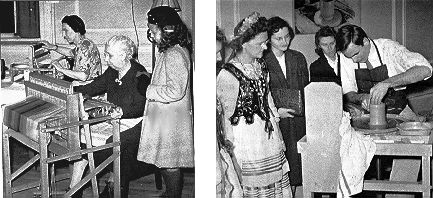
Weaving and Ceramics Demonstration at the New England Folk Festival, 1944. Courtesy of New England Folk Festival Association.

In 1944, right before the end of WWII, then governor Morris J. Tobin held a Conference on Recreation, convening leaders from throughout the Commonwealth to discuss ways to relieve wartime stress and promote understanding between cultures. The International Institute answered the call, helping to organize and sponsor a Fall Folk Festival at its former headquarters, the Boston YWCA. Over two days, 200 Bostonians gathered to witness demonstrations of folk arts and crafts, performances of lively music and dance from a wide variety of immigrant communities, African American spirituals, and traditional music and dance from the Wampanoag and Navajo tribes. The Fall Folk Festival would grow into the New England Folk Festival, which was sponsored annually by IIB for the next 25 years.  

IIB took its role as a preserver and promoter of immigrants’ cultures very seriously. During this period, the Boston Council of Social Agencies conducted a study recommending that IIB discontinue its “nationality work”—which focused on strengthening immigrant communities through education and cultural activities—to focus strictly on the “technical issues” of the immigration and naturalization process. IIB protested, calling on its many allies in academia and government to submit letters in support of IIB continuing the full scope of its services. This campaign prevailed, convincing the Council to withdraw the recommendation, and IIB stayed true to its founding vision. In fact, IIB expanded its “nationality work” during this period, notably welcoming its first Black nationality group, the Liberian College Association, and convening a Chinese Club to support Boston’s Chinatown neighborhood.  

Fighting for Fairness

While continuing its cultural and case work, IIB also returned to addressing workforce issues. Immigrants in Boston had long been vulnerable to exploitation in the workforce because of language barriers, prejudice, and lack of access to legal protection. From its earliest days in the 1920s, IIB mediated between immigrants and their employers to advocate for fair wages and treatment. When the U.S. government awarded Boston contracts for shipbuilding and production of ammunition and other products needed for war, many of Boston’s immigrants and their children heading back into once-shuttered factories faced exploitative conditions. In 1946, IIB successfully advocated for the Massachusetts Fair Employment Act which established the Fair Employment Practices Commission—a huge win for immigrant and all workers’ rights in Boston. The new commission could enforce laws prohibiting employment discrimination on the basis of race, color, religious creed, national origin, or ancestry, and in 1950, its mandate was extended to housing and public accommodations.  

IIB also continued to advocate for fairness in immigration policy at the federal level.  In 1952, when Pauline Gardescu took the reins as the third Executive Secretary of the International Institute of Boston, she began her tenure by testifying before congress in opposition to the discriminatory (and ultimately adopted) racial and national origin quota proposed in the McCarran-Walter Act, which set limits by country on the number of immigrants that could be admitted into the U.S., heavily favoring those from northern and western Europe.  

Welcoming “War Brides”

Many Bostonian immigrants who fought in WWII returned home to new opportunity. The Servicemen’s Readjustment Act, later known as the G.I. Bill of Rights, or simply the G.I. Bill, provided veterans with loan guarantees for home mortgages, money for college or vocational school, and unemployment compensation. The bill helped millions of European immigrants who had fought in the war, including many whom IIB had helped through poverty, to buy their first home in the U.S. and join its middle class.  

Returning soldiers also brought home spouses from the countries in which they had served. IIB welcomed these new Bostonians, helping them with immigration legal and naturalization services, and bringing them together for mutual support in weekly convenings of an “Overseas Wives Club.” IIB furthered its work on behalf of women immigrants through advocacy, fighting for gender equality to be enshrined in the federal immigration laws of the day.  

Providing Refuge to the Persecuted and Displaced

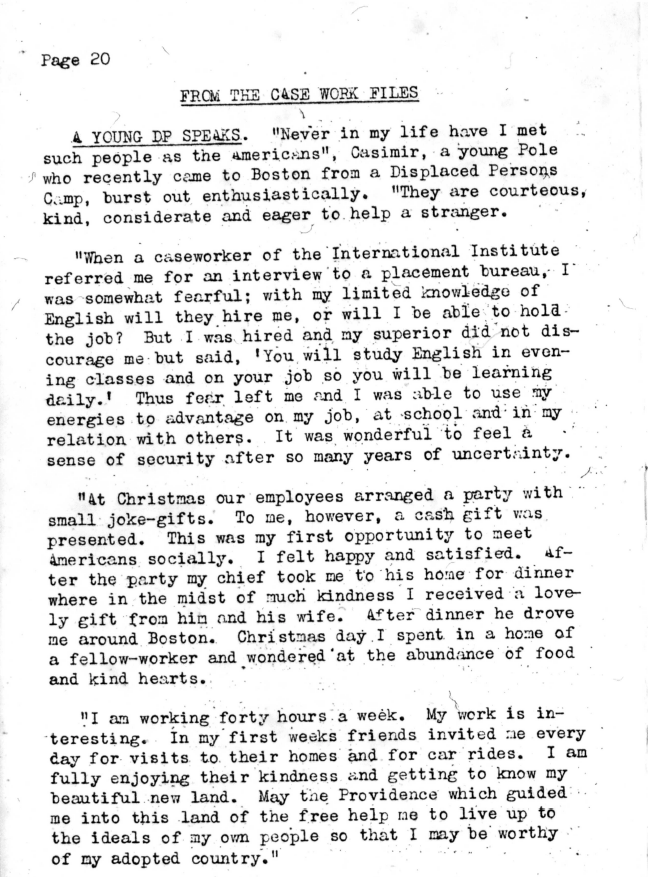
A Polish displaced person reflects on their experience in the U.S., from a 1950 edition of The International Beacon

By 1948, seven million Europeans had been displaced by the war, prompting the passage of the federal Displaced Persons Act, a pivot point for U.S. immigration and the work of IIB which was further expanded in 1950 to accommodate Jews who had fled Nazi atrocities. Supported by IIB, this was the first U.S. bill aimed specifically at granting entrance to immigrants forced from their home countries and prevented from returning for fear of violence or persecution. This bill led the U.S. to admit an initial 400,000 “displaced persons” (DPs) into the United States over and above immigration quotas provided they find a place to live and a job. 

Between 1948-1952, IIB led the way in resettling 10,000 Displaced Persons in Boston, sending interpreters to meet them as they arrived at Boston Harbor, finding sponsors to help more than 200 individuals with housing and employment, and providing support services. Other notable recipients of support were three so-called “Ravensbrück Rabbits,” women who had survived medical experiments in a Nazi concentration camp in Poland and came to Boston seeking reconstructive surgery under the sponsorship of a group led by journalist Norman Cousins. IIB provided these brave survivors with housing, interpretation, and financial support. 

In 1951, the International Institute coordinated the “Special Project–International Refugee Organization (SPIRO)” which resettled more than forty families of displaced people who had disabilities or other challenges requiring special support. The following year, IIB expanded its English language classes to serve 2,500 Displaced People, and a two-year grant from the Ford Foundation enabled IIB to provide both English classes and job training for more than 600 refugees from Russia and the Ukraine by the end of 1953. Many of these new arrivals, along with refugees from China and Eastern Europe, were admitted under the Refugee Relief Act of 1953, which authorized visas for those fleeing communist countries.  

Today, the International Institute and our supporters continue the legacy of advocating for fair immigration and employment policies and necessary resources for refugee resettlement, while working to make Boston a home for the displaced and the persecuted.  

Durante el año de nuestro centenario, celebramos 100 años de apoyo a los refugiados e inmigrantes del área metropolitana de Boston, que han cambiado sus vidas, y nos preparamos para nuestro segundo siglo de servicio. Obtenga más información aquí: Centenario del IINE Boston.

Miniaturas de blogs de educación superior

Los universitarios aprenden sobre reasentamiento de refugiados echando una mano

Grupo RT Noreste

Los colegios universitarios y las universidades definen la cultura de Nueva Inglaterra, aportando innovación y un significativo intercambio cultural, ya que atraen a educadores, investigadores y estudiantes de todo el mundo. Para el IINE, los institutos y universidades son socios importantes; profesores y administradores colaboran en nuestros programas de formación profesional y ayudan a los clientes del IINE a fijar sus objetivos educativos. Muchos estudiantes locales hacen prácticas, aprenden sobre el trabajo entre bastidores y prestan un apoyo muy necesario al personal del IINE.

Ahora el IINE está forjando un nuevo tipo de asociación con colegios y universidades locales: colaborar directamente con los estudiantes en clases sobre migración, asuntos internacionales y negocios internacionales para ofrecerles oportunidades prácticas de aprendizaje-servicio. Los beneficios son triples:

  • Las familias refugiadas reciben el apoyo de jóvenes voluntarios motivados que exploran su nueva ciudad junto a ellos.
  • IINE consigue ayudar a formar la próxima generación de acogedores y simpatizantes.
  • Los estudiantes participantes van más allá de la investigación para adquirir experiencia y marcar una diferencia tangible en la vida de los refugiados que necesitan apoyo en esta etapa crucial.

"Los estudiantes universitarios que vienen aquí a aprender y los refugiados que vienen a empezar de cero renuevan y enriquecen nuestras comunidades", dice Kate Waidler, Coordinadora de Voluntariado y Patrocinio Comunitario del IINE. dice Kate Waidler, Coordinadora de Voluntariado y Patrocinio Comunitario del IINE. "Hay mucho que ganar al reunirlos. Es importante para los estudiantes que realmente intentan comprender las relaciones internacionales conocer a algunas de las personas reales de las que hablan cuando discuten sobre humanitarismo y víctimas de la guerra, y es estupendo para los refugiados conocer a algunas personas más allá de los especialistas en casos: jóvenes con sueños y aspiraciones diferentes que son igualmente acogedores y quieren aprender a ayudar."

Kate ha establecido recientemente asociaciones con dos universidades de Boston mientras asistía a las reuniones mensuales del proyecto Proyecto de apoyo a la enseñanza superior en el reasentamiento de refugiados (SHERR)y está orgullosa de que el IINE sea uno de los primeros grupos en pasar de la teoría a la práctica. "El grupo tenía la sensación de '¡Vaya, ya lo estáis haciendo! Me di cuenta de que somos pioneros".

Exchangnir conocimientos y habilidades con los estudiantes en Northeastern

En la primavera de 2024, el IINE completó una asociación inauguralcon la Universidad Northeastern (NU) trabajoen con estudiantes en su "Globalización y Asuntos Internacionales" y "Aspectos culturales de los negocios internacionales" . La colaboración incluyó visitas a las aulas de NU del personal del IINE que formó estudiantes en aspectos del reasentamiento de refugiados. También se invitó a refugiados e inmigrantes a las aulas para que participar en valiosos debatesiones sobre sus experiencias encontrar trabajo en un nuevo país. Sl estudiantes participaron en múltiples aspectos del trabajo de campoAlgunos viajesa a la oficina del IINE en Boston para tutoría en o enseñar mientras que otros proporcionaron asistencia práctica asistencia prepararing para acoger a los nuevos refugiados.

Alfabetización digital

Un grupo de estudiantes de NU se encargó de dar a los refugiados e inmigrantes con poca experiencia tecnológica una clave para acceder a las clases y servicios del IINE, desenvolverse en sus comunidades y tener éxito en el trabajo: la alfabetización digital básica.  

Los estudiantes diseñaron e impartieron su propio taller para ayudar a los clientes de IINE a manejar teléfonos inteligentes y Chromebooks para acceder y utilizar programas y aplicaciones necesarios, incluidas las plataformas de instrucción ESOL en línea de IINE; y para escribir, editar y buscar. Se celebraron tres sesiones del taller para clientes de Somalia, Camerún, Haití, República Centroafricana, Guatemala, Sudán del Sur y Afganistán, con interpretación en varios idiomas. El proyecto fue diseñado y dirigido por Rosemary Barnett-Young, Voluntaria AmeriCorps del IINE.

Presupuesto para estudiantes de NU

"Era algo que tanto los clientes como el personal necesitaban", dice Rosemary. dice Rosemary, "así que estaba ansiosa por poner en marcha las clases. En mi propio trabajo con los clientes, tuve algunos problemas con la ayuda virtual para explicarles cómo participar en reuniones en línea, etc. Los estudiantes de Northeastern fueron increíblemente importantes para ofrecer estas clases en persona. Los clientes dijeron que fue una clase estupenda y que les ayudó a aprender muchas cosas nuevas sobre informática. Muchos se han puesto en contacto y han expresado su interés en clases de informática de seguimiento."

Huskies Apoyo a Familias: Un estudiante de Northeastern Acoger a los recién llegados

Dos grupos de estudiantes de Northeastern asumieron la importante tarea de prepararse para acoger a los refugiados recién llegados y hacer que su primer día en su nuevo hogar fuera un éxito, reflejando la labor del programa de patrocinio comunitario Resettle Together del IINE. programa de patrocinio comunitario Resettle Together. Tras completar la formación inicial con el personal del IINE y la formación en línea con el Refugee Welcome Collective, una organización nacional que apoya el apadrinamiento comunitario, a cada grupo se le asignó una familia de refugiados recién llegados de la República Democrática del Congo, con unas pocas semanas para prepararse. Sus principales tareas consistían en asegurarse de que el primer apartamento de sus familias en Estados Unidos fuera totalmente acogedor y estuviera repleto de víveres, recibir a sus familias en el Aeropuerto Internacional Logan, asegurarse de que llegaran sanas y salvas a su nuevo hogar y ofrecerles una primera comida caliente y culturalmente apropiada.

Thomas Brulay, estudiante de segundo curso de Asuntos Internacionales y Negocios Internacionales en Northeastern, fue uno de los alumnos asignados a los Koufoukika, un grupo de cinco hermanos y un hijo adulto. La primera tarea de su grupo fue recaudar dinero suficiente para que los Koufoukika pudieran pagar el primer mes de alquiler y la fianza.

"Nuestra recaudación de fondos se llamó "Huskies apoyando a las familias," dice Thomas, explicando que Huskies es el nombre de los equipos deportivos de Northeastern y un apodo para sus estudiantes.

Aunque no sabía mucho de la familia que iba a acoger, la propia experiencia de Thomas como trasplantado a Boston le ayudó a empatizar con ellos. Por ejemplo, "Grupo RT NoresteLes repartimos chaquetas para el clima de Boston. Me recordaba a cuando crecí en Miami, donde siempre hacía entre 40 y 40 grados, y cuando llegué a Boston, sobre todo en invierno, cuando hace 25 grados, así que creo que tenía eso en mente". 
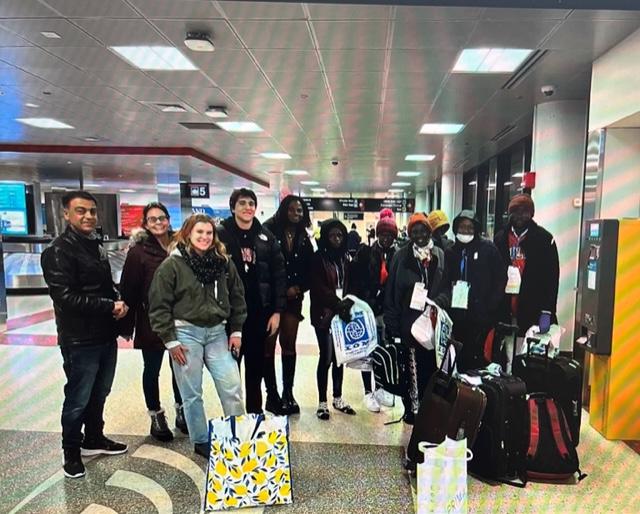
Thomas se sumó a la experiencia de los Koufoukika como estadounidense de primera generación. Su madre nació en Brasil y su padre en México.

"La perspectiva de inmigrante [que tengo] por mi familia realmente me impulsó a ayudar a estas personas. Creo que haber nacido en Estados Unidos y ser capaz de hablar inglés y moverme por ahí... es genial poder usar mis habilidades y mi familiaridad [para ayudar]".

Además de inglés, Thomas habla portugués, español y un poco de francés, lo que le resultó muy útil cuando conoció a los Koufoukika en el aeropuerto.

"La familia sólo hablaba francés, y yo cursé dos años de francés en el instituto, pero se me olvidó bastante". dice con una sonrisa. "Me esforcé por hablar con ellos. Parecían confusos cuando nos conocimos, como diciendo: '¿Quiénes son estas personas? Pero me presenté y entonces me entendieron un poco mejor"."

Thomas presentó a los Koufoukika a un conductor contratado por el IINE. Aunque el conductor no hablaba francés, levantó su teléfono para mostrarles una pantalla en la que aparecía el nombre de la familia. Thomas dice que "se les iluminaron los ojos" cuando lo vieron.

"Definitivamente me hizo darme cuenta de lo duro que puede serreflexiona. Cualquiera puede acercarse a ti, no siempre hay alguien que intenta ayudarte". Estuvieron en el aeropuerto de Dulles como ocho horas, siendo interrogados por funcionarios de inmigración estadounidenses, y finalmente llegaron a Boston y estaban muy cansados. Fue estupendo poder ayudarles, trasladándoles a un lugar cómodo donde dormir en Boston para que pudieran empezar su nueva vida... [me hace] darme cuenta de lo afortunado que soy".

Después de que el conductor llevara a los Koufoukika a un motel donde se alojarían mientras se preparaba su apartamento, Thomas volvió a Northeastern con los miembros de su equipo. Utilizaron la cocina del dormitorio para preparar a la familia un plato de pollo al estilo congoleño para el que había encontrado una receta en Internet, y luego se lo entregaron, su último deber como voluntario de reasentamiento.

Thomas dejó su experiencia inspirado y planea hacer más voluntariados en el futuro. Ofrece este consejo a otros estudiantes que puedan estar interesados:

Yo diría: "¡Adelante! Puede que al principio dé un poco de miedo, pero intenta ponerte en su lugar. Es muy duro, sobre todo para los refugiados, que buscan una vida mejor y un futuro mejor".

Universidad de Massachusetts Boston: Diccionario de datos, Manual de la vivienda, y ESOL de Igualdad

En la Universidad de Massachusetts (UMass) de Boston, sstudiantes de a clase llamada, "Tl Complejo panorama del reasentamiento de refugiados: Transnational Migración y Concurrent Realidades actuales," comprometido en algunos otros proyectos muy prácticos con impacto duradero.

Evaluar el progreso con un diccionario de datos

Tras conocer necesidad del personal del IINE, un grupo de estudiantes de la UMass desarrolló lo que ellos llamado a "Diccionario de datos", una herramienta de evaluación basada en encuestas para medir la eficacia de los programas del IINE a la hora de ayudar a los refugiados a integrarse en sus nuevas comunidades. Basándose en su investigación académica therramienta de diagnóstico incluía preguntas para los clientes sobre cómo ellos en la consecución de sus objetivos def adquirir competencias lingüísticas, acceder a prestaciones públicas, integrarse en sus nuevas comunidades, alcanzar autosuficiencia, y progresarhacia la ciudadanía. La herramienta final se tradujo a dos idiomas adicionales de idiomas antes de entregarla a los trabajadores sociales del IINE, que que ahora planean el programa con una familia de refugiados.

Manual de búsqueda de vivienda

Los voluntarios de reasentamiento de UMass Boston trabajaron en una de las primeras etapas del proceso y una de las más difíciles: encontrar una vivienda asequible que esté cerca de recursos clave como el transporte público, tiendas de comestibles y centros comunitarios, en un mercado de la vivienda notoriamente escaso. Tras informarse en IINE sobre el proceso y los escollos de la búsqueda de vivienda, el grupo de siete estudiantes se puso en contacto directo con los propietarios para proponerles a los clientes de IINE como inquilinos, comprobar la disponibilidad y el interés, y luego pasar las pistas al personal de IINE. Utilizaron la información obtenida de la experiencia para ayudar a documentar y racionalizar la búsqueda de vivienda, creando una hoja de cálculo que automatiza la información clave del listado y un folleto lleno de consejos útiles e instrucciones paso a paso.

Lea el post de IINE sobre la búsqueda de alojamiento para los refugiados.

"¡Estos recursos son increíbles!" dice Kate, que supervisó el proyecto. "Estos estudiantes tomaron la iniciativa, empujando a través del factor de intimidación de tener conversaciones informadas y sensibles, y nos entregaron herramientas que hacen nuestro trabajo más fácil, y por supuesto, mejoran en gran medida la vida de los refugiados que hacen un nuevo comienzo aquí."

Al final del proyecto, los alumnos reflexionaron sobre su aprendizaje y su éxito. Un alumno escribió,

"Este proyecto realmente me hizo perfeccionar mis habilidades de investigación y aprender a ser ingeniosa, y también me dio la oportunidad de reflexionar sobre mi posición en la que la vivienda no es un problema que tengo, sino uno con el que puedo ayudar a los demás."

ESOL para la igualdad

Los estudiantes de UMass Boston de una cohorte de Inglés para Hablantes de Otros Idiomas tuvieron la oportunidad de ponerse en la piel de un instructor para algunos estudiantes adultos ansiosos. Con el nombre de "ESOL para la igualdad", cada estudiante de la UMass fue emparejado con un cliente que se encontraba en la lista de espera de ESOL del IINE. Con la formación y la orientación del IINE, cada uno de ellos diseñó e implementó un curso de estudio individualizado para sus estudiantes y lo impartió durante un semestre.

"¡Estos diseños estaban realmente pensados y bien ejecutados!" dice Kate. "Nuestros instructores de 'ESOL for Equality"' se tomaron el tiempo necesario para conocer los objetivos y niveles lingüísticos de sus alumnos y luego les ayudaron a enseñar el vocabulario específico que necesitaban."

"Una instructora quería conocer a su alumna en una biblioteca local, así que entabló relación con la bibliotecaria y, como parte de una clase, ayudó a su alumna a sacarse el carné de la biblioteca. También la ayudó a abrir una cuenta bancaria. Otros instructores crearon vídeos para ayudar a los clientes a practicar las lecciones, trabajaron con ellos a través de Zoom y les enseñaron alfabetización digital, jugaron con ellos a juegos de palabras e incluso les llevaron de excursión a museos locales. Esto fue más allá de la enseñanza del inglés, facilitando algunas grandes oportunidades para las conexiones sociales y el intercambio cultural."

Gianna Speaks, una estudiante de Bioquímica de la UMass Boston que trabajó como profesora de "ESOL para la igualdad" y decidió continuar como profesora de ESOL del IINE cuando concluyó el proyecto, reflexionó, "Ser voluntaria de ESOL fue una experiencia reveladora. Realmente me permitió echar un vistazo a las vidas de los refugiados, y a las similitudes y diferencias entre culturas y formas de vida. También me dio una idea de las dificultades que conlleva tener que adaptarse a un nuevo idioma, además de todo lo demás. Fue muy gratificante ver cómo cada lección acercaba a mi cliente a sus objetivos (conseguir un trabajo/ir a la escuela)."

---

El IINE sigue desarrollando nuevas formas de asociación con instituciones de enseñanza superior. En abril, el IINE puso en marcha un programa piloto en el Centro de Desplazamiento Forzado de la Universidad de Boston. Los instructores del programa imparten talleres a los trabajadores sociales del IINE sobre políticas y prácticas de reasentamiento de refugiados, a escala mundial y nacional, con el fin de ampliar y contextualizar sus conocimientos en la materia. Los objetivos a largo plazo de la iniciativa son crear un modelo que pueda ser reproducido por otras universidades y agencias de reasentamiento y crear una credencial para los participantes que les ayude a avanzar en sus carreras.

Con estos primeros éxitos ya en los libros, el IINE se complace en forjar más asociaciones con colegios y universidades en el futuro, reuniendo a profesionales e investigadores, y conectando a la próxima oleada de jóvenes que han llegado a Boston para estudiar con los refugiados que han venido aquí en busca de seguridad y un nuevo comienzo, todos ellos preparándose para un futuro brillante.

Conozca a nuestro CHRO Miniatura

Conozca a nuestro Director de Recursos Humanos  

Our Chief Human Resources Officer Nina Nova-Duran reflects on IINE’s culture, how the organization has grown since she joined in 2021, and her advice for potential employees.   

Tell us about your path to the International Institute of New England.

I came to the role with over 20 years of experience in human resources and eight years of experience in operations management. I had previously been part of the executive team at Table Talk Pies, where I oversaw all three manufacturing facilities and corporate offices. In that role, I had a strong connection to the employees working on the ground floor, most of whom were immigrants. That aspect of my work was very rewarding – arranging ESOL classes, offering professional development opportunities, and strengthening career paths so these employees could stay and grow with us.  

When I learned about the role at IINE, I was excited for the opportunity to bring my experience—specifically around strategic planning, creating culture change, and growing rapidly—to an entirely new sector, and most of all, to a mission I was immediately drawn to.  

I also grew up in IINE’s backyard, basically! My parents and I immigrated to Roxbury, MA from the Dominican Republic when I was five years old. I always think about how if my parents had known about IINE—and had received the help, ESOL classes, employment support, etc. that IINE provides—their experience in the U.S. would have been so different. I’m glad to be part of an organization helping people like my parents to find a fresh start in their new country.  

How has the organization evolved since you first joined? 

When I first arrived at IINE, there were around 60 full-time and part-time staff and around 30 on-call. Two and a half years later, we have tripled in size. We have added new Programs staff to our Boston, Lowell, and Manchester offices; expanded the Unaccompanied Children’s Program by building a whole new team in New York; and ensured all of these new staff have the support they need by hiring additional roles across the Finance, Operations, HR, and Advancement departments. While growing the organization, we have also focused on diversifying our staff to reflect the client populations we serve. When I first started at IINE, the organization was welcoming hundreds of Afghan evacuees. We were able to identify several clients with strong professional backgrounds, who we were then able to hire as full-time staff. Currently, we are supporting thousands of Haitian immigrants, and have hired many to the team. They join us with a unique understanding of our mission, the immigrant process, and our client’s cultures and backgrounds. Today, 48% of our staff were born outside of the U.S. 

In addition to offering us a chance to diversify our staff, our growth has allowed us to strengthen our policies and infrastructure. I’m proud that we have been able to equip our staff with the tools and training needed to advance in their careers, so we can frequently promote from within.  

How would you describe IINE’s culture? 

Everyone is very genuine about their commitment to the mission. Our work isn’t easy, but our staff are so dedicated. They truly care about helping refugees and immigrants, and we make sure to celebrate and recognize that.  

We also know how to have fun! It’s so important that people have an opportunity to get out of their shells, express their unique personalities, and get to know each other. Our quarterly in-person events allow everyone to disconnect from work and enjoy themselves.  

Staff Photos

Those events are also an important tool for fostering a sense of community across our three sites and virtual staff. My team is always thinking about how we can build relationships and communication across the organization. Part of that is ensuring the HR team is always present and reachable. We make a point of attending staff meetings at each of our sites and regularly sharing updates on policies, events, resources, etc. It’s important that all staff feel engaged and informed.  

What do you look for in potential employees? 

I look for candidates who display what we call our Core Competencies: 

  • An ability to collaborate effectively and compassionately and consider the impact of one’s actions on others 
  • A commitment to excellence and to bringing one’s best to work every day 
  • A desire to continuously improve and the ability to embrace challenges as the fuel for learning 
  • An awareness of culture, bias, and privilege, and a desire to seek out insights and perspectives from under-represented voices 
  • An ability to communicate effectively and respectfully with everyone they encounter 
  • A genuine belief in IINE’s mission, which drives all of our work 

In addition to our core competencies, I look for candidates who are innovative, eager to bring ideas to the table, and who are excited at the prospect of growing with the organization.  

What advice would you give someone interested in joining IINE? 

This might seem obvious, but do your homework! Understand our mission and our clients, and then help me understand how your vision and passions align with our work. The cover letter, in particular, is a great opportunity to capture your experience and interests. Sometimes a resume doesn’t tell the full story, especially if you do not have direct experience for the role, so I always advise candidates to use the cover letter to sell themselves. 

Anything else you would like to share with our readers? 

I’d like to say how grateful I am to work beside such collaborative, insightful professionals – both on my team and across the organization. We are only as strong as the people we have around us, and I really value the feedback, insights, and perspectives of my colleagues. It makes IINE a special place to work!  

HR Team
From L to R: Talent Acquisition Specialist Courtney Good, Chief Human Resources Officer Nina Nova-Duran, HR Coordinator Jayne Cormier, Senior HRIS Generalist Lisa Stewart

Interested in joining our team? Our collaborative, team-oriented environment offers opportunities to serve refugees and immigrants, while learning from other staff and departments. View career opportunities here.

La historia de Nazia: El incansable compromiso de una refugiada afgana con la educación y la esperanza

Nazia Blog Banner

En hmás ardiente y most importante job

Nazia creció en Afganistán y desde muy joven sintió verdadera pasión por la enseñanza. Se convirtió en profesora de inglés cuando estaba en 10º curso y durante años siguió enseñando por poco o ningún dinero, deseosos de adquirir experiencia.  

"La enseñanza ha sido el trabajo de mis sueños. En nuestro país, la gente no tiene una buena perspectiva de la enseñanza: creen que es un trabajo sencillo, pero es el más duro e importante. Un médico tuvo una vez un profesor. Un presidente tuvo una vez un profesor".

Con el tiempo, Nazia alcanzó el éxito y el reconocimiento en su profesión. Mientras terminaba la carrera de Magisterio, enseñaba inglés a niños y a estudiantes universitarios y, tras graduarse, aceptó un puesto de profesora de adultos en línea. Con trabajo duro y sacrificio, se había construido una vida haciendo lo que le gustaba. 


Una nube oscura

Entonces llegaron los talibanes y se lo llevaron todo. Era 2021 y Kabul había caído en lo que pareció un instante.

"[Las mujeres] perdieron el derecho a recibir una educación y a tener un trabajo. No podíamos viajar solas, teníamos que tener un tutor. Sentíamos como si una gran nube oscura se hubiera cernido sobre nuestro país y no fuera a alejarse. Todo se volvía oscuro. Sentías como si un trueno fuera a golpearte; el trueno eran los talibanes".

Como mujer, ahora era ilegal que Nazia enseñara. De todos modos, tardó un año entero en encontrar una oportunidad para hacerlo.-una decisión que conllevaba un riesgo real.

"En nuestro barrio vivían talibanes, así que cuando daba clase, cerraba todas las ventanas y puertas. Tenía miedo de que oyeran mi voz hablando en inglés y causara peligro a mi familia".

Los talibanes hicieron todo lo posible por avivar las llamas de su miedo.

"En dos ocasiones distintas, recibí un mensaje de WhatsApp de un número desconocido con una foto de perfil de los talibanes, en el que me preguntaban: '¿Has vuelto a dar clases?' Borré el mensaje y bloqueé la cuenta. Fue aterrador, pero no dejé de hacerlo porque había muchas mujeres que necesitaban educación, necesitaban una luz en la oscuridad. Mi clase no era sólo para enseñar inglés, era para dar a las alumnas motivación para ser valientes, para no perder nunca la esperanza".

Nazia no se rindió. De hecho, quería hacer más. Decidió crear un grupo de apoyo social y educación para otras mujeres que vivían bajo el régimen talibán, al que llamó "Lifesaver Girls". Le costó muchos intentos encontrar un centro educativo lo suficientemente valiente como para acoger esta reunión ilegal, pero con perseverancia consiguió convocar una reunión. Sentía que tenía que hacerlo. 

"Después de que los talibanes tomaran el poder, la mayoría de las chicas se sintieron decepcionadas y deprimidas. Este grupo las motivó. Cuando vinieron por primera vez a la reunión, se podía sentir la desesperanza y [ver] una profunda tristeza en sus rostros. Hablamos de algunas mujeres de éxito que lo hicieron lo mejor que pudieron en las situaciones más difíciles, y les presentamos vías en línea para obtener una educación. Al final de la sesión, se podía ver el brillo de la esperanza en sus ojos".

A noche noche

Nazia vivía en Ghazni, una ciudad a unas dos horas de Kabul. En diciembre de 2023, recibió una llamada de la organización que estaba ayudando a evacuarla de Afganistán. Le dijeron que estuviera en Kabul a la mañana siguiente. A las mujeres no se les permitía viajar solas, así que partió con su padre. Esperaron 14 días antes de ser evacuados a Pakistán. Luego tuvieron que caminar una hora en plena noche para encontrarse con el conductor que los llevaría a Pakistán y luego a Qatar.

"Fue una noche muy dura. Fue muy estresante. En la frontera entre Afganistán y Pakistán, los talibanes comprobaron todo lo que llevábamos y nos preguntaron: '¿Adónde vais? ¿Vas a un país extranjero? Les dije: 'No, estoy enferma'. Mi padre me empujaba en silla de ruedas para que me creyeran".

Nazia dijo a los talibanes que otro pariente varón la esperaba en la frontera, por lo que su padre pudo dejarla. Entonces se quedó sola. Los talibanes la controlaron cuatro veces. Cuando llegó a Pakistán, permaneció tres noches antes de ser evacuada a un campo de Qatar. Fue un periodo difícil.

"Era como estar en una gran cárcel. No te permiten salir del campo. Me estresaba que no aceptaran mi caso y pensaba en cómo viviría en Afganistán. Me detendrían por salir sola del país".

Al cabo de 28 días, el caso de Nazia fue aprobado. Llegó a Boston en enero de 2024.

Aprender a andar

Nazia con la orientadora profesional del IINE Emma Pond

Una semana después de su llegada a Boston, Nazia se inscribió en los servicios del Instituto Internacional de Nueva Inglaterra (IINE). Los asistentes sociales la ayudaron rápidamente a obtener su tarjeta de la seguridad social, a obtener la tarjeta de la seguridad social, a recibir prestaciones alimentarias y sanitarias y a obtener el permiso de trabajo. Los equipos de Educación y Empleo del IINE la ayudaron a redactar un currículum, a empezar a buscar trabajo y a explorar oportunidades para cursar un máster. También la invitaron a un grupo de apoyo mensual para que otras mujeres afganas se conocieran, socializaran, compartieran consejos y exploraran juntas su nueva ciudad.

Grupo de mujeres afganas del IINE en Boston

Nazia dice que la gente que conoce en el IINE es "realmente amable y servicial. Estoy muy agradecida". Se está adaptando a la vida en Boston y aprendiendo a afrontar nuevos retos con la ayuda de IINE.

"Tiene algunas dificultades. Me estoy acostumbrando a un nuevo entorno -vivir sin mi familia, viajar sola-, pero es una experiencia interesante. Ahora soy como un bebé que intenta andar, se levanta y se cae, pero no pierde la esperanza. El bebé está seguro de que aprenderá a andar aunque le cueste. Aquí, en Estados Unidos, estoy aprendiendo a andar. El IINE me está ayudando a aprender".

Encontrar el light

Incluso antes de venir a Estados Unidos, Nazia soñaba con hacer un máster y luego un doctorado en la Universidad de Harvard. Ahora este sueño parece más cercano.

"Vine a Boston por casualidad, es una bonita coincidencia. Quiero hacer un máster y un doctorado en [Enseñanza de Inglés para Hablantes de Otros Idiomas] y, algún día, ser profesora. Todo el mundo dice que ser estudiante de Harvard sería duro; estoy de acuerdo en que es duro, pero no es imposible".

Nazia también es escritora. Ya ha tenido cierto éxito: un relato corto publicado en el sitio web de una universidad de Iowa. Está escribiendo más cuentos y espera escribir algún día una novela romántica. Una cosa es segura: nada la detendrá en su empeño por alcanzar sus sueños. No es fácil, pero sabe que ahora tiene apoyo y libertad.

"En nuestro país no podíamos salir después de las 5 de la tarde. Me siento segura. Aquí no hay talibanes ni nadie que me impida seguir mis sueños. Cuando lo paso mal y echo de menos mi país, paseo y veo sonrisas bonitas. Siento 'esto puede ser duro, pero estoy en un buen ambiente...'Creo que cuando algo es duro, te convierte en la verdadera versión de ti mismo. Puede que haya momentos en los que te sientas abatido, como si nada fuera a salir bien, pero aun así, en ese momento, podemos encontrar la luz".

Estamos orgullosos de haber acogido, reasentado y apoyado aed refugiados en la región de Nueva Inglaterra durante más de 100 años. Más información sobre nuestra labor de reasentamiento de refugiados.

Blog Pinpoint

La importancia del matiz y la empatía: destacar los servicios lingüísticos del IINE

When you need a translator in order to be understood, trust is everything.

There’s real vulnerability in relying on someone to accurately relay your meaning, tone, and intention in a language you don’t understand—and there’s security and comfort in being able to trust that your interpreter is both skilled and caring enough to get it right.

Through IINE’s Language Services, IINE staff frequently rely on interpreters of speech and translators of text with these qualities to help refugees and immigrants access services, secure housing, and apply for jobs.  

Because IINE understands how important this service is in helping newcomers to integrate, and in helping their new communities get the most from their resources and skills, we also provide low-cost language services to other nonprofits, schools, hospitals, and community partners. Services include on-site interpretation, remote (phone and video) interpretation on-demand, and document translation services for immigration documents, all in over 300 languages. 

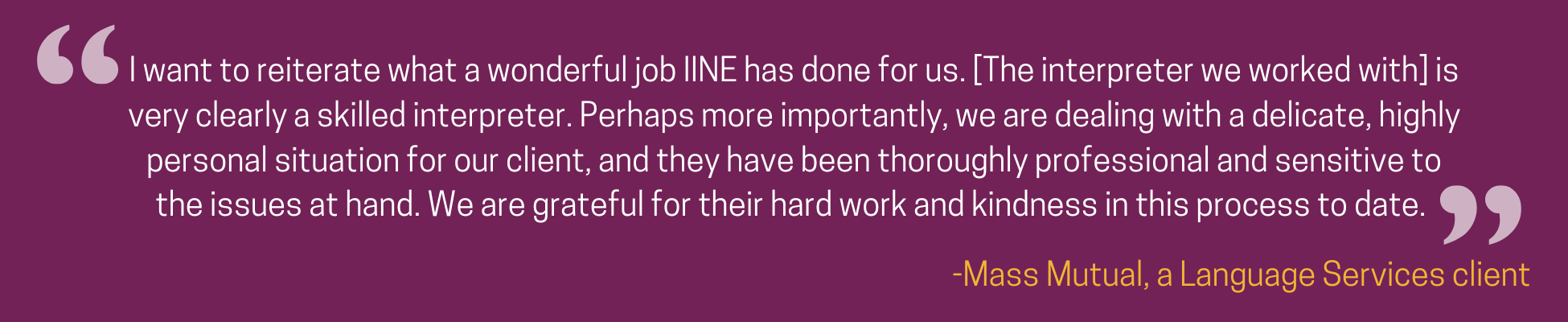
Interpreters quote

In 2023, IINE Language Services provided 3,000 hours of interpretation for more than 1,400 clients.

All revenue generated is reinvested in IINE’s programs and services for immigrants and refugees. For Tram Fultz, who manages the Language Services, this reinvestment is one of the most important reasons for clients to choose the service.

Tram Fultz

“I think that if you’re mission-minded; invested in diversity, equity, and inclusion; and interested in having your work reflect the changing demographics of our country, then you want to use organizations that represent that to the fullest amount possible.”  

Tram points out that the program supports IINE’s mission even further through its hiring practices: “We try to employ our refugee and immigrant clients to give them that leg up into the middle-to-upper reaches of our economic society.” 

One important part of working within IINE and hiring IINE clients is the deep empathy that translators bring to their work. Tram points to a recent experience working with pro bono lawyers to assist Afghan and Haitian families in applying for asylum as illustrative of this compassion.  

 “The feedback that we’ve gotten on our interpreters is that they’re very sensitive. That’s so important because just the very nature of the fact that you have to seek asylum means something really, really terrible happened.” 

It’s easy for Tram to empathize with our clients as well. Tram was born in Vietnam, and her father met her mother shortly after escaping from a reeducation camp. When Tram was very young, she and her family fled to the U.S. as refugees. She remembers very well what it was like to be a non-native speaker suddenly immersed in a foreign culture and expected to succeed. 

“I was six years old, and I didn’t know any English at all—maybe I could say ‘hello,’ but that was about it—and I went to the first grade [in Connecticut]. There were no interventions. There was nobody that even had the capacity to psychologically understand what learning a new language would be like. I remember looking around in the lunchroom for someone who looked like me and coming up with nothing. And I spoke no English. So, that whole first year of first grade, I didn’t say anything because I didn’t understand what was happening. But by the time I repeated the 1st grade the next year, I had enough mastery of the language to get the kind of grades expected of me by my family.” 

“On top of all that, my family didn’t speak English either, so I was basically the translator at, you know, seven years old.” 

These experiences especially have brought Tram to view translation services as far more than a practical matter. 

“Speaking in one’s mother tongue, with all of its intricacies, is really important. If we lived in a perfect world, it should actually be a right. We should have the right to be able to communicate in languages that we understand. That’s why in all the sci-fi, everybody has some implantable device so that they can automatically communicate, and other people can receive what they’re saying.” 

Tram believes that when clients choose IINE’s Language Services, whether they’re hospitals, municipalities, or individuals, they are making an important moral choice. They’re choosing honesty and accessibility.  

“It means that they’re trying to look at people holistically, rather than at a demographic level, and we’re proud to provide them with support.” 

Juan, one of our interpreters, fully shares in this sense of mission.

“I cherish every single encounter [with a client],” he says. “It’s the satisfaction of knowing that someone is able to be assisted.” 

Juan, an IINE Interpreter

Juan was born in Colombia. He moved to the U.S. when he was 22 years old with his mother, who does not speak English. Like Tram, his experience as a translator began with helping his family. He says he was drawn to the job “as a way of applying what I know to help bridge communication for folks like my mother, especially in a medical setting.” 

While he translates for a wide variety of clients, including legal, educational, and corporate, Juan is particularly passionate about interpreting in a medical setting because of his own professional background. Juan was once a medical technician in the New Hampshire National Guard and now primarily works as a physician’s assistant at a medical center in NH.  

Part of what he finds gratifying about interpreting in a medical setting is that he understands the stakes, having had past experiences in which he felt that highly important information was not being translated accurately when people were in great need of help. He says, “It is a good feeling when [it’s] not just interpreting, but also making sure [people] understand.”  Juan’s empathy and dedication have led his clients to request him again and again. 

Juan emphasizes that he translates not necessarily because he needs this work—he mostly translates on his days off from his primary job—but because he finds it so fulfilling. “I truly enjoy that people feel informed,” he says.

IINE connects communities and cultures through language. Learn more about our interpretation and translation services. 

10 mitos comunes sobre inmigrantes y refugiados

By Alexandra Weber, Senior Vice President and Chief Advancement Officer at the International Institute of New England

Public conversations around immigration policy are becoming more heated, politicized, and, dangerously, filled with inaccuracies. Educating ourselves on immigration policy, the immigration process, the level of support refugees and immigrants receive, and how they pay that support back in dividends—and then sharing this information with others—can help create a more honest narrative and a warmer welcome for newcomers. Here’s a breakdown of some common myths about immigrants and refugees, corrected with nonpartisan facts and figures: 

1. Myth: It’s easy to enter and remain in the U.S. 

Reality: The legal immigration process is arduous, complicated, and backloggedand many of the rules change in response to current events and political considerations. 

  • For refugees, the process to come to the U.S. is offered to very few, entails multiple steps, including an extensive vetting process, and often takes years to achieve. Learn more about the process in our interactive Refugee Vetting Journey.
  • For many other immigrants eligible for U.S. entry, the complexity and cost of the application process is intense. Many allowed to enter are given only a temporary opportunity to stay and those hoping for longer-term protection must fight uphill battles to adjust their initial status to a more permanent status that allows them to remain in the country.
     
  • Once an individual files the application for citizenship, which cannot happen until at least five years after receiving a green card, they often have to wait years more. In 2012, the average processing time from citizenship application to approval was 4.6 months. Today, the wait has tripled in length to 15.5 months. 

2. Myth: Immigrants are more likely to be criminals.  

Reality: The opposite is true. 

  • Statistically, immigrants residing in the U.S. are less likely to be criminals. A recent study analyzing 150 years of U.S. Census data shows that immigrants have never been incarcerated at a higher rate than U.S.-born individuals. The gap has widened since 1960, and immigrants today are 60% less likely to be incarcerated than U.S.-born citizens.
     
  • Furthermore, crime rates actually decreased as immigration grew in 200 U.S. cities from 1970 to 2016.
     
  • While Fentanyl trafficking in the U.S. has been persistently blamed on immigrants, this claim is false. As recently reported by the New Hampshire Bulletin, “In 2022, U.S. Sentencing Commission data showed that Americans accounted for nearly 90 percent of convicted fentanyl drug traffickers, and 96 percent of fentanyl seizures occurred at official ports of entry, not along migration routes between checkpoints, according to U.S. Customs and Border Protection reports analyzed by the Washington Post.” 
Immigration and crime stat

3. Myth: Refugees and immigrants receive an unfair level of support from the government and are a drain on the U.S. economy. 

Reality: The support new arrivals receive is extremely limited. Additionally, most refugees and immigrants enter the U.S. workforce immediately upon becoming eligible and then go on to contribute tremendously to our economy, giving back far more than they ever received 

  • Refugees and persecuted populations receive only basic support on arrival through public programs such as food stamps. Most begin their lives in the U.S. with extremely limited resources. Public support received by these families is temporary and requires participation in the U.S. workforce. Initial support is also repaid many times over as families contribute to the economy and tax base immediately and, if allowed to stay, across a lifetime.
     
  • Newcomers strengthen our workforce, filling roles in healthcare, STEM, construction, environmental services, and more, and 22% of entrepreneurs nationwide were born outside of the U.S. According to a 2021 report from the American Immigration Council, immigrants in the U.S. have a collective spending power of $1.4 trillion and paid $525 billion in taxes each year.
     
  • In many New England states, immigrants are the key and often only strategy to combatting a shrinking workforce and community. Our local and national economies depend on immigrants. In fact, according to a recent report from the Migration Policy Institute, “Immigrants and their U.S.-born children accounted for all U.S. civilian labor force growth in the past two decades.  

4. Myth: Immigrants take jobs from other Americans.

Reality: This is a falsehood often used to pit vulnerable groups against one another and divert focus from policies that exploit and undervalue workers. It is untrue on many levels. 

  • “The Lump of Labor Fallacy” is a term economists use for the misconception that there is only a fixed number of jobs to be had in the U.S., implying that newcomers would need to take or limit opportunities from U.S.-born individuals. As a recent study from the Economic Policy Institute shows: “the idea that immigrants are making things worse for U.S.-born workers is wrong. The reality is that the labor market is absorbing immigrants at a rapid pace, while simultaneously maintaining record-low unemployment for U.S.-born workers.”
  • Far from stealing jobs, immigrants often take on taxing jobs that other Americans are not willing to do. As the Brookings Institution has stated: “The impact of immigrant labor on the wages of native-born workers is low… However, [immigrant] workers often work the unpleasant, back-breaking jobs that native-born workers are not willing to do.”
  • We currently have more job openings than qualified applicants to fill them, both nationwide and in New England, including dangerous labor shortages in healthcare fields. 
     
  • The future of our labor force depends on immigration. As the U.S. birthrate steadily declines, immigrants are vital to growing the labor force. According to a recent report from the Migration Policy Institute, “With U.S. birth rates falling, the immigrant-origin population has been a vital source of growth for the U.S. population in the past two decades. Without immigrants and their U.S.-born children, the prime working-age population (ages 25–54) would have shrunk by more than 8 million people and the population of children and young adults under age 24 would have shrunk by more than 5 million people between 2000 and 2023.”  
  • Immigrants who receive the necessary support are also actually more likely to start new businesses, acting as job creators. 

5. Myth: Today’s immigrants don’t want to learn English.    

Reality: Most immigrants are extremely eager to learn English in order to navigate their communities, advocate for themselves and their families, and enter and succeed in the workforce as quickly as possible. Here in New England, every language instruction provider, including IINE, has long waiting lists for our free ESOL classes. Due to budget cuts, providers currently fill less than 10% of demand for these classes. 

6. Myth: U.S. asylum policies are causing a crisis. If the U.S. ended or restricted peoples’ rights to enter the U.S. seeking a safe haven from persecution and violence, we wouldn’t have unmanageable immigration surges. 

Reality: People seeking freedom from persecution and violence will do whatever they can to reach safety. Attempts to restrict their ability to apply for legal protection, such as Title 42 and “Remain in Mexico, have not stopped or slowed attempts; in fact, attempts have grown exponentially during the implementation of these policies, which have done nothing to address the root causes of displacement. Restrictions merely backlog the legal process by millions of cases and remove protections for an extremely vulnerable population, exposing them to further persecution and violence.  

7. Myth: Supposed asylum-seekers are really just coming here for jobs.

Reality: When people attempt to claim asylum, they have to prove that they face persecution or have a credible fear of persecution in their home countries that prevents them from returning.  

  • Most are fleeing repressive regimes and destabilization that threaten their lives. They make impossibly dangerous journeys to come to the U.S., jeopardizing the safety of their families and themselves—a risk they would never take if there was a better choice. Often arriving with few financial resources and immense language and cultural barriers, they begin their lives in the U.S. facing tremendous challenges.
     
  • This myth persists in large part because our current immigration legal system is so under-resourced that pending asylum cases stretch into the millions, and once started, can take as long as five years to complete.
  • Asylum is far from guaranteed and the uncertainty surrounding the process can be frightening and destabilizing. This is not a situation one would seek for any reason other than dire necessity. 

8. Myth: Immigrants are being imported by the Democratic Party to sway election results.

Reality: This harmful conspiracy theory has no basis in fact or logic.  

  • It takes many years for immigrants to gain eligibility to vote, and any claims that immigrants have voted who were not eligible to do so have been proven false by voting records.
  • Immigrants are not a homogeneous group, and the idea that future immigration will necessarily favor the Democratic Party falsely assumes that most immigrants vote the same way, or even that most immigrants from the same regions vote the same way, and that their political loyalties are unchangeable. Various claims that immigration has significantly favored the Democratic Party in elections have also been disproven.
  • In many cases, this conspiracy theory is predicated on a false assumption that immigrants simply vote based on immigration policy. Like most American voters, immigrants vote based on a range of issues that affect their quality of life and align with their diverse values.  
Any claims that immigrants have voted who were not eligible to do so have been proven false

9. Myth: Refugees and immigrants bring culture, ideology, or ideas that are harmful to the U.S

Reality: Immigrants most often come to the U.S. because of their affinity for its economic and governing principles, not in spite of them.  

10. Myth: The U.S. prioritizes services for refugees and immigrants more than for its own military veterans. 

Reality: It is counterproductive and illogical to artificially pit these priorities against one another, but if a comparison is called for, the investment is not even close.  

  • The U.S. allocated $303.8 billion to the Veterans Administration in 2023, compared to $1.7 billion to the Office of Refugee Resettlement and $913.6 million for the entire U.S. Citizenship and Immigration Services department.  

Another variant of this myth is that U.S. values dictate that it should not do anything to help refugees and asylum seekers until it has helped all underserved U.S. Veterans. 

  • This ignores the important facts that many veterans are themselves former immigrants and that immigrants have always been important contributors to U.S. military efforts.
  •  It is also counter to one of the key values our military fights to defend—that the U.S. is a defender of freedom and democracy and safe haven from repression and anti-democratic forces.  

- - -

Welcoming refugees and immigrants strengthens U.S. communities, our cultural diversity, our economy, our integrity as a defender of freedom, our global standing, and our unique identity as a pluralistic nation. Dispelling myths is an important way to make their pathways easier.  

Thank you for your interest in supporting refugees and immigrants in our community. Learn more about these issues by subscribing to our newsletter and following us on social media 

El Instituto Internacional de Nueva Inglaterra recibe una donación filantrópica histórica de Bancel Philanthropies

Bancel Philanthropies’ pledge of $6,000,000 marks the largest single philanthropic gift in IINE history 

BOSTON April 25, 2024 – The International Institute of New England (IINE) has announced it has received the largest single philanthropic gift in organizational history from Bancel Philanthropies. The gift of $6,000,000 — $1,000,000 per year over six years — will be used to assist IINE in providing life-changing support services to refugees and immigrants rebuilding their lives in the New England region.  

This historic gift comes at a time when the Commonwealth of Massachusetts has been working diligently to integrate a growing number of immigrant families. For decades, IINE has implemented and honed a proven community-driven integration model, bringing both the operational and economic advantages of immigrant integration to the Commonwealth. With this additional funding from Bancel Philanthropies, IINE’s services, such as legal assistance, housing support, and case management services, will allow the organization to further advocate for permanent housing solutions, expedited work authorizations, and expanded support systems and services to help families achieve stability. 

“This gift is an incredible show of confidence in the work we do every day to meet the needs of the refugees and immigrants in our care and in the enduring importance of our mission,” said Jeff Thielman, president and CEO of the International Institute of New England. “Bancel Philanthropies shares our belief in advocating for the human rights, protection, and support of refugees and immigrants. With these funds, IINE will be able to further expand its support services and programs to help the growing number of new arrivals who urgently need support from our whole community to build a life here.”

Bancel Philanthropies is the family philanthropy of Brenda and Stéphane Bancel and invests in people and programs with the potential to transform lives, advance justice, and heal communities. Stéphane Bancel, an immigrant from France and the CEO of Moderna Therapeutics, was honored as IINE’s Golden Door Award recipient in 2022, a prestigious award given annually to a leader born outside the United States who has made outstanding contributions to American society. 

“Stéphane and I are inspired by organizations like the International Institute of New England that are helping those in need and enriching our society as a result,” Brenda Bancel said. “We’re honored to offer our support, which will allow IINE to continue making a real difference for refugees and immigrants in New England. Having witnessed firsthand IINE’s ability to unite the community in service of their clients, we have complete confidence that our contribution will allow them to advocate for our new community members’ rights, safety, and success even more effectively. “

As one of the longest-established and most trusted social service organizations in the region, IINE serves thousands of individuals and families annually. This gift from Bancel Philanthropies will allow IINE to increase its services and offerings to serve more than 20,000 immigrants in 2024, which is critical in responding to the large influx of Haitian and Central and South American families arriving homeless in Massachusetts. 

SOBRE EL INSTITUTO INTERNACIONAL DE NUEVA INGLATERRA

The International Institute of New England (IINE) creates opportunities for refugees and immigrants to succeed through resettlement, education, career advancement, and pathways to citizenship. With locations in Boston and Lowell, Massachusetts, and Manchester, New Hampshire, IINE serves more than 10,000 individuals annually, including people displaced by political instability, violence, and climate crises, child and adult survivors of human trafficking, and unaccompanied children joining family members in New England. IINE offers a comprehensive range of programs and services to help these newcomers feel welcome, achieve stability and security, access resources in their new communities, advance their education and employment goals, and integrate into their communities. IINE’s expertise builds on more than a century of service, and with continued partnership from community groups and support from philanthropists throughout New England, IINE will continue this service for the next 100 years and beyond. 

ABOUT BANCEL PHILANTHROPIES 

Bancel Philanthropies is the family philanthropy of Brenda and Stéphane Bancel, and invests in people and programs with the potential to transform lives, advance justice and heal communities. Our goal is to fully exert our belief in the goodness of humanity through building relationships with community leaders. We fund projects that speak to the fundamental emotion that nurtures us through hardship and sustains the human heart: love. Our funding priorities are creating equitable access to education, increasing food security, reducing health inequities, bolstering interfaith initiatives, reducing racial inequities, supporting trauma survivors and vulnerable communities, improving youth mental health and social isolation, and stewarding sustainable conservation and food systems. To learn more, visit bancelphilanthropies.org. 

Conozca a nuestra Junta Directiva Miniatura

Entrevista con Libby May, miembro de la Junta Directiva

A member of the International Institute of New England’s Board of Directors since 2021, Libby May is a communications executive specializing in K-12 education and higher education issues. She currently serves as the Chief External Affairs and Communications Officer for Southern New Hampshire University, where her work includes internal and external communications, media relations, events, alumni engagement, community relations, and government affairs. Libby supports IINE’s continued growth through her deep commitment to strengthening the Greater Manchester community and ensuring more equitable opportunities for all.  

We spoke with Libby to learn more about her passion for welcoming refugees and immigrants, how she strives to be an effective board member, and what excites her most about IINE’s future.  

Can you share a bit about yourself? 

I grew up in Washington, DC and spent most of my career there, working with nonprofit and advocacy organizations in the field of communications. So, I’m not a New England native, but I was drawn here for my current role—as the Chief External Affairs and Communications Officer for Southern New Hampshire University—which I have held for the past nine years.  

I’m really proud and feel very lucky to work with nonprofits. My first job out of college was at a PR firm, and I didn’t love it. I remember someone telling me around that time, “Think about what gets you out of bed in the morning and follow that instinct.” It was the best professional advice I have ever received. For me, the answer was clear: working with nonprofits to tell their stories and bring more good into the world. There’s nothing better than working beside passionate individuals to further a mission.  

Another big part of my background is that I am a mom to two young kids. Raising them has fueled my work – in education and the nonprofit space, as a whole. I want to help build diverse, welcoming communities for them to grow up in.  

Tell us about your journey to the International Institute of New England.  

In 2017, Southern New Hampshire University opened the Center for New Americans to serve the needs of immigrants in Greater Manchester. We wanted to acknowledge that there were many other groups in the area supporting this population, while identifying opportunities for us to fill in any gaps. We began to partner with other organizations to provide language, education, and wellness support – this was my first introduction to the International Institute of New England.  

From the start, I was so impressed by the organization’s commitment to providing wraparound programming. When an opportunity came around to join the Board, I was excited to become even more connected to the community.  

What do you consider the most important contributions of a board member? 

I think one of the most important things a board member can do is lean in. Read the materials, understand the team’s work, ask great questions, be there and be involved.  

I think particularly with nonprofits, which don’t tend to have large staffs or budgets, board members can really make a difference. In a way, I use my expertise  to be an unpaid consultant. So whether that means helping brainstorm A/B tests we can run on email campaigns or weighing in on social media vendors, I try to draw on my professional expertise and act as a voice of support.  

As a board member, I always try to listen to the team and voice that their work matters – it’s powerful for people.  

Looking forward, what excites you most about IINE’s future? 

I’m so proud of how IINE is always willing to pivot to meet the needs of the populations they serve. I loved watching IINE create programming for Afghan women—how they recognized the women’s unique needs by asking the right questions and brought together people and resources so organically. The staff at IINE are genuinely curious. They ask, “What can and should we be doing differently?” Seeing this adaptability makes me hopeful about the organization’s future.   

Of course, I’m especially excited about the work in New Hampshire specifically. As I shared, I’m not from New Hampshire, but I have come to really respect the grit of the people here. The NH nonprofit community, in particular, is made up of incredible, hard-working people who are doing collaborative, boots-on-the-ground work to support new arrivals. I walk into a building every day where I’m reminded that this state was built on the backs of immigrants. For folks in New Hampshire, no matter how many generations removed they may be from when their families first came here, they remember those journeys, and they recognize the determination and strength it takes to come here, put down roots, and build a life. I think New Hampshire folks see themselves in immigrants – we all share the desire to work hard to support ourselves and our families.  

What inspires your philanthropy? 

My parents always instilled in me that as members of a community, it’s our duty to give back. You don’t walk through a door without holding it open for the person behind you. You never know when you will need someone else to hold the door for you.  

It’s these values that have fueled my work with nonprofits and my philanthropy overall. It’s what I aim to instill in my young kids as well. They’ll tell you, Mom always says you can be anything in the world, just have a kind heart. We all have a responsibility to give back to the world that we live in.  

El Consejo de Administración del IINE está formado por líderes empresariales y comunitarios de toda Nueva Inglaterra. Vea a nuestros miembros y equipo directivo aquí.