Driven to Serve
“Of all the things I’ve done with the Afghan community over the last few years, the driver’s education has been the most empowering, for them, and for me,” says IINE volunteer, Ken G.
Ken’s done quite a bit. He started volunteering with IINE in 2021 when the Taliban retook control of Afghanistan and hundreds of Afghan evacuees began resettling in Manchester, New Hampshire. Ken learned about the situation through his church and felt compelled to respond. He helped to form a community group called the New Hampshire Afghan Support Network and won a grant to fund its programming.
Working with IINE, he led fellow community volunteers in helping Afghans to integrate into their new community. Efforts included a men’s social group that offers both recreation and service opportunities, like helping to set-up apartments for fellow refugees, and Sewing Seeds for Hope, an initiative to bring Afghan women together in sewing circles and help them sell their work both in-person and online.
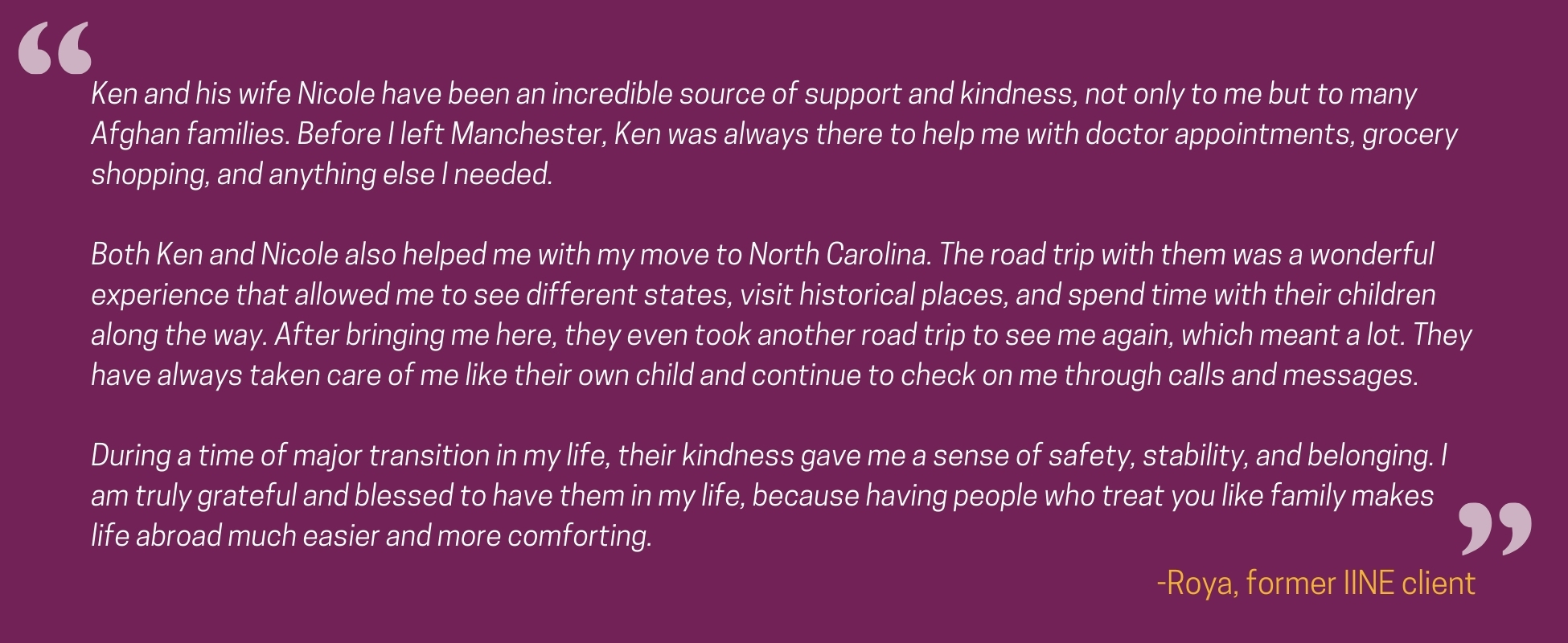
“Ken’s done so much,” says Mike Mailloux, the Volunteer Coordinator at IINE’s Manchester office. “He’s been a personal English tutor for four of our clients. He regularly drives women in our Sewing Seeds for Hope group to markets and craft fairs. He actually drove Roya, one of our clients, all the way to North Carolina, where she was starting college, and so much more. Whatever he does, he gives 150%.”
Logging Miles
Transportation has long been one of the most daunting challenges facing new arrivals to the Manchester area. Housing tends to be far away from amenities, like grocery stores and shops, and from employers. Meanwhile, public transport services are limited, which means IINE’s clients often have to rely on carpooling with volunteers and fellow refugees. Recently, IINE launched a driver’s education class to help as many clients as possible get licenses. Mike tapped Ken to help students prepare for their road tests.
“Over the past few months, my humble 2019 Toyota Yaris and I have spent almost thirty hours with twenty-eight Afghans,” says Ken, “so far, evenly divided between fourteen men and fourteen women. The car has a few small bruises to prove it! I am in fine shape.”
The Word on the Street
Ken has enjoyed working with each of them and says that they faced different challenges.
“Most of the men have needed mainly a few hours of practice and a tour or two around the Manchester DMV test route, and then they are golden. After all, they did virtually all the driving back in Afghanistan. I did have an amusing moment with two of the men who had studied and driven in Japan, where they drive on the left side of the road. Those two needed a little more than the usual adjustment for U.S. roads.”
Because of the repression they faced under the Taliban, most of the women Ken drives with have had less experience, but some have spent some time in the driver’s seat.
“The wives often have begun learning at the wheel with their husbands, but the word on the street is that ‘now you need to practice with Ken.’ As many of us know, teaching your own family member can be more than a little tense. These ladies have come along well, though, with many proudly succeeding.”
Ken has helped foster a tight-knit community and says his students help to motivate each other.
“There seems to be a little bit of competition going on between those who pass the first time and those who need multiple times to succeed. To be fair, the advantage of having time with me at this point is that I am patient and know the test route very well. I can even tell individuals to be careful not to make a certain mistake, because ‘this is how a certain friend of yours failed the test!’”
Some of Ken’s students have taken the wheel for the first time with Ken by their side.
“The most challenging group is the young women who have never driven. They need a lot of time, beginning with driving circles around a parking lot at about five miles per hour. Then we go out on the street, then out in the country, then on the highway. Some are a little afraid at first of high-speed driving, as a highway in Afghanistan is probably like Union Street in Manchester. After a while, they learn that driving on a U.S. interstate is probably the easiest kind of driving. As with any group of students, some need a lot of practice, while others get the hang of it really quickly.”
Going the Distance

Ken says, “The bottom line is that twenty-five of twenty-eight now have their licenses. The freedom and empowerment that this gives is huge, and I am always humbled by the gratitude they express. This has sometimes resulted in my wife and me being given gifts of food and even being invited into homes for some first-class Afghan meals.”
Ken likes to give his students gifts as well.
“Karen, one of my stellar volunteer friends, came up with the idea of ordering some key chains with Afghan flags on them. I always have one in my pocket on the day of a road test. When the person passes, and after the DMV gives them their temporary license, I hand them their keychain ‘on behalf of the volunteer group.’ It means a lot to them and warms my heart knowing that they have a better chance at starting a new life in our strange culture where driving is a necessity.”
• • •
Refugees and immigrants make long, difficult journeys to escape violence and rebuild their lives in the U.S. You can give them the help they need.
Related Articles

Maryam and Mauret: A Volunteer Helps a Young Afghan Refugee Pursue Her Dreams in New Hampshire

Restrictive and Unjust: IINE Statement on Presidential Determination on 2027 Refugee Admissions

Spotlight Report Excerpt: On Connecting Immigrant Talent to Healthcare Careers