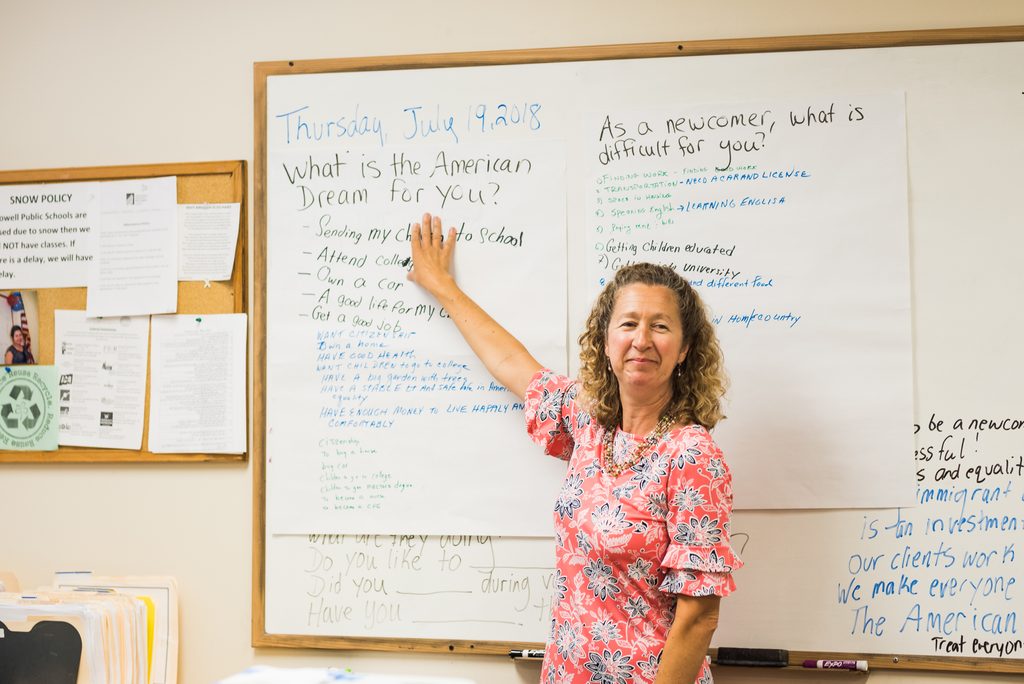
Sherry Spaulding just celebrated her thirtieth work anniversary with the International Institute of New England. She has had many roles over the years and currently manages English for Speakers of Other Languages programming for our Lowell office. In a recent interview, Sherry reflected on some of her favorite IINE memories and what keeps her excited about the work.
What drew you to IINE?
Basically, I had gone to college in order to become a French teacher and then taught for two years at a public school in New Hampshire. And guess what? I really didn’t like teaching high school French. It was a subject that the students didn’t care about.
I moved to Boston with my then-boyfriend, who was going for his master’s degree, and I did some odd jobs as a French translator for an engineering company, but I was still looking to do some kind of teaching.
I was looking for jobs at the Boston Language Institute, and they were the ones who said, Well, why don’t you teach English? I’m like, oh, no, I’m not an English teacher. They’re like, no, you’d teach the English language. And I said, to who? Like, I had no clue. I was like, who in America would need to learn the English language? And that’s when they directed me to the International Institute, then on Commonwealth Avenue in Boston.
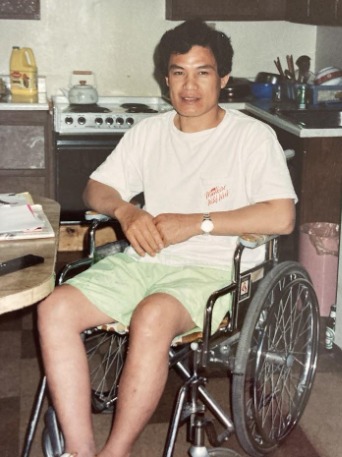
I went there for a training and became a volunteer for three years, working with a Vietnamese man in Dorchester. So here I am, a young 20-something, going to Dorchester twice a week to work with a 40-ish-year-old Vietnamese man in his apartment, who was wheelchair-bound after being in a prison camp for 12 years.
How was that volunteer experience?
Wonderful! I was able to help him improve his English, and I got him a part-time job at a school. He liked children, and his children were back in Vietnam, so a school was a good fit. I helped him become a citizen.
It was that experience that really spurred me to get my master’s degree in applied linguistics at UMass Boston—which was how you got to ESOL at the time—and that’s what led me to this job.
Legendarily, you were hired by IINE Staff Accountant Leona Breslow, who is now in her 33rd year here and was then Coordinator of Adult Education.
I was. I was in my last year of my master’s degree. I was doing it part-time while working two part-time jobs. When I was interviewing with Leona, she was like, I don’t know, Sherry, how are you going to handle school, these other jobs—and you’re planning your wedding?
And I was like, I don’t know! Maybe this is too much for me. Maybe I can’t handle this! And she goes, Oh, well, I was just going to offer you the job if you think you can handle it.
I’m like, I’ll take it!
I stepped into an ESOL Coordinator-type role in the evening while still teaching ESOL to new arrivals in the morning, which I absolutely loved.
You’ve had many titles over the years.
Yes, ESOL Instructor, Adult Basic Education Instructor, ESOL Coordinator, Employment Specialist, even briefly the Site Director (which was not my forte). That’s really what’s kept me here—the fact that no two years are the same. Every year brings new challenges, populations, or programs.
Like right now, I’m doing Pre-CNA—a new part of our skills training program that we developed to help prepare people to become Certified Nursing Assistants—and it’s like, how do we create this program? How do we create the curriculum? How do we do the marketing? Who’s the best fit? I seem to thrive on that.
You’ve always gravitated toward education.
My strength is in teaching—and I love it. Especially really low-level newcomers. I think about when I tested a Bosnian family who had just arrived, and I was like, Hello, what is your name? Where are you from? And nothing, no response. I was like, how am I going to teach somebody who knows no English? There’s so much change you can see in such a short period of time, especially with that group who are just brand new.
You love a challenge.
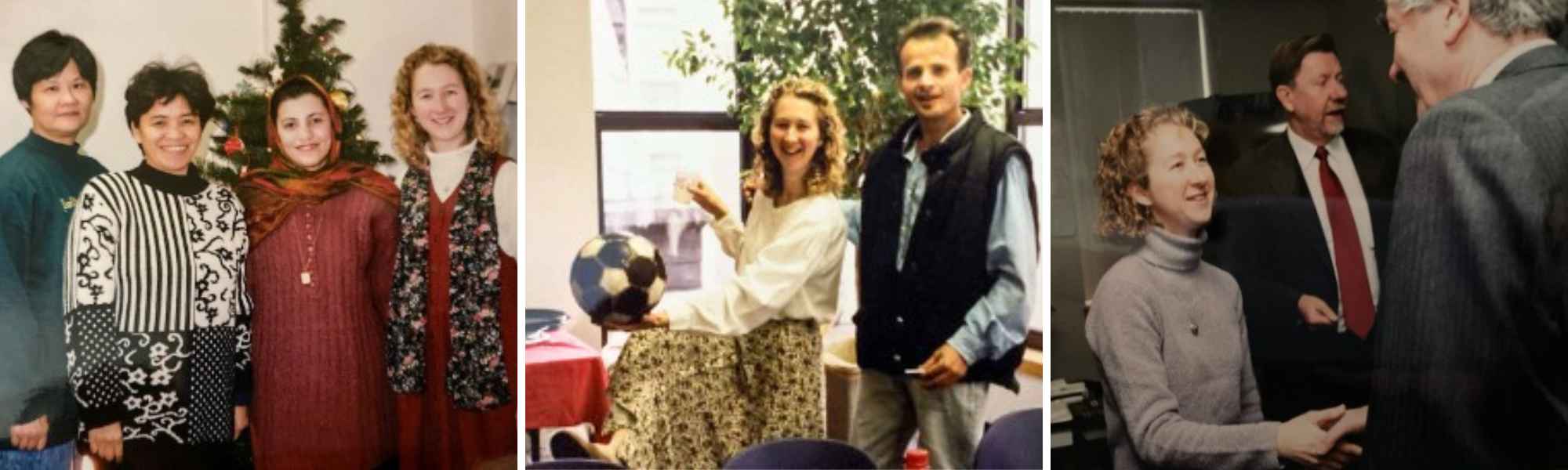
I love a challenge. I also love the change that comes with each new wave of people we’re serving. In 1997 it was the Bosnians, and then, you know, Somali Bantus came in, and many were pre-literate, so that was a whole new change in programming. The Kosovars came very quickly, Iraqis, Afghans, and then up in Lowell we had the Burmese—there was not a single Burmese person living in Lowell at the time, I don’t think. Then the Nepalese, the Bhutanese.
These were new populations we were bringing into Lowell. Lowell is just such a welcoming city for that—so many community partners that work together. For each group, we had to change the way we do community orientation and cultural orientation, because you really had to tailor it to that group and their needs.
I ran into one of those first Burmese families the other day. They were out leaf peeping. Their daughter got married, they’ve got their grandkids, you know, everybody’s so stable. They’re all doing so well, they’re thriving.

You’ve seen a lot of change over the years, good and bad. What have some of the constants been?
There’s always been a lot of community support. There’s a lot of compassion out there. I get to see that side of it. And I’ve seen a lot of staff members come and go, but every staff member has been engaged in the mission and working their hardest for it.
What does a typical workday look like for you now?
There still is no typical! We’ve got eight ESOL classes running. I manage who’s in which class based on their contracts. I manage communications with students who are having challenges. I’m running to meetings and check-ins and putting calendars, schedules, testing sessions, and flyers together. We’re putting Pre-CNA together, so that’s also creating intake forms and evaluation surveys, and setting goals with students. But also, today, I had a teacher who broke her foot, so I subbed for her class this morning and then for another teacher in the afternoon.
Do you have any favorite client success stories from over the years?
Too many to name, really. But certainly Wassam. That one actually got some media attention. He had a pretty low English level when he had just arrived from Iraq, and he had a family, so he was a busy man, but you know what? It was just the right place, right time.
Dr. Mason, who was volunteering teaching Driver’s Ed, told me his student hadn’t shown up one day. So I was like, Dr. Mason, this is Wassam. He was a surgeon back in Iraq. He’s trying to pass whatever tests he needs to become a doctor here.
Dr. Mason really helped him become a doctor. It took many years. It was very exciting when it happened and he thanked us.
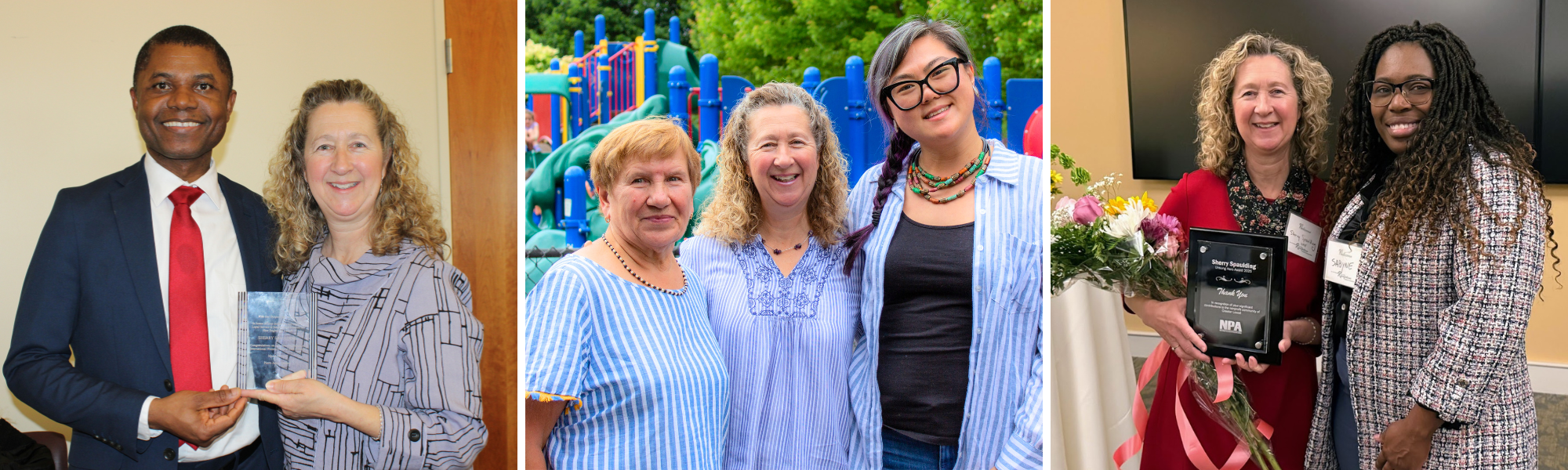
Samuel Jordan was my first job placement when I was an Employment Specialist, a guy from Liberia with pretty good English. I got him a job in facilities maintenance at UMASS Lowell around 2004. In 2020, Sam contacted me. He said, Sherry, I’ve got to tell you: I just retired. I loved my job. You got me that job, and I was so satisfied with it, and now I am a retired person!
Wow, that must have been so satisfying.
I love when people come back to thank us, or when you see them out on the street and know that, even if they stayed in an entry-level job, they appreciated it, and now their kids are thriving. One of our former youth clients just became a lawyer. That’s really exciting. You think, that’s what they came here for; they came out of these situations really to take care of their kids.
When I go to the Lowell Folk Festival, and they’ve got the Burmese food station for example, I like to reconnect with former clients there. Their kids are married, gone to college, they’ve bought houses. I mean, they’re just thriving. It feels great!
Interested in joining our team? Our collaborative, team-oriented environment offers opportunities to serve refugees and immigrants, while learning from other staff and departments. View career opportunities here.
Related Articles

“We are a nation of immigrants”: IINE Donors Share Why They Give

From the Desk of the CEO: Voting For a More Humane, Inclusive, and Welcoming Nation

“I Rode for Human Rights and Dignity for Everyone”: Cyclists Raise Awareness and Funds at 7th Annual Ride for Refugees and Immigrants