Why our appreciation for the ability to endure and adapt should inspire holistic support—including for wellbeing
By Alexandra Weber, MSW, LICSW, Senior Vice President & Chief Advancement Officer
The Resilience “Superpower”
Around ten years ago, when I was working as a counselor on IINE’s Program team, I treated a Haitian woman who was living in domestic servitude at the mercy of someone who gave her a place to sleep in exchange for endless unpaid cleaning, cooking, and housekeeping. She was waiting for adjudication of her asylum case and had no money and nowhere else to go. This women is the mother of three children whom she had to leave behind in Haiti, along with their grandmother, after she was attacked by a gang because of her political beliefs and advocacy work. She was penniless, overtired, overstressed, grieving, and terrified for her children, and yet every day she put one foot in front of the other, always pushing forward no matter what she had to push through. Over time, she won her asylum case, began to heal from her trauma, found a job, became relicensed as a nurse, and brought her kids to live with her in the U.S.
When you work with refugees, you tend to draw inspiration from their resilience. We describe this skill as being like a “superpower.” In fact, “Superman” himself is an expression of this feeling, created in 1938 by the children of refugees who escaped persecution in Eastern Europe.

The stories we hear at IINE may not be supernatural, but they are no less astonishing. We meet refugees when they first arrive in the U.S. with little more than a small suitcase, and so many challenges ahead of them. We learn about what they’ve survived: violence, threats to their families, loss of their human rights and their homes, separation from their loved ones, years spent in the limbo of a refugee camp or a long and dangerous journey. Then we watch them propel forward, navigating unfamiliar terrain while learning English, acquiring new skills, excelling at entry-level jobs, and supporting their families.
While on this journey, refugees sometimes seem to be drawing on bottomless wells of strength, gratitude, and hope.
Moving Beyond Inspiration
It’s important to remember, though, that while inspirational, refugees are human, not superhuman, and we can’t always see the sacrifices inherent in their resilience—the emotional strain, suppression of grief and fear, deferral of self-care, and other hidden suffering. As Congresswoman Ayanna Pressley reminded us at a recent immigration forum, “people celebrate resilience, but that resilience is born out of necessity—because systems have failed people.” She’ll often tell her crowds, “I don’t want you to just be resilient. I want you to be resourced.”
One of the best ways to honor resilience is by providing resources that support healing and growth.
Responding Holistically
At IINE, we work to balance our clients’ strengths and vulnerabilities. We offer a continuum of services from resettlement to language training, career services, and pathways to citizenship, centering the choices of adults who have survived significant adversity to ensure they feel a sense of control over the lives they are rebuilding. We also focus on services that are accessible—sensitive to their trauma and healing, hybrid to best accommodate their schedules, and holistic so that we are removing barriers to economic mobility, such as transportation and childcare.
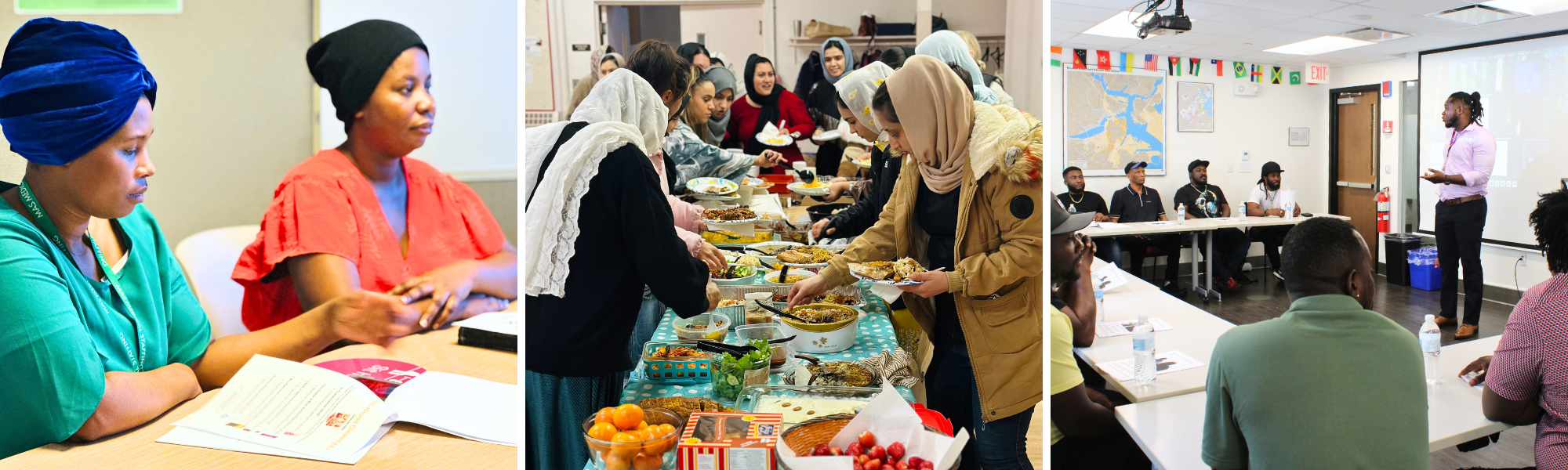
Our services are delivered by case specialists who share clients’ languages and cultures. We’ve also created affinity groups, in which clients who share common backgrounds can come together in safe spaces to socialize, cook, craft, go on outings, and volunteer together.
Centering Self-Efficacy
Another way we resource clients is through teaching while helping. We recognize that, while it can be an enormous relief to have support, true independence is what clients seek and what we need to prepare them for. We ensure immigrants understand the complicated laws, rules, and conventions that shape their lives here, but in building language, work, and navigation skills, our role is to support their agency and give them the access and tools they need to achieve self-sufficiency as quickly and sustainably as possible.
Addressing Emotional Health
In what is our greatest bow to true resilience, at IINE we acknowledge that no one is a bottomless well of strength. Trauma takes a toll, and as trauma researcher Bessel van der Kolk put it, “the body keeps the score.” The majority of IINE’s clients have experienced violence and persecution and live in its physical and emotional aftermath.
This year, in the face of a new level of suffering under destructive immigration policy changes and indiscriminate detention and deportation, IINE has made a year-long investment in training front-line staff in our Boston office in an intervention developed by the World Health Organization to support adults in communities exposed to adversity who experience psychological distress. As a clinical social worker, I am stepping back into a limited program role to help supervise our non-clinical staff in learning techniques to help clients manage their depression, anxiety, and stress, and improve their psychosocial well-being. With additional support, we hope to expand this program throughout IINE in the years to come. We know from supporting so many people through their integration journey that wellbeing is the greatest superpower of all.
Welcoming, supporting, and integrating refugees is a community effort. Explore opportunities to get involved.
Related Articles

Maryam and Mauret: A Volunteer Helps a Young Afghan Refugee Pursue Her Dreams in New Hampshire

Restrictive and Unjust: IINE Statement on Presidential Determination on 2027 Refugee Admissions

Spotlight Report Excerpt: On Connecting Immigrant Talent to Healthcare Careers