metapixel
Skip to main content

Tag: Boston

Nazia’s Story: An Afghan Refugee’s Relentless Commitment to Education and Hope

Nazia Blog Banner

The hardest and most important job

Growing up in Afghanistan, Nazia developed a true passion for teaching at a young age. She became an English instructor when she was in 10th grade, and for years, continued teaching for little or no money, eager to gain experience.  

“Teaching has been my dream job. In our country, people don’t have a good perspective about teaching – they think it’s a simple job, but it’s the hardest and most important job. A doctor once had a teacher. A president once had a teacher.”   

With time, Nazia became successful and well-known in her profession. While completing her university degree in education, she taught English to both children and university students, and then after graduating, accepted a role teaching adult learners online. With hard work and sacrifice, she had built a life for herself doing what she loved. 


A dark cloud 

Then, the Taliban came and took it all away. It was 2021, and Kabul had fallen in what felt like an instant.  

“[Women] lost the right to get an education and have a job. We couldn’t travel alone, we had to have a guardian. It felt like a really big, dark cloud had come over our country and it was not going to move away. It made everything dark. You felt like thunder was going to hit you; the thunder was the Taliban.” 

As a woman, it was now illegal for Nazia to teach. It took her a full year to find an opportunity to do so anywaya decision which came with real peril.

“Taliban were living in our neighborhood, so when I taught, I would close all the windows and doors. I felt afraid they would hear my voice talking in English, and I would cause danger for my family.” 

The Taliban did their best to fan the flames of her fear. 

“Two separate times, I received a WhatsApp message from an unknown number with a profile picture of the Taliban, asking me ‘Have you started teaching again?’ I deleted the message and blocked the account. It was terrifying, but I didn’t stop because there were a lot of women who needed education, they needed a light in the darkness. My class was not only for teaching English, it was to give students motivation to be brave, to never lose hope.” 

Nazia did not give up. In fact, she wanted to do more. She decided to start a social support and education group for fellow women living under the Taliban, which she named “Lifesaver Girls.” It took her many tries to find an education center brave enough to host this illegal gathering, but with perseverance, she was able to convene one meeting. She felt she had to. 

“After the Taliban took over, most of the girls got disappointed and depressed. This group motivated them. When they first came to the meeting, you could feel the hopelessness and [see] deep sorrow in their faces. We talked about some successful women who did their best in the hardest situations, and we introduced them to online ways to get an education. At the end of the session, you could see the brightness of hope in their eyes.”  

A really hard night 

Nazia had been living in Ghazni, a city about two hours from Kabul. In December of 2023, she received a call from the organization that was helping to evacuate her from Afghanistan. They told her to be in Kabul the next morning. Women were not allowed to travel alone, so she set off with her father. They waited 14 days before being evacuated to Pakistan. Then they had to walk an hour in the middle of the night to meet the driver who would take them to Pakistan and then to Qatar.  

“It was a really hard night. It was so stressful. At the Afghanistan-Pakistan border, the Taliban checked all of the stuff we had and asked ‘Where are you going? Are you going to a foreign country?’ I told them ‘No, I’m sick.’ My father was pushing me in a wheelchair so they would believe me.” 

Nazia told the Taliban that another male relative was waiting for her at the border, so that her father was able to leave her. Then she was alone. She was checked by the Taliban four separate times. When she got to Pakistan, she stayed three nights before being evacuated to a camp in Qatar. It was a difficult period.  

“It was like you are in a big jail. You are not allowed to go out of the camp. I was stressed that my case wouldn’t be accepted, and I would think about how I would live in Afghanistan. I would be arrested for leaving the country alone.”  

After 28 days, Nazia’s case was approved. She arrived in Boston in January 2024.  

Learning how to walk 

Nazia with IINE Career Navigator Emma Pond

Within one week of her arrival in Boston, Nazia enrolled in services at the International Institute of New England (IINE). Case Workers quickly helped her get her social security card, enroll in food benefits and health care, and acquire her work permit. IINE’s Education and Employment teams helped her to write a resume, begin searching for jobs, and explore opportunities to pursue a master’s degree. She was also invited to a monthly support group for fellow Afghan women to meet, socialize, share advice, and explore their new city together.  

IINE’s Afghan Women’s Group in Boston

Nazia says that the people she meets at IINE are “really kind and helpful. I’m really thankful.” She is adjusting to life in Boston and learning how to navigate new challenges with IINE’s help.  

“It has some hardships. I’m getting used to a new environment—living without my family, traveling alone—but it is an interesting experience. Nowadays, I’m like a baby trying to walk, standing and falling down, but still not losing hope. The baby is sure they will learn how to walk even though it is hard. Here in the U.S., I’m learning how to walk. IINE is helping me to learn.”  

Finding the light 

Even before she came to the U.S., Nazia had dreamed of pursuing a master’s degree and then a PhD at Harvard University. Now this dream feels closer. 

I came to Boston by chance— it’s a really beautiful coincidence. I want to get my master’s and PhD in [Teaching English for Speakers of Other Languages], and one day, become a professor. Everyone says being a Harvard student would be hard; I agree it’s hard, but it is not impossible.” 

Nazia is also a writer. She has already had some success—a short story published on the website of a university in Iowa. She’s writing more short stories and hopes to write a romance novel one day. One thing’s for sure: nothing will stop her from striving for her dreams. It’s not easy, but she knows she now has support—and freedom.  

“In our country, we couldn’t go out after 5 p.m. Here, I can. I feel safe. There is no Taliban here, no one that will restrict me from following my dreams. When I have a hard time and miss my country, I walk around, and I see beautiful smiles. I feel ‘this might be hard, but I’m in a good environment… ‘I believe that when something is hard, it makes you the real version of you. There might be moments you feel down, like nothing is going to get right, but still in that moment, we can find the light.”  

We are proud to have welcomed, resettled, and supported refugees in the New England region for over 100 years. Learn more about our refugee resettlement work here.

Life Science Cares – About IINE

Over the summer, IINE deepened our relationship with a unique corporate partner.  Life Science Cares (LSC) is an association of like-minded local bio-tech companies that have banded together to increase their philanthropic and volunteer impact in the region.

In 2017, IINE was designated as one of the organization’s beneficiaries and invited to a Council of Champions Mixer at Millipore Sigma in Burlington, MA. LSC collected gift cards at the mixer that IINE used to purchase new professional clothes and groceries for our clients.

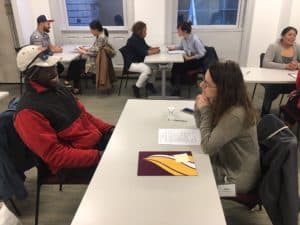
Recently LSC brought 13 volunteers to Boston participate in a “Mock Interview Night” for students participating in IINE’s evening English classes for Speakers of Other Languages. Mock interviews give IINE students the opportunity to practice their job interviewing and English skills with a local professional.  Coming up in November, Life Science Cares volunteers will host a special Thanksgiving celebration for students in our Boston ESOL classes.

In addition to engaging with IINE as volunteers, Life Science Cares provided IINE with a generous grant in support of our employment programs in our Boston and Lowell sites. We were honored to be among the organizations selected for support during Life Science Cares’ first formal grant-making year.

Meet Biar Kon

Meet Biar Kon

All you really need to know about Biar Kon is this: in the right shoes, under a spotlight, he is unstoppable.

During last week’s Suitcase Stories® performance on World Refugee Day, he gave a tour-de-force storytelling presentation before a crowd of almost two hundred people.  In his dapper patterned suit and bedazzled shoes, he mesmerized the audience with the story of his experience in Dadaab refugee camp in Kenya.

Biar was born in Sudan, but he and his family fled their homeland in 1993, and for the next two decades, Biar lived in the Kakuma and Dadaab refugee camps in Kenya. In 2015, Biar and his family resettled to Boston and then moved to Lowell, MA.

Currently a student at Middlesex Community College, Biar will complete his associate’s degree in Business Administration this fall. After graduation, Biar hopes to complete his bachelor’s degree and earn his master’s in business administration with a minor in political science at a university in Boston. Obviously a dedicated student, Biar said that in his spare time he reads business books — his latest favorites are The Science of Getting Rich by Wallace Wattles and Think and Grow Rich by Napoleon Hill.

On top of his busy academic schedule, Biar also serves as an IINE intern in Lowell, where he helps resettle refugees and interprets for some Somali and Swahili-speaking clients.

When he tells the story of his early life, Biar purposely draws a connection between his own experience and what he imagines children today are enduring at camps in Africa, and in detention centers in Texas. He remembers how it feels to be powerless over one’s own life.

Biar is a bit shy about his hopes for the future. He said his “biggest motivation” is the dream of one day opening his own business. Until that time, though, it seems he will study, learn, help people, and continue to share his own powerful story in the hope that those who hear it will be inspired to give a young person a chance to succeed – just like the chance he feels he received when he came to the U.S.

What Would You Risk?

Imagine being faced with a terrible choice – risk persecution, imprisonment, and torture, or leave behind everything you’ve ever known for a slim chance at safety? What would you do, if your survival was at stake?

Every day across the world, people like you and me are forced to flee their homelands because of violence and persecution. This is the reality of an unprecedented 21.3 million refugees worldwide, including the 623 refugee women, men, and children from 20 countries that the International Institute of New England (IINE) resettled in the past year in Massachusetts and New Hampshire. These clients had the courage to fight for new lives, and with our help are now reclaiming the future that was stolen from them.

Recently, I met Hanna Petros Solomon, a refugee from Eritrea who risked her life twice to come to the United States. Orphaned at a young age, Hanna and her siblings had little chance of surviving one of the most repressive regimes in the world. Together, they made the decision to escape – and were caught. For three years, Hanna was transferred from prison to prison, places known to be rife with torture and other human rights abuses.

Eventually, Hanna convinced a prison guard to let her go. This time, she successfully escaped from Eritrea with her siblings and fled to Ethiopia, before resettling to the U.S. as a refugee in 2012 and reuniting with her grandmother and sister in Boston. Yet the safety of family and a new life could not erase the trauma she experienced in her homeland. To acclimate to her new surroundings and transition to American life, Hanna needed the diligent assistance of IINE staff.

Hanna’s caseworker placed her in our English and Cultural Orientation classes at our Boston site, where she learned how to navigate her new city and its cultural expectations. Hanna then enrolled in and graduated from our Hospitality Training Program, and with the help of her training specialist found work as a server at the Boston Marriott Long Wharf Hotel.

Today, Hanna is looking ahead to her next graduation ceremony. As a junior at Tufts University studying clinical psychology, she is determined to help others like her heal from mental and emotional trauma. One day, Hanna would like to return to Eritrea and be a part of fixing its broken mental healthcare system. But first, we are pleased to welcome her as an intern at IINE in Boston this summer.

“I chose to intern at IINE,” explains Hanna, “because I want to show clients and my refugee peers that they can make it in life. They have the chance to change their lives.

In 2016, the Institute served 1,737 new Americans like Hanna. As our nation wrestles with questions about how open our borders and society should be, IINE continues to provide education, job training, and other critical programming to people seeking safety and the chance of prosperity. Our services are needed now more than ever, and we are grateful for the support and dedication of our community. Thank you for your generous support, and for helping us give newcomers like Hanna a chance to change their lives.