metapixel
Skip to main content

Author: Jeff Thielman

A New Path Forward: Raising the Refugee Cap

A New Path Forward: Raising the Refugee Cap

Last week, President Biden announced he would expand the number of refugees admitted to the U.S. to 125,000 annually, with an immediate increase beginning soon. The 15,000-person cap set by the Trump administration was the lowest since the Refugee Act became law in 1980 with overwhelming bipartisan support.

In the executive order, Mr. Biden wrote, “The long tradition of the United States as a leader in refugee resettlement provides a beacon of hope for persecuted people around the world, promotes stability in regions experiencing conflict, and facilitates international collaboration to address the global refugee crisis.”

The executive order is a crucial step forward. There are more refugees and asylum seekers than at any time in modern history, even surpassing World War II numbers, and globally there are 26 million refugees, a number larger than the entire population of Australia.

The President’s announcement is a hopeful sign, but there is a lot to do to rebuild the resettlement system’s infrastructure at home and abroad. The previous administration gutted the refugee processing system. The Citizenship and Immigration refugee corps, for example, has only 136 refugee officers on staff compared to 352 officers in 2017, and one-third of refugee resettlement offices nationwide have closed.

During the past four years, IINE served a smaller number of refugee arrivals. However, we expanded our workforce development, English for Speakers of Other Languages (ESOL), and immigration legal services programs, allowing us to serve more new Americans than we did before 2017.

IINE has begun taking steps to prepare for the increase in refugee arrivals, working with our national partner, the U.S. Committee for Refugees and Immigrants, and local community health centers and volunteer groups as we determine the staff we need to support newcomers. We are excited to welcome more refugees to New England and are encouraged by President Biden’s commitment to rebuilding systems that were dismantled under the previous administration.

“Safer, Stronger, and More Prosperous”

“Safer, Stronger, and More Prosperous”

Two weeks into the Biden-Harris Administration, IINE is encouraged to see continued executive action aimed at halting and reversing immigration policies that disrupted millions of lives, businesses, and families in refugee adn immigrant communities throughout the United States.

Following six executive actions on his first day in office that protected DACA recipients, overturned the Muslim Ban, and injected humanity into removal proceedings, President Biden signed three additional Executive Orders this week impacting immigration. Taken together, these orders underscore how “our country is safer, stronger, and more prosperous” when immigrants are treated humanely and recognized as assets to our society and economy 

President Biden’s three new orders, which give hope and directly impact families enrolled in our services today, serve to: 

  • Create a dedicated task force to reunite migrant children taken from their families at the southern border. Over 500 children remain separated from their parents or caregiversThe task force will be chaired by newly-confirmed Secretary for the Department of Homeland Security (DHS) Alejandro Mayorkas, the first Latino and immigrant to lead DHS. 
  • Restore humanitarian protections for vulnerable migrants from Central America seeking asylum and redress sufferincaused by the Migrant Protection Protocols, which has forced tens of thousands of women, men, and children in search of safety to live in precarious and insecure situations in Mexico while awaiting the opportunity to apply for asylum in the U.S. 
     
  • Initiate a top-to-bottom review” of policies and regulations enacted by the previous administration, including changes to the public charge rule that served to make immigrants and their families too afraid to access public benefits, despite disproportionately high rates of housing instability, food insecurity, and job loss due to the Covid-19 pandemic and economic crisis. 

We are particularly pleased by the President’s instruction to review the possibility of reinstituting the Central American Minors (CAM) Parole Program, which was created under the Obama administration. IINE case workers previously implemented this program by ensuring that paroled youth received intensive support services, including connections to public schooling, health and mental health services, and legal assistance. While the CAM program was terminated in 2017, IINE has continued to support Central American and other migrant youth who travel on their own to the U.S. in search of safe harbor and family reunification. You can read about one such child in IINE’s recently-published 2020 Annual Report. 

IINE also celebrates President Biden’s announcement on Thursday of his intention to raise the refugee admissions ceiling to 125,000 in the next full fiscal year, which begins on October 1. Over the past four years, we have had a front-row seat to the previous administration’s efforts to dismantle our national system of refugee resettlement. Where once the U.S. was a humanitarian leader in offering safe refuge globally, these processes have been badly damaged and will take time to rebuild to full and expanded strength. But it is a challenge we welcome, and at IINE we stand ready and eager to receive refugees from around the world.   

The First Week: Executive Orders Focused on Immigration

The First Week: Executive Orders Focused on Immigration

It has been a week since the inauguration of President Biden, and we are seeing positive signs of change in immigration policies. A subset of the new President’s executive orders began the effort to overturn more than 400 actions issued by the previous administration that undermined established pathways for legal immigration, naturalization, and humanitarian refuge.

Here is a brief recap of some of the notable orders issued in the new President’s first days in office:

  • President Biden directed the acting Department of Homeland Security (DHS) Secretary to take all steps necessary to preserve the Deferred Action for Childhood Arrivals (DACA) program. Some members of the IINE community are DACA recipients, and they welcome this relief.
  • One order signed by the new President revoked previous actions banning immigration by people from predominantly Muslim countries including Iran, Libya, Somalia, Syria, Yemen, and other nations. The action reverses the so-called “Muslim Ban” and gives hope to many people we have resettled from these countries who are anxious to bring their children, parents, and siblings to the United States.
  • Another order redefines DHS enforcement priorities for undocumented residents and allows a review of previous enforcement and deportation rules, a step in the right direction towards a more humane way to treat people who live, work, have families, and pay taxes in the U.S.
  • The President directed the State and Homeland Security departments to reinstate the Deferred Enforced Departure program for Liberians until June of 2022, allowing them to obtain work authorization and take other steps to adjust their legal status in the U.S. This is good news, and we encourage those impacted to contact our Immigration Legal Services program for assistance.

Later this week, we expect to see additional executive orders focused on immigration.

We look forward to seeing the progress of the Biden administration’s new comprehensive immigration bill, the U.S. Citizenship Act of 2021, which aims to provide an eight-year path to citizenship for an estimated 11 million people living in the United States without legal status. If you are interested in learning more, a fact sheet is available here. This is a time for bipartisan consensus on common sense immigration reform.

For more than 100 years, IINE has been committed to helping refugees and immigrants in New England restart their lives and, in doing so, contribute to our region’s growth and prosperity. It will not be easy to undo the lasting, human impact of the past four years during which so many families suffered from policies that forced separation, deportation, and loss of sanctuary. Reconstituting a more humane immigration system is a long-term project that requires sustained political will and the ongoing engagement of IINE’s supporters and others who care deeply about our nation’s historic commitment to welcoming and embracing people from around the world.

Inauguration Day

Inauguration Day

Tomorrow Joe Biden and Kamala Harris become President and Vice President of the United States. For the International Institute of New England, the change in administration is a welcome relief. At IINE, we look forward to working with the new administration in fulfilling its pledge of restoring America as “a nation of laws and a nation of immigrants.”

I took the helm at IINE in the run-up to the 2016 election—a challenging time for an organization supporting refugees and immigrants, more challenging still for those we serve. In the intervening years, we have seen our clients and their communities vilified in public discourse, categorically cut off from critical services and assistance, barred from opportunities for advancement, and denied—often with great cruelty—their legal right to seek safety and to reunite with loved ones.

While the value our country places on their talents, their sacrifices, and their resilience may have atrophied in recent years, the United States has never stopped being a nation of immigrants. Refugees and immigrants continue to persevere as pioneers and entrepreneurs, the lifeblood of our economy and society.

The Biden administration will be setting a new agenda and tone for our country. As an organization with over 100 years’ experience serving new Americans, here are some things we would like to see prioritized:

An immigration system that treats immigrants like people. Over the past four years, over 400 executive actions have undermined and dismantled established pathways for legal immigration, naturalization, and humanitarian refuge. On top of religiously—and racially—selective admissions policies, this includes the repudiation of an internationally protected right of asylum, characterized by expulsions en masse of people fleeing violence, along with the state-sanctioned separation of vulnerable families and the incarceration of their children.

IINE’s legal specialists have had to sit across from a refugee mother and tell her that no, it will not be possible to apply for her husband and oldest daughter to join her in safety. That yes, at one point it had been possible, but the government decided that anyone from her country—even her family—presents too big a threat to the U.S. Our caseworkers have met with unaccompanied children and followed up with referrals to connect them with psychosocial services, not just to process their experiences of flight from their home country, but also from detainment once they reached the U.S.

We ask our leaders to think about these and tens of thousands of other experiences of those who work in immigrant-serving organizations as they develop new policies and laws.

Relief policies that reflect immigrant contributions to our country. Nearly 70 percent of all immigrants in the U.S. workforce hold essential jobs – performing work that keeps our communities, not to mention our country, running. Yet, many essential workers must make an impossible choice between earning a paycheck and protecting their health. At the same time, along with other members of the BIPOC community, immigrants are facing extreme economic hardship arising from the COVID-19 crisis, further exacerbating longstanding structural inequalities. Both the hospitality and food service industry—major employers of immigrants—have been devastated, while public relief efforts exclude some classes of immigrants who are facing spiking rates of joblessness, food insecurity, and housing instability.

We will continue providing private, emergency assistance to families facing homelessness and food insecurity, but we implore the Biden administration and Congress to pass measures that provide more resources to our clients and to eliminate public charge rules that have made many too afraid to access public benefits.

Pathways to Citizenship. As an organization with a rapidly growing Immigration Legal Services program that helps many immigrants become new Americans each year, we support the efforts of the new President and Congress to make it easier and faster for people to become U.S. citizens. We are thrilled to learn of the Biden administration’s plan to unveil a comprehensive immigration bill on day one that aims to provide an eight-year path to citizenship for an estimated 11 million people living in the United States without legal status.

Demonstrated commitment to inclusion and welcome. The violence on January 6 was a blight on our democracy, demonstrated profound disrespect for the U.S. Constitution, and was a frightening event for many IINE clients, particularly refugees. Resettlement represents reaching a final place of permanent safety after years, sometimes decades, of insecurity and upheaval. No matter the challenges ahead in their new lives, at least they are finally free from the fear of violence and persecution. This has been the long-held promise of resettlement in the United States—once a given, but now requiring concerted effort to uphold. While we cannot undo the sustained damage to the resettlement program overnight, we enthusiastically support the new President’s proposal to admit 125,000 refugees to the U.S. each year.

It will not be easy to undo the lasting, human impact of the past four years. Reconstituting a more humane immigration system is a long-term project that requires sustained political will and the ongoing engagement of IINE’s supporters and others who care deeply about our nation’s historic commitment to welcome and embrace talent from around the world.

We urge you to join IINE as we support every effort of the new administration and Congress to treat new Americans in a dignified manner that reflects our nation’s best ideals.

Sincerely,

Jeff Thielman
President & CEO

The Difference Between Two Mondays

The Difference Between Two Mondays

After a momentous weekend, our staff returned to work—either virtually or in person—yesterday. Here’s what their Monday looked like:

  • In Boston, a member of the Employment team helped an immigrant client file an application for unemployment. They had been working at a nearby hotel for a number of years before being furloughed and eventually let go due to the pandemic.
  • In Lowell, a member of the Education and Skills Training team made an internal emergency request for rent support. An asylee client was too sick to work after contracting COVID-19 while on the job as an essential worker.
  • In Manchester, a member of the Community Services team enrolled a refugee family in our mobile food pantry, which makes contactless drop-offs to clients’ homes. Getting to the grocery store would normally involve a bus ride, an added worry for parents concerned about the second coronavirus surge.

In short, it looked much like last Monday, before the country voted in perhaps the most consequential election in modern American history.

We congratulate Joe Biden on his election as the 46th President of the United States. We also celebrate the election of Kamala Harris, the daughter of immigrants, to the second highest political office in our country. She will be the first Black woman and person of South Asian descent to become Vice President. We look forward to working with a new presidential administration that has pledged to reaffirm the United States as “a nation of immigrants and a nation of laws.”

Over the last several years, we have had a front row seat to how both public opinion and policy have been wielded against refugees and immigrants—how legal avenues for immigration and humanitarian asylum have been systematically dismantled, how access to critical services and support has been categorically cut off, how families, businesses, and entire communities have been destabilized and uprooted.

While an imminent shift to a more inclusive policy environment will be hugely impactful for our work and for the communities we serve, rebuilding the impacted processes, systems, and institutions—not to mention trust in them—is a longer-term project, one that is just as important.

Whether last Monday or next, the International Institute of New England has and will continue to work towards a society in which immigrants are welcomed and valued by everyone. With the potential for expanded pandemic relief, we will continue to advocate for resources that match the heightened levels of need among the people we serve. With renewed hope for refugee resettlement, family reunification, and sensible immigration policies, we will continue to provide up-to-date guidance and expertise, along with the critical, on-the-ground work we’ve delivered for over 100 years.

Our work, in short, is far from over. As we look to the future with hope and prepare to serve even more women, men, and children in the days and months ahead, we need you to continue to support our work and the broader, national effort to rebuild the systems that welcome and embrace new Americans.

Sincerely,

President and CEO
International Institute of New England

IINE Statement on the Refugee Admissions Cap for FY21

IINE Statement on the Refugee Admissions Cap for FY21

The International Institute of New England (IINE) condemns the Trump Administration’s newly-announced plan to permit no more than 15,000 refugees to enter the United States during Fiscal Year 2021, which starts today (October 1). Our nation can and should do so much better. Today’s announcement means that many refugees already living in the US, including our own clients in Massachusetts and New Hampshire, will go yet another year without reuniting with their children, parents, spouses, and other family members. It ignores our nation’s long history of welcoming persecuted people and represents yet another attack on the immigrant community.

In short, this decision is a blow to the 120,000 people already approved for admission to the United States, the vast majority of whom have spent years waiting for a chance to find permanent safety for themselves and their families. With more than 26 million refugees in the world today, the US is not only abandoning our historic commitment to provide humanitarian assistance to displaced people, but we are limiting our ability to work with other nations to manage unprecedented levels of forced migration worldwide.

In the past 12 months, while adhering to all COVID-19 safety measures, IINE safely resettled 64 people who are beginning new lives in New England. The refugee admissions system has strict health and safety screenings in place both before and after a refugee arrives in this country and can safely receive many more displaced people, even in the midst of a pandemic.

We are heartbroken for the countless refugees who will not be able to access safety in the United States this year and for their loved ones who will continue to fear for them, and to miss them.

For those women, men, and children who do arrive as refugees in the coming year, we look forward to welcoming you and to providing the services needed to restart your lives in New England.

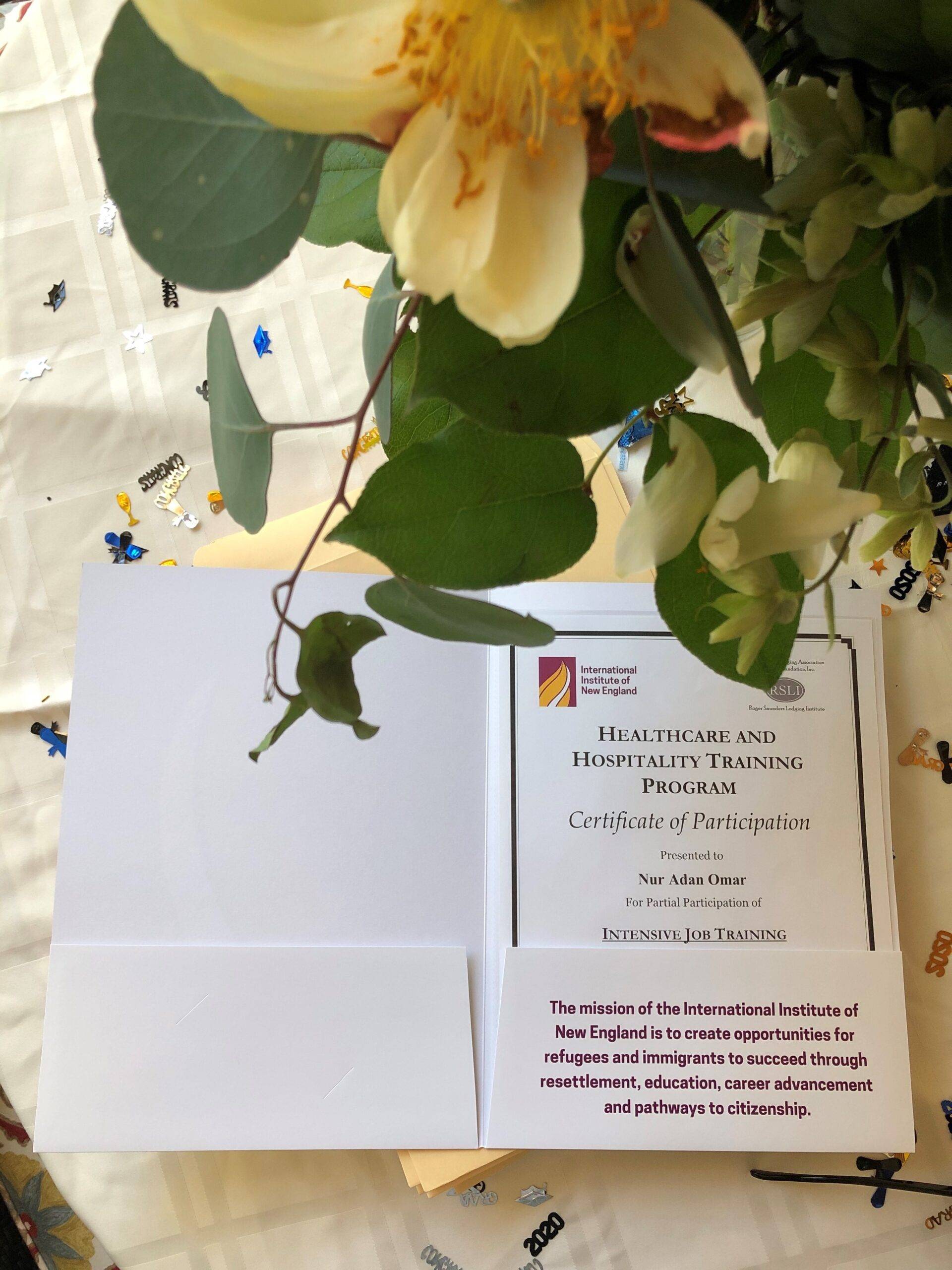
Congratulations to Our Graduating Class: Healthcare & Hospitality Training Program

The International Institute of New England’s Healthcare & Hospitality Training Program (HHTP) is a nine-week course designed to prepare immigrants for jobs in the hospitality and healthcare industries, and to equip them with the necessary skills to launch their careers. IINE has offered skills-training programs in-person and on-site at our office in Boston for over 15 years. However, that was before COVID-19.

In only a matter of weeks, traditional classrooms all over the country were transformed, including classes at IINE. To help prevent the spread of COVID-19 and to keep our students and employees safe, the spring 2020 HHTP class moved to an online learning platform. The transition was challenging; the nine-week course started on March 9, in person, only to switch to online learning just 12 days later. Reflecting on the experience, Chief Program Officer, Xan Weber commented, “It has been remarkable for me to witness how effectively and quickly we have moved all of our programming to remote delivery.”

Despite the very real challenges that came with adapting to virtual learning, both students and instructors found inspiration in the dedication and commitment of those around them. “They have been incredibly supportive, patient, and engaged for nearly two months now,” said HHTP instructor Mary Blunt. “[Their] hard work is inspiring. Every day it was such a joy and an honor to turn on my webcam, say hello, and spend about the first three minutes just saying hello to everybody…’.

Even though the latest HHTP graduation ceremony looked different from previous events, it still felt the same, filled with joy and best wishes for the graduates. To mark the long-earned celebratory moment for the graduates and their families, the IINE workforce development team – from the admissions specialist to the skills training manager – put together an online celebration to congratulate the students on their achievements.

In a series of recorded video clips, students shared their favorite class moments and thanked everyone for “attending” their ceremony. “My favorite part of this class was hearing about customer service and hearing my classmates share stories” said Faisal Yagoub, an HHTP graduate originally from Sudan. Another student, Natalya Podusenko from Uzbekistan, stated “Thank you for coming to my graduation and for celebrating this special moment with me.”

Even though this graduating class could not gather in person to celebrate, they were still able to share this special moment online. “You’ll be entering the workforce at an unusual time, but that is likely to have many different opportunities, and you are well prepared” added Ms. Weber. In fact, an HHTP graduate from a previous cycle was recently able to secure a job at Starbucks despite the challenging job market imposed by COVID-19.

Memory Lane Calling – IINE Client Comes Full Circle

Memory Lane Calling – IINE Client Comes Full Circle

By Sherry Spaulding, Education and Youth Program Manager

I received a very special phone call today. It was Samuel Jordan, the 74-year-old patriarch of a Liberian family who was my very first job placement client when I started working at IINE’s Lowell office as an Employment Specialist in 2004. He was calling to tell me that he is retiring after 16 years with the grounds maintenance department at UMass Lowell, the job I helped him get when he first arrived in the United States.

As Samuel tells it, “You called UMass and you got me an interview there. You took me to the interview and waited for me to finish.” I remember that day well. I was so nervous for Samuel. The department manager wouldn’t allow me to sit in and I could see there were at least half a dozen other people in the boardroom for the interview.

I called the manager back a few days later but he couldn’t give me any details on how Samuel did. Turns out, he couldn’t say anything until Samuel’s offer letter had been sent – a full-time position with excellent benefits. Samuel was so excited. I was so excited. From there, I went on to help many other members of Samuel’s family.

As our call came to an end, Samuel shared with me from his heart: “I want to say to you from all of us [the Jordan family]. Thank you! Thank you! Thank you! And May God Bless You! God sent you to me and to my family.”

Lockdown

Welcome to America. You Are Now in Lockdown. – IINE Resettles Refugee Family

This message comes from Rahmatullah Aka, IINE’s Community Services Manager in Boston. He shared this story as part of our All Together campaign, made possible by a generous $15k match offer from a family foundation and friend of IINE. This month, they will match every donation, dollar-for-dollar, up to $15,000 $30,000

As the Community Services Manager in IINE’s Boston office, one of my most important responsibilities is to visit newly-arrived refugees in their homes on their first day in the United States. Even though they are often exhausted and a little overwhelmed, I try to make them feel welcome as I explain what services we’ll provide in their first months here.   

This is what my caseworker did for me when I resettled to Boston from Afghanistan in 2016, and what I planned to do for the Iraqi refugee family scheduled to arrive on March 23rd from Turkey. However, no one plans for a pandemic.  

On the same morning the family was expected to land at Logan Airport, Governor Baker announced a stay-at-home advisory in Massachusetts due to COVID-19. Instead of greeting the family at the airport, bringing them to their new apartment, and building a relationship through home and office visits, our work together began with a phone call. Over the next few days and weeks, I started to get to know them over video conference, not unlike how I communicate with my loved ones back in Afghanistan – except they were just miles away from me.  

Arriving to the U.S. as a refugee is hard. Arriving in the midst of a pandemic makes it even harder. There were no in-person MBTA orientations or on-site English assessments at our office in Chinatown. The family couldn’t go to the clinic for a routine health screening, and their public benefit applications were delayed for weeks. And probably hardest of all, I couldn’t meet with them face-to-face to answer their questions and tell them that things would get easier.  

Fortunately, IINE was able to draw on its own fundraising to provide emergency cash assistance for housing, food, and essentials for this family, and so many others.  

My biggest concern for the family was their emotional health. It’s lonely arriving in a new country, and even lonelier when you’re stuck in lockdown. For the first few weeks after they arrived, I worried that the family was hardly leaving their apartment. Nevertheless, I encouraged them to take small steps. In a recent video chat, they shared that they made a “socially distanced” visit to a nearby park which lifted their spirits. This progress means so much to me. These days, they end every call with, “We can’t wait to meet you in person.” I can’t, either.  

She Was an Asylee With COVID-19 and Needed Help

She Was an Asylee With COVID-19 and Needed Help

This message comes from Sabyne Denaud, IINE’s Community Services Manager in Lowell. She shared this story as part of our All Together campaign, made possible by a generous $15k match offer from a family foundation and friend of IINE. This month, they will match every donation, dollar-for-dollar, up to $15,000 $30,000

Like my colleagues, I’ve been working from home since the beginning of April. It’s been an adjustment for my husband and me, since both us are now working remotely. He’s an engineer and works from our family room while I’ve moved from the living room to the porch since the weather turned nice. It really helps that my mom lives with us and can watch our two young kids. I think about many of our clients who don’t have these benefits – to work from home and have in-house childcare. 

I remember these thoughts being on my mind the morning of May 29th, when an urgent email landed in my inbox – it was from a lawyer, reaching out to IINE on behalf of a client, a woman from East Africa who was recently granted asylum. The lawyer wrote that this woman had contracted COVID-19, lost her job as a Certified Nursing Assistant, and needed help. I picked up the phone immediately. 

I can’t tell you the woman’s name, but over the course of that first two-hour conversation I learned that she is warm and kind, and prefers to focus on the opportunities ahead instead of the challenges behind her. We got her enrolled in our case management services, helped her access public benefits, and also provided her with emergency cash assistance from IINE’s own fundraising to cover food and rent. One of our services is helping people navigate the healthcare system, and we made sure she had the information she needed. 

Two months later, like many COVID-19 patients, she has recovered from the virus but is not as strong as she once was. Her doctor cleared her to work but prohibited her from doing much heavy lifting, a requirement for someone who works as a Certified Nursing Assistant. 

She began looking for a new job, and recently told me during one of our weekly calls that she found a part-time position delivering food, a step forward that we celebrated together. She also has shared that she deeply misses her kids, who are approved to come to the US from their home country but can’t travel because of the pandemic. As a mom, I can’t imagine being separated from my children, especially right now. 

I look forward to continuing to connect with and support this woman as she continues in our case management services. Often at the end of our calls, she shares how she appreciates our conversations and trusts me, and therefore trusts IINE, to help. 

I know I could not do my work without the collaboration of my colleagues and our broader community of supporters, including friends like you! 

IINE Opposes Proposed Asylum Regulation

The Department of Homeland Security (DHS) and the Department of Justice (DOJ) recently issued proposed asylum regulations that will make it nearly impossible for people to pursue asylum claims in the United States. Asylum is a lifeline for tens of thousands of vulnerable people fleeing persecution. It is a form of legal protection offered to those already in the U.S. who cannot safely return to their home countries. Obtaining asylum is already a difficult, lengthy, and costly process, and the proposed regulations are another attempt to close our borders.

This new rule would not only violate the United States’ humanitarian duties under both domestic and international law, but will result in countless women, men, and children being sent back to constant danger in their home countries. If this rule is published as written, the U.S. will cease to be a global leader in providing protection to the most vulnerable.

Our attorneys at the International Institute of New England provide high quality and affordable immigration legal services to families and businesses, and many people in our services are asylees who are active, engaged members of their communities.

Click here to read the public comment by IINE’s Managing Attorney, Chiara St. Pierre.

Collaboration Between Local Organizations Brings Fresh Produce to the Kitchens of Newcomer Families in Lowell

Collaboration Between Local Organizations Brings Fresh Produce to the Kitchens of Newcomer Families in Lowell

The International Institute of New England officially suspended all its in-person services on March 13. Ever since, we have been working tirelessly and creatively to continue to support our immigrant and refugee communities. We had to adapt to these unprecedented circumstances and keep providing the critical employment, case management, and legal immigration services we have been providing for more than 100 years.

In the diverse city of Lowell, Massachusetts, our team continues to operate support programs for refugees and immigrants. As COVID-19 spread, and low-wage workers became disproportionately impacted by both the illness itself and the indirect consequence of the drastically slowing economy, IINE has provided direct emergency funding and resources to families at risk of hunger and homelessness. Since March, IINE has been able to provide grocery store gift cards to families most in need. However, single-parent families, families with COVID-19 symptoms, and those with transportation challenges may struggle to get to a grocery store – and the supply of fresh produce has been uneven throughout these uncertain times.

To this equation, we now add Mill City Grows, a partner non-profit with a focus on food access and food justice. Mill City Grows works on increasing community access to healthy food through the development of urban food production and distribution networks. IINE’s new partnership with the organization has made it possible for families to augment their grocery budget with fresh vegetables, provided at no cost each week by Mill City Grows and its community funding partners. Due to the wonderful success of the partnership, Mill City Grows and IINE will expand delivery from 20 to 35 families.

In order to get the produce from the farm to the families’ fridges, IINE has engaged volunteers to collect bags of produce at a Mill City Grows pick-up location, and safely deliver them to the doorsteps of immigrant families throughout the city. The result is nutritious fresh food on the tables of people who otherwise might not be able to find, nor afford, delicious local veggies. The recipients have gotten creative with their recipes and by all accounts are enjoying the valuable supplements to their cupboards.