metapixel
Skip to main content

Our offices will be closed on Friday, June 19 in observance of Juneteenth.

Author: Danielle Gauthier

Donors Share Why They Give

Dedicated donors make the International Institute of New England’s work supporting thousands of refugee and immigrant families possible. Hear from donors about their personal connections to IINE and the reasons they are compelled to support our mission.

Wade Rubinstein

Leadership Council Member

“It was at a Suitcase Stories® event back in 2017 that I first learned about the International Institute of New England. I was so moved by the stories I heard, I became an IINE volunteer in Lowell tutoring recent arrivals in English. It is a singularly American experience to sit in an IINE classroom with twenty people of different nationalities, genders, and ages learning English together.

As the son and grandson of immigrants to the United States, I feel compelled to help people seeking a better life for themselves and their families. My wife, Jill Block, and I are committed to supporting IINE’s mission with our philanthropic giving. It’s a joy to know that our contributions are helping people from all over the world settle in New England and build productive lives.”

A presenter shares her journey at a Suitcase Stories® event

Pam Chung

ESOL Tutor

Immigrants, often refugees, arrive in the U.S. bewildered, frightened, and overwhelmed. They come here with hopes for a better life than the one they left, and many really had no choice. I was lucky to be born and raised here and I am glad to share my good fortune with others who have had a challenging path.

IINE provides tools for immigrants to succeed, and we benefit from them being here. Take a look around and see who is providing services at restaurants, hotels and airports, not to mention health care, and more. It is important for me to help provide people with the tools they need to succeed in this new, foreign world. And it is fun and gratifying for me to learn from them. There is much to be gained from the friendship and assistance of these newly arrived members of our society, and I believe strongly that I, and you, should donate to IINE to help it continue its work. The International Institute does a marvelous job, under a great deal of pressure, with grace, care and good humor. 

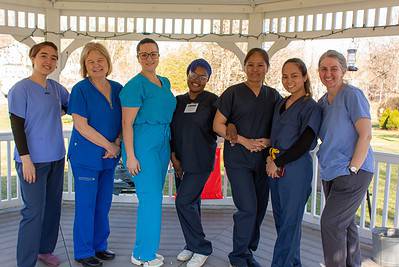
A student in our Certified Nursing Assistant training program

Annie and Bob Schmalz

Long-Time Supporters

After the 2016 election we were horrified with the anti-immigrant rhetoric and activity and began to look for ways to help refugees. We learned of IINE at that time. We brought a program from IINE to our continuing care retirement community, Carleton-Willard, and collected items to be donated. I attended an annual award banquet in Boston. Our son is an attorney for INS and we are aware of what is going on from that point of view. Our connection to IINE is a tangible way that we can do something. 

Julianne Mehegan

Dedicated Supporter

I support the International Institute of New England because of its long track record and proven results in helping immigrants and refugees. IINE has developed programs to support these newcomers and ensure they get the health care, language skills and training needed to become productive citizens. Now more than ever the services of IINE are needed to smooth the way for new generations of immigrants.

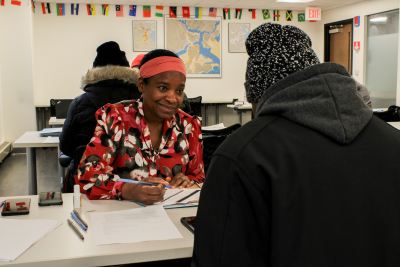
Our ESOL students receive help from teachers and tutors

Refugees and immigrants find safety and hope in our region because of supporters like you. Please consider donating today. 

Q&A With New Board Member Ann Merrifield

Can you share a bit about yourself? 

Ann MerrifiedI was born and raised in southern Maine. I earned a Bachelor of Arts in Zoology and a Master of Education from the University of Maine, and then an M.B.A. from the Tuck School at Dartmouth College. Shortly after, in 1982, I moved to Boston, and I have been here ever since! My husband and I raised our three children on Beacon Hill. We have a long history with the city and feel lucky to call it home.  

In terms of my career, my first role after coming to Boston was at Bain & Company, a management consulting firm. I stayed there for more than a decade, ultimately becoming a Partner, before moving to Genzyme Corporation. At the time, it was a fledgling biotech company. During my 18 years there, I had multiple roles, including leading global business strategy and operations for the Biosurgery division, and helping develop a start-up genetic diagnostics business. It was a wonderful organization and culture, and being able to help so many people from a healthcare perspective was truly a highpoint of my career. Since retirement, I have primarily been engaged with board work, supporting a number of life sciences and nonprofit organizations.  

Tell us about your journey to the International Institute of New England.  

As a small-town kid from Maine, joining global companies such as Bain and Genzyme really expanded my perspective. I had a chance to travel around the world and meet people from backgrounds very different from my own. That helped me form a more global point of view.  

The first time I learned of IINE was when the organization honored Henri Termeer, a Dutch immigrant and CEO of Genzyme, at the Golden Door Award gala. I became more familiar with IINE through Zoltan Csimma, who oversaw human resources at Genzyme, and would become IINE’s Board Chair for many years. With each event I attended and conversation I had, I became increasingly impressed by IINE’s incredible work and impact. I became a member of the Leadership Council and stayed engaged in that way until this year, when I took on the role of a board member.    

What do you consider the most important contributions of a board member? 

Naturally, there are governance and fiduciary responsibilities. IINE is very well-run and effective in those areas, so I think the most important aspect of my role as a board member becomes the advisory responsibility – helping IINE remain focused on its mission and its future. It has been exciting to take on this role while IINE is in the midst of developing a new strategic plan and preparing to increase its investment in private philanthropy. I have been so impressed by how IINE has risen to challenges over the years. Ensuring we can continue to weather any storms that come our way requires strong fundraising, and I am looking forward to supporting this work.  

I think IINE has done a commendable job of assembling a board of very talented individuals with diverse experiences and perspectives. It creates a robust dialogue. I’m looking forward to bringing my career perspective and philanthropy expertise to bear on our work as a group.  

What excites you most about IINE’s future? 

I’m a lifelong learner, so more than anything, I’m excited to learn! IINE’s business model is very complex, in terms of the multiple funding streams. Everyone has worked incredibly hard to get IINE to the level of impact it has reached today, where the organization is serving thousands of refugees and immigrants. I look forward to learning from my fellow board members and IINE leadership.  

What inspires your philanthropy? 

My sister and I were raised by an incredible mom, who supported our family on her own as a dedicated schoolteacher. With my family’s support, as well as a number of wonderful opportunities and scholarships, I was able to succeed. I feel very fortunate, and it’s important for me to give back, to help others find opportunities and success, too.  

IINE’s Board of Directors includes corporate and community leaders from across New England. View our members and leadership team here.

Spotlight Report: Immigrant Families in Emergency Shelters (November 2023)

The Spotlight Report is a quarterly report to bring you a deeper understanding of our work. This Spotlight Report covers why so many immigrant families have entered Massachusetts’ emergency shelter system in recent months, and how IINE is working with the state and federal governments and partner organizations to provide immediate support as well as advocate for long-term solutions.

Cyclists Raise Awareness and Funds at Annual Ride for Refugees and Immigrants

On September 24th, International Institute of New England Board members, volunteers, staff, friends, and local community members suited up and hopped on their bikes to participate in IINE’s 5th annual Ride for Refugees and Immigrants. 
 
Created by IINE Board member Will Krause, The Ride brings together both seasoned cyclists and casual riders to bike a 50- or 12-mile route to raise funds and awareness for refugees and immigrants in our communities.  

Riders departed from Arlington, MA, stopping in Lowell to take a tour of our new office space and learn more about IINE’s work before meeting up with additional riders on the route back to Arlington. A big thank you to the 21 riders who participated and made the day such a success 

Highlights of the Ride

Supporters and Staff Raise Critical Funds to Help Refugees and Immigrants in Our Communities 

IINE supporters, friends, and staff members collectively raised nearly $32,000 to provide resettlement services, intensive case management, adult ESOL, career advancement, youth programming, and immigration legal services to refugees and immigrants in need. Several shared the reasons they were inspired to ride: 

Riders Enjoy a Delicious Post-Ride Celebration at Kickstand Café  

A special thank you to owner Emily Shea and her staff at the Kickstand Café in Arlington, who, for the third year in a row, graciously hosted a post-ride reception. Riders and supporters enjoyed delicious food and drinks as they reflected on the event’s impact (and tried to stay dry in the drizzly fall weather!).  

A Valued and Generous IINE Partner, Starbucks Sponsors the Ride

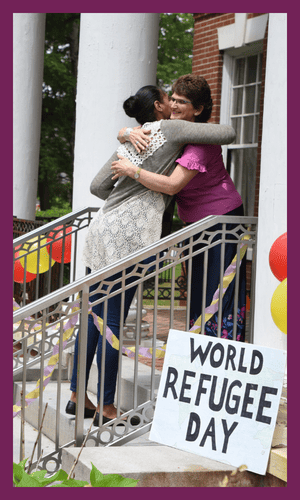
Special thanks to the Starbucks Corporation for their generosity as our very first corporate sponsor of the annual Ride. The company’s ongoing partnership with our organization – from offering employment opportunities to our clients, to providing grant awards and event sponsorship, to volunteering at our World Refugee Day celebration – exemplifies how the mobilization of our corporate community can make life-changing impact on refugees and immigrants seeking a new start in New England. 

Thank you again to everyone who supported The Ride! By donating to IINE, you make a direct difference in the lives of refugees and immigrants in our communities 

From the Desk of the CEO: Thank You for Rising to the Challenge in 2023

By Jeff Thielman, President and CEO at the International Institute of New England

As our 2023 fiscal year comes to a close, I want to take a moment to reflect on a year that was unlike any other – and to thank you, our supporters, for rising to meet a level of need none of us could have anticipated a year ago.  

This past year was remarkable in many ways:  

The vast majority of those entering services have come here from Haiti, where political turmoil, natural disasters, water scarcity and famine, and widespread gang violence have displaced millions. Many put their hopes in the U.S. and set off on a long and perilous journey, and for tens of thousands, Massachusetts is their final stop and their new beginning. Here they join a rich community and the 3rd largest Haitian diaspora in the U.S. For Haitian immigrants—and for the thousands of clients we serve each year from more than 60 countries of origin—IINE provides life-saving support by unlocking and delivering federal and state benefits (including food, healthcare, and housing support) they are eligible for and cannot receive without the help of an organization like ours. 

The challenges immigrants face when entering the U.S. are immense. Their journeys to self-sufficiency are often hampered by inadequate funding in Massachusetts for adult ESOL (English for Speakers of Other Languages) classes, which have extremely long wait lists. Some immigrants also experience delays in the approval of the federal work authorization documents needed to secure jobs. IINE has advocated for increased state and federal funding to expedite immigrant entry into our workforces, lobbying regularly to improve and expand services that support the stabilization and integration of families with so much to offer our community and economy.

Core to all our programming is IINE’s long-term vision that refugees and immigrants are able to realize their dreams and contribute to New England’s growth and prosperity. In support of this, this year IINE launched a new Financial Literacy class. Taught at our Boston and Lowell offices and free for all students, the class covers a range of topics from the basics of banking to financial planning, buying a home, and understanding credit scores and reports. We also piloted a new job skills training program focused on professional development. Designed for a range of English language levels, the course focuses on workplace norms in the U.S. Topics include professionalism and social skills, customer service, email etiquette, transferable skills, teamwork/collaboration, resume and cover letter writing, job search strategies, mock interviews, and salary negotiations. Learn more about the program in our interview with Associate Director of Workforce Initiatives Kubana Alexis. 

This Spring, in partnership with Stellar Story Company and Global Arts Live, seven storytellers took to the Somerville Theatre stage to share their own stories of migration and cross-cultural exchange. Recounting hardship, triumph, and self-discovery, the storytellers brought audience members to their feet. Four additional storytellers, including our youth client Mapendo Mutingamo, shared their personal journeys at IINE’s World Refugee Day celebration at Middlesex Community College in Lowell. Experience our youth client Mapendo’s Suitcase Stories® performance on our blog. 

Launched in the summer of 2022, Resettle Together is a new kind of community sponsorship model through which volunteers enter into a formal partnership with IINE to raise resources for, welcome, and resettle a family of refugees. The partnership expands capacity while drawing on our staff’s expertise and each volunteer group’s community roots. The result? Refugees feel more deeply supported, welcomed, and integrated into their new communities. Over the past year, ten new Resettle Together groups have formed, successfully completed orientation, and have been matched with an IINE refugee family. Tom Barrington, a member of the group “Team Together,” shared his experience. “Accompanying a refugee family is an immense privilege,” he said. We are able to get to know courageous people who have all kinds of hope and dreams for their future. They have all kinds of opportunities along a crooked road. We cannot travel that road for them but can be with them.” Hear more about his group’s experience supporting an Afghan family of nine in our Town Hall webinar.   

Thank you again for your ongoing support. Refugees and immigrants are finding safety and hope in our region because of you.  

Employee Profile: Meet Joe Gilbert, Education Program Manager

After spending the majority of his career in higher education, Joe Gilbert joined the International Institute of New England as the Education Program Manager in our Manchester office last year. In our latest employee profile, Joe shares how the ESOL program and his team have evolved, the many hats he gets to wear in his role, and where you are most likely to find the native New Hampshirite on a day off.  

What brought you to the International Institute of New England?

I had been teaching at the University of New Hampshire in their ESOL Program for a couple of years and was preparing to wrap up my time there. Then, during my last semester, the pandemic hit. So, that changed my plans entirely. I became a stay-at-home dad for the next two years. Once the world started to become a little safer and my kids returned to school in person, I started the job hunt. 

I wasn’t sure where I wanted to be. I knew that staying in higher education might require moving, which wasn’t appealing, and I was also eager to work with a different population. Many of the students in higher education ESOL programs tend to come from wealthy international families who can afford to pay full tuition out of pocket. While there were enjoyable aspects of teaching in that environment, I wanted to help people who were more vulnerable and people who were coming to New Hampshire with the intent of staying and building a life here. I started researching opportunities to work with immigrants and refugees and that put the International Institute of New England on the map for me.  

Initially, I had been looking for a teaching job since that was the majority of my prior experience, but then the Education Program Manager position in Manchester opened up. It felt like a bit of a stretch because of the administrative and management aspects, but it was an exciting opportunity to join an organization whose mission I really connected with.  

Yesterday marked your one-year workiversary! How has your role and team grown since you started?

Joe speaks with students during an English Class Orientation

We have welcomed quite a few new faces! We have also been able to expand our team’s capacity by making a number of part-time positions full-time. We are currently hiring additional teachers, too (you can view job openings here).  

When I first joined, the program had recently grown from four ESOL classes to six. We have three levels, and morning and evening sessions for each. We have also expanded our community partnerships. Through a contract with Network for Health, we now teach a healthcare-focused English class onsite for employees at two hospitals in Manchester.  

We are working on starting up afternoon English classes next month in a partnership with the new Meelia Center for Community Engagement. Those will be onsite at St. Raphael’s Parish on the West Side of Manchester, where many clients live who have a harder time getting across town to our Brookside Church classrooms. We are also exploring a partnership with Manchester Community Schools, where our teachers would teach our curriculum to parents and students onsite at schools after hours

So, our program has grown quite a bit. At the same time, my role has shifted too. When I started, I was teaching a class myself, and all of our classes were held virtually on Zoom. Then, as our classes and partnerships began to grow, and as we looked to transition to in-person and hybrid classes, I shifted my focus to oversee those initiatives. A big part of my job has been getting our classes and technology up and running, training teachers and students on how to have hybrid classes, and strategizing on how to get students to our classes when they don’t have reliable transportation as our new in-person location, the Brookside Church, is not directly downtown.

What does your day to day look like? 

It could be 20 different things! This week, in particular, is our first week of classes for the fall semester, so I have been attending orientations for all of our students. I want to be present so students know who I am and recognize me as a familiar face.  

To give you a broader sense though, on any given day, I might be: 

  • Checking in with my team members, who range from teachers to administrative support to data entry specialists. 
  • Attending a weekly Department of Education meeting, where we cover topics ranging from student intake and assessment to curriculum development, data management, and volunteer coordination. 
  • Meeting with our office’s Senior Program and Contract Manager Kayla Rossmeissl to discuss budgets, personnel, and any updates that need to be shared across all Manchester staff who work with our refugee and immigrant clients 
  • Touching base with other service providers in the state who serve similar populations to share ideas and advice. 
  • Meeting with my counterparts at our Boston and Lowell offices, Kristan Fitah and Sherry Spaulding, so we can share innovations and help brainstorm solutions to any challenges. It’s always helpful to pick each other’s brains – and it’s a good opportunity to share our resources and insights so we can try to avoid any duplication of efforts.  
  • Meeting with other departments at IINE, whether it be IT to discuss setting up new tech for our classrooms, HR to discuss staffing, or Marketing (as I am for this interview!) to share ideas on how to promote our ESOL program, etc.  
  • Updating performance trackers and preparing quarterly reports for the DOE 
  • And of course, troubleshooting and responding to any situation that may arise! That might mean substitute teaching for a class, helping order new textbooks for students, conducting student tests, helping with new student intakes, giving students a ride home, organizing donations, etc. So, I get to wear many hats.  

What do you enjoy most about your role? 

Seeing the impact that we make in people’s lives is by far the most rewarding aspect. By learning English, our students are learning self-sufficiency: how to fill out forms to access services, how to communicate during a doctor’s appointment or with their children’s teacher, and how to navigate a grocery store. We’re able to help people gain the skills and confidence to take charge of their own education and career goals. Some of our students come to us with no formal education in any language, at all – to see them gain survival English is huge. And then we have our more advanced students who have gone on to enroll in community colleges or UNH!  

Being at a nonprofit and being able to deliver direct humanitarian aid, it’s something I really value. I can give our students dignity; for example, by providing shopping vouchers for the thrift shop onsite at Brookside so they can get a bag of winter clothing for their kids.

What advice would you share with someone who is interested in joining IINE?

Joe and his family on vacation in Tennessee, including a stop at the Bush’s Baked Bean Museum!

Be prepared for the unexpected. It’s often an all-hands-on-deck effort here. If you have a skill or interest that you don’t think would necessarily be an asset, it probably will be – and we’ll put it to good use! Everyone here helps each other.  

How do you enjoy spending your time outside of the office?

I have a little bit of a homestead at home. I have fruit trees, blackberry bushes, and ducks and geese. My geese are noisy, and this is a feature, not a bug. They’re very effective at alerting against predators. On my days off, you’ll often find me splitting firewood. That’s what I consider self-care – and doesn’t hurt that it keeps our house warm for cheap!  

Interested in joining our team? Our collaborative, team-oriented environment offers opportunities to serve refugees and immigrants, while learning from other staff and departments. View career opportunities here. 

Migrants, Immigrants, Refugees, Asylum-Seekers, Parolees: Understanding the Key Differences

Migrants. Immigrants. Refugees. Asylum seekers. Parolees. They all leave their homes seeking a better life. Some leave by choice, others by dire necessity. The terms used to describe people who make these difficult decisions and journeys are determined by why they come, and the different legal rights they have when they arrive.

Migrants and Immigrants

The terms “Migrant” and “Immigrant” are not humanitarian legal statuses, just descriptors. Though usage varies, formally the main difference between migrants and immigrants is the permanency of their stay in a new location.

Migrants

Migrants are people on the move either within their home countries or internationally, who do not necessarily intend to stay at their destination indefinitely. It’s important to note that “migrant” is often used as an umbrella term when people’s motivation for crossing borders, or their ultimate status after arrival, is unclear. 

Immigrants

Immigrants choose to move to a foreign country with the intention of settling there. They often go through a lengthy vetting process. Many become lawful permanent residents and eventually citizens.  

“Emigrant” is used to describe a person while leaving their country of origin, and “immigrant” is used to described someone who is entering or has entered a new country.

Refugees, Asylum-Seekers, Parolees, Temporary Protected Status (TPS) Recipients, Victims of Trafficking, and Unaccompanied Children

These terms refer to Humanitarian Legal Status—they are defined by their reasons for coming or means of arriving, and also by the rights and protections they receive upon arrival in the U.S. 

Refugees

Refugees leave their home countries and are unable or unwilling to return because of a well-founded fear of being persecuted for reasons of race, religion, nationality, membership of a particular social group, or political opinion. 

Diana and Randy Blog Thumbnail
Meet Diana and Randy, refugees from Cuba

Those who obtain the legal status of “refugee, are given protections under international laws and conventions. They can live and work legally and receive lifesaving support from agencies like IINE. The determination is made by an official entity such as a government or the U.N. Refugee Agency before the journey is made to a new country. In the U.S., refugees can join the workforce and have pathways to become lawful permanent residents and eventually citizens. 

Informally, “refugee” is sometimes used as an umbrella term to describe anyone who leaves their country due to unsafe conditions, regardless of legal status. Learn about IINE’s Refugee Resettlement program.

Asylum-Seekers

Asylum-seekers leave their home countries with the hope of obtaining the same protections given to refugees once they arrive at their country of destination. Upon reaching or crossing the border, they must apply for “Asylum,” and prove to authorities that they have suffered persecution, or fear that they will suffer persecution, based upon race, religion, nationality, membership in a particular social group, or political opinion. Those whose claims are successful—and who are granted protections within their new countries—are called “Asylees.” Asylum-seekers can apply to work in the U.S. while their cases are pending and like refugees, asylees have a path to a green card, and eventually, citizenship. 

Temporary Protected Status (TPS)

Temporary Protected Status allows designated foreign-born individuals to temporarily remain in the U.S. and apply for work authorization in the U.S. while it is deemed unsafe to return to their country of origin.  

When a war breaks out, or a natural disaster strikes a foreign country, people from that country who are currently in the U.S. may be granted TPS by the U.S. government. TPS is sometimes renewed over several years—and sometimes the renewal decision becomes politically contentious. The status does not inherently provide a pathway to citizenship, or the same rights and protections afforded to refugees and asylees, but TPS recipients can apply for asylum, or other humanitarian legal statuses 

Parolees

Zahra joined IINE’s staff as a parolee to the U.S. following the 2021 evacuation of Afghanistan. Read more.

Parolees, also known as “Humanitarian Parolees,” are granted entrance to the U.S. temporarily for urgent humanitarian reasons—usually for one year at a time. Like TPS recipients, they do not inherently have a pathway to citizenship, but can apply for authorization to work while in the U.S., for asylum, or for other humanitarian legal statuses. 

Cuban/Haitian/Nicaraguan/Venezuelan (CHNV) Parolees

CHNV Parolees, under a new legal status, can enter the U.S. for two years if they have sponsors in the U.S. who commit to providing housing and financial support for this period. This mirrors the Unite for Ukraine (U4U) program launched earlier for Ukrainians fleeing the Russian invasion of their country. 

Read our “Spotlight Report: Welcoming Haitians” to learn more about why so many Haitians are making the difficult decision to come to the U.S. and how IINE is responding to their arrival. 

Victims of Trafficking

Victims of Trafficking are people who are subjected to force, fraud, or coercion for the purpose of commercial sex, debt bondage, or involuntary labor. Human Trafficking is one way in which people are forced to move across borders, but trafficking victims can be U.S. citizens, Lawful Permanent Residents, or foreign nationals.  

IINE provides a Trafficking Victims Assistance Program to provide case management and immigration legal support to foreign-born victims of trafficking.

Unaccompanied Children (UC)

Unaccompanied Children are people younger than 18 years-old who enter the U.S. independently of a parent or legal guardian and for whom no parent or legal guardian in the U.S. is available to provide care and physical custody. They are usually fleeing unlivable conditions and threats to their safety in their home countries, and often seeking to reunite with family members in the U.S. Learn about IINE’s Unaccompanied Children program.

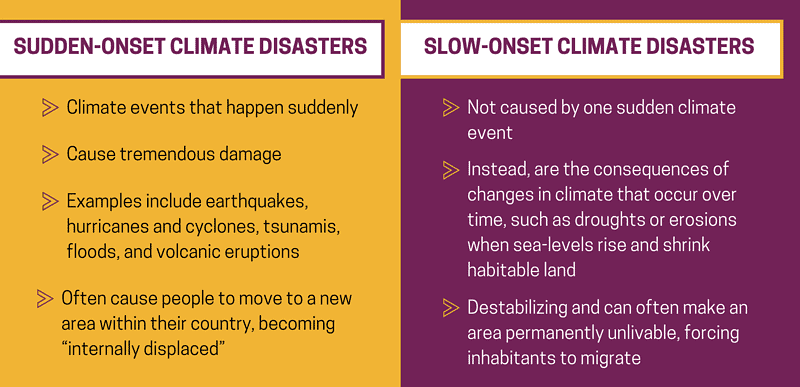
Internally Displaced Persons and Climate Disaster Displaced Persons (CDP)

These statuses currently fall outside of humanitarian protections.

Internally Displaced Persons (IDP)

IDP have been forced to leave their homes because of violence, human rights violations, or natural disasters, but, either by choice or necessity, have not crossed an internationally recognized border. IDPs do not have special status internationally or in the U.S. with rights specific to their situation.  

Climate Displaced Persons (CDP)

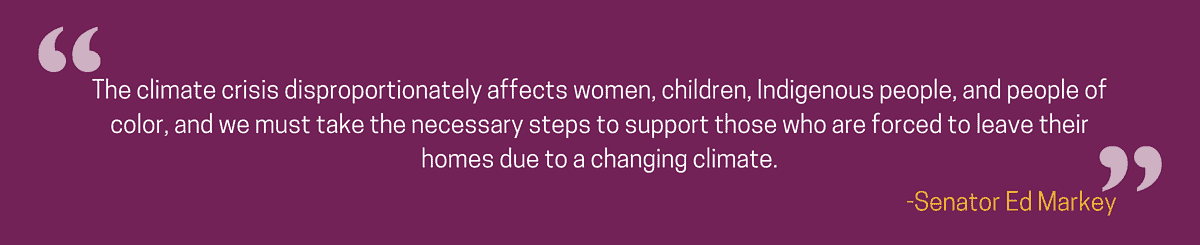
CDP have been forced from their homes due to disasters caused by climate change. A growing population, individuals displaced by climate disasters alone do not currently qualify for humanitarian protections internationally or in the U.S.

Refugee Youth Spend Summer Exploring, Learning, and Bonding

This summer, refugee youth in Lowell, Massachusetts and Manchester, New Hampshire who participated in IINE programs throughout the year had the opportunity to stay engaged during the school break. With staff and volunteers, they explored their local communities, practiced their English skills, learned about art and science, and formed deeper bonds with their peers. 

Lowell, Massachusetts

“That was really nice. I met a lot of people and made new friends,” writes Farah, a 14-year-old from Afghanistan practicing her English in a tutoring session. “My favorite activity was planting the pots. It was so fun and I love the nature, which makes me happy.” 

Farah is one of twenty young refugees who have spent much of their summer with IINE in Lowell, not only working on their English, but also, sewing, swimming and playing sports at a local YMCA, practicing yoga in a dedicated youth space in the Lowell office, and taking field trips to local spots like Lowell’s New England Quilt Museum.  

They’ve also been making art—the “planting pots” activity that Farah enjoyed took place over two weekly “Art Afternoons.”  While listening to music, eating snacks, sipping tea, and mingling, participants were guided by an IINE community volunteer and a summer intern in decoratively painting two pots. In one pot they planted herbs—choosing from parsley, sweet basil, coriander, and chives—which IINE will plant in a community garden. In the second, they potted spider plants, which each participant was able to take home with them. 

The refugee youth taking part in Art Afternoons and other summer activities range in age from 14-20 (and sometimes bring younger siblings along to join the fun) and have come to the U.S. from Afghanistan, the Democratic Republic of the Congo, Haiti and Syria. They are drawn from IINE’s year-long programs, Refugee Youth Mentoring and Youth Goal, in which they are matched with volunteer mentors, who help them set, pursue, and achieve their educational and career goals. They also participate in peer support groups, like a group especially for Afghan women, and workshops in which members of the local community present on education, work opportunities, and skill-building.  

As refugees, these youth have all experienced early trauma, and given their language and economic barriers, can feel isolated in their new communities. IINE Youth Services Manager Isabel Goes developed IINE’s summer programming to keep them engaged, help them practice their English, and encourage them to socialize and make friends. 

“The biggest thing was building community bonds with our youth—reducing isolation when resettlement starts,” says Goes, “and we’ve seen clients form close bonds this summer, which will be useful during the fall. We have tutoring twice per week which helps with English, but it’s also nice to have informal conversations during activities and see how far clients can get with what they know so far. It also opens the door if youth need any guidance during this time.”

While Goes also cites the potted plant activity as a highlight, she is particularly excited for what she has planned to cap off the summer. “There have been a lot of requests for a bake-off or a cook-off with IINE staff as judges! We also want to reserve space in the park for an end-of-summer celebration with yard games.”  

Manchester, New Hampshire 

Meanwhile, IINE staff at our Manchester site planned an equally fun summer for the children and youth engaged in our Refugee School Impact program, which supports newly arrived refugees in navigating the Manchester public school system.  

IINE School Impact Coordinator Jamie Suarez partnered with Southern New Hampshire University’s Center for New Americans Amika Youth Program, helping to plan summer field trips to state parks, amusement parks, and more during the school break.  

IINE has had a great relationship with the program for several years, and Suarez says, “This is a new expansion to our shared goal of giving refugee youth great experiences and keeping the kids educationally engaged throughout the summer months. We are providing additional funding to their existing program so they can take more kids and expand on their field trip experiences.” 

Among other fun activities, youth had a blast at Dupont Splash Pad and Chucksters mini-golf, found inspiration at the Currier Museum of Art, and enjoyed hands-on learning experiences at the SEE Science Center.

“Summer programming at the SNHU Center for New Americans was an absolute blast,” says Center for New Americans Program Coordinator Aloyo Lidia Yen. “The kids enjoyed new experiences with field trips to places some had never been before, mini golf, beach trips, movies, and more! Thank you, IINE, for helping make this happen.”
 

Volunteer mentors and tutors help our refugee youth clients to practice English, complete school assignments, prepare for interviews and exams, and more. If you are interested in volunteering with our youth, visit our Get Involved webpage. 

Suitcase Stories®: How a Cup of Coffee Transports Maryna to Happier Days in Ukraine

Maryna, a Ukrainian refugee, was living in Kyiv with her daughter when Russia invaded the country in 2022. In her recent Suitcase Stories® performance she shared the story of her difficult and brave decision to say goodbye to family and friends in Ukraine with no idea when they may be reunited, and her determination to give her daughter a safe home in the U.S. Maryna came to IINE as a client and now works as an Employment Specialist on our Career Services team. Every day, she helps fellow Ukrainian refugees and other immigrants to acclimate to life in the U.S. and secure employment. The following is a transcript of Maryna’s story in her own words.

Maryna shares her story at IINE’s International Women’s Day event

Since moving to the United States last year, I have visited many coffee shops in Boston, including Starbucks, Tatte, and Panera. I like Starbucks coffee the best. I order my latte with soy milk and one sugar. I am allergic to regular milk. I like how everything feels normal when I am drinking coffee. But sometimes, when I am sitting at a coffee shop and I hear the sounds of airplanes in the sky, I am immediately transported back to Ukraine. The sound makes me nervous, and I feel like I should run to a shelter. This is a kind of associative feeling from which it is very difficult to leave.

In Ukraine, I was a successful businesswoman. I worked in retail, setting up new businesses such as H&M and Adidas in malls.

I remember when I used to worry about such trivial problems as a broken nail or some kind of ugly hairstyle. This all changed on February 24, 2022. I remember waking up at 4 am as usual because I have a five-month-old daughter, and I needed to feed her. I saw fireworks at the window, or I thought it was a firework. Suddenly, I received an SMS from my friend who lived in the north of Ukraine. He wrote me: “Maryna, take your daughter, dog, and cat, and drive to a safe place. The War Has Started.” I was shocked. I didn’t know what to do. I called all my neighbors to tell them to take their stuff and drive. In one hour, my neighbors came and helped me to package all my stuff. When we finally left, I was driving with my 5-month daughter, cat, and dog and two neighbors (because they had no car).On the road, there were traffic jams, panic, horror, and crowded queues to fill up the car. I called my friends to know which road will be good. We were driving towards the border with Poland and hoped to find friends who could take us for the night. A drive that should have taken five hours took twenty-one. When we got to Lviv, our friends accepted us. Instead of taking a hot shower, resting, or having a bite to eat, we went straight to a shelter because we heard sirens throughout the city. I thought we would stay with them for one night, but instead, we stayed for three months. I did my best to stay busy. I volunteered, collecting donations coming across the border and distributing them to people. I remember my daughter crawling among the boxes.  We had to stay busy, or my mind would go to dark places. The whole time I thought, “We will go home in a few days, we will go home in a few days.”  But a few days would be another week.

Eventually, my neighbors and I decided to return to Kyiv. It was our home. We resigned ourselves to the fact that it will not be the same as before and that we would learn how to live in a new reality. We would be strong. Still, it was hard to return. People were different. People smiled less, and many businesses were closed. I could not return to work because international companies were no longer opening stores in Ukraine. I learned that the nanny who had watched my daughter when I went to work had been killed.

Still, I didn’t want to leave Ukraine. It is our home. I wanted to be strong.

This changed one day when a rocket flew into a neighboring house, and a five-year-old girl lost her parents and became an orphan and disabled. At that moment, I realized the same thing could happen to me and that my daughter could be left an orphan. I told myself I need to move. I found a program that helps Ukrainians to move to the U.S.A. My friend sponsored us, and after we got approved, I packed two pieces of luggage with our belongings and left. Again, the road was hard, and with every distant kilometer, I understood that my heart is in Ukraine, but I want to have a safe future for my daughter.

Upon arrival in Boston, I had to complete all the documents to legally stay in this state of the country so that we could be citizens of this community, and other Ukrainians suggested to me that I could apply to IINE. And I am very grateful to them for assisting in the preparation of all documents, for obtaining insurance, for helping with job searches, and for the fact that now I am part of them and can help Ukrainians like me.

One of the things I remind other Ukrainians is to find joy in the small moments. For me, that is a cup of coffee. Sometimes when I miss home, I actually go to the Natick mall and order a cup of coffee and walk around. It reminds me of my life in Ukraine, and I feel a little less anxious.

Plus, you can’t hear the airplanes from inside the mall.

Suitcase Stories® programming invites storytellers to develop and share meaningful personal experiences of migration and cross-cultural exchange with others—from large audiences to small groups—of all ages. Everyone has a Suitcase story.™ Learn more about Suitcase Stories®.

2 Years After the Afghan Evacuation, Afghans Deserve Permission to Stay in Their New Home

2 Years After the Afghan Evacuation, Afghans Deserve Permission to Stay in Their New Home

By Alexandra Weber, Chief Advancement Officer and Senior Vice President

Two years ago, on Sunday, August 15, 2021, the Taliban took control of Afghanistan’s capital, Kabul. More than 76,000 Afghans were evacuated to the U.S. Families arrived exhausted, fearful, and unsure of what would come next, and resettlement agencies across the country rushed to respond. Thanks to an incredible outpouring of support from our donors, community partners, and volunteers, IINE welcomed and resettled more than 500 Afghan evacuees in Massachusetts and New Hampshire within five months. 

Now, two years later, what does life look like for Afghans in the U.S.? Devastatingly, it is still full of unknowns.  

Humanitarian Parolee Status – An Impermanent Solution to a Lasting Problem  

Afghans Deserve Support and Permanency in the U.S.

Afghan evacuees came to the U.S. as humanitarian parolees and were granted legal permission to stay for two years. Recently, the U.S. government offered Afghan families an extension of parole for another 12 months—which, in effect, extends their limbo. Afghan evacuees, most of whom traded their safety to support our country, need more than short-sighted and temporary permission to stay in the U.S. Having worked with the U.S. as allies, returning to an Afghanistan still ruled by the Taliban is not an option. 

Join IINE in advocating for the Afghan Adjustment Act (AAA). The bipartisan bill, recently reintroduced to Congress, would allow Afghans to apply for green cards and set them on a pathway to becoming permanent citizens. The AAA would enable those who came alone to bring their families to the U.S.; many Afghan evacuees were separated from their families in the chaos of being airlifted from Kabul, and their families remain in Afghanistan, in danger every day. Passing the AAA will mean that thousands of Afghans will be able to reunite with their families, and together, remain safely in the U.S. a country they have come to call home.  

A New Community, A New Home 

Afghan woman sewing at a sewing machineDespite living in limbo, over the past two years Afghans have put down roots in New England. IINE has helped Afghan families in Manchester, New Hampshire gather weekly to cook together, socialize, practice English, and play games. They attend workshops on topics ranging from dental hygiene to child car safety, learning the cultural customs and norms of their new country. In Lowell, Massachusetts, Afghan women gather weekly for an IINE-led sewing class. A few participants have gone on to start their own sewing business; they are excited to be supporting their families and contributing financially in a way they never have before.  

There are many more stories like these. Afghans have created community here. New England is now home. 

Lend Your Voice in Support  

Because of generous support from people like you, IINE has welcomed and supported 554 Afghans since August 2021. You can advocate for their permanent residency in the U.S. by contacting your congressional representative today and asking them to pass the Afghan Adjustment Act (S.2327 and H.R. 4627).

IINE’s donors are our heroes! When the Taliban seized control of Afghanistan, you stepped up. You helped ensure that families who come to Massachusetts and New Hampshire find welcome and life-saving support. Now, your help is needed once more.

Violence, chaos, and widespread food and water shortages in Haiti are endangering the lives of its people. IINE is currently serving more than 5,000 Haitian immigrants – a number unlike anything we have ever seen before. Learn more and discover how to support this vulnerable population here: https://iine.org/5-things-to-know-about-the-crisis-in-haiti.

Employee Profile: Meet Julian D'Andre, Case Specialist

Employee Profile: Meet Julian, Case Specialist

Julian joined the International Institute of New England earlier this year as a Case Specialist. Driven by a desire to help fellow Ukrainian refugees, Julian spends his days helping our clients to access the resources they need to achieve security in their new home. Julian shared his path to IINE, what he enjoys most about his role, and how he finds hope and purpose as the war in Ukraine continues.  

Julian D'AndreWhat brought you to the International Institute of New England?

I didn’t necessarily envision myself working at IINE, but having lived in Ukraine for nineteen years of my life, I had a strong desire to help Ukrainians who were coming to Massachusetts through the U4U program. I knew that I would be well equipped to bridge the gap between Ukrainians who moved to Massachusetts and the possibilities that are available to them.

What does your day to day look like? 

As a Community Services Case Specialist my day to day varies, but every day there is a fair amount of documentation that takes place. In addition, I apply to different public benefits for my clients and check in with them to make sure that their needs are being met to the best of my ability.

What aspect of your role do you enjoy most? 

I enjoy interacting with my clients and helping them to get from where they are to where they would like to be. I enjoy being a step in the process of becoming integrated into the community. I love connecting people, so meeting people and connecting them to different resources, community leaders, etc. is something I enjoy.

What advice would you share with someone who is interested in joining IINE?

IINE is a special place in that you are one of the first people that someone meets when moving to the United States. You have the unique opportunity to help someone get on the right path toward their goals. In addition, you can be kind to someone who may not have experienced kindness or positive emotions for a long time.

Share something you are passionate about.

It’s difficult at times to focus on hobbies because for Ukrainians, the number one goal at the moment is victory and survival. In order to get to victory faster, I started an initiative for creative people to do projects for people and use the revenue to support Ukraine. I have been doing photo and video shoots to help my friends who are fighting in Ukraine and who are in dire situations (you can view the photos and videos on Instagram).

Interested in joining our team? Our collaborative, team-oriented environment offers opportunities to serve refugees and immigrants, while learning from other staff and departments. View career opportunities here. 

Mapendo Suitcase Stories

Suitcase Stories®: Mapendo Reflects on Her Family’s Journey From the Democratic Republic of Congo and Starting Over

“This is when we knew we had to start life all over.” Mapendo, a refugee youth client at IINE, is originally from the Democratic Republic of Congo; however, she and her family have not been there in over a decade. In our blog, she shares her Suitcase Stories® performance – the story of her family’s journey from their home in the DRC, where life was comfortable until her father suddenly went missing; to Uganda, where they lived for ten years; to the U.S. After a long, difficult journey, Mapendo and her family of eight are putting down roots in Massachusetts, and Mapendo is determined to find success. She recently graduated from our Certified Nursing Assistant Program so she can pursue a role in healthcare. Here, she shares her story in her own words… 

When I was young I felt like a celebrity because my father was a famous sculptor, researcher, and book writer about African art. We lived a life everyone worked hard to get in the Democratic Republic of Congo. It was a luxurious life with my parents and four older siblings. Life was too smooth until one day my father went missing. We didn’t take it very seriously for the first weeks because he usually went for business trips for his research work, but as weeks turned into months, we started getting worried. The fact that we were not able to communicate with him made it even worse. As a little girl who never thought of living without both of her parents, I remember asking my mother each single day to bring back my father, but with tears rolling down her eyes, she had nothing to say. She only got more grief.

Mapendo gives a Suitcase Stories® performance at IINE’s 2023 World Refugee Day event in Lowell, MA

One night, we received a call from an anonymous number to find out it was my father. He was elaborating on how unsafe it was for us in Congo and that we had to flee immediately to Kampala, Uganda. That very night my family started packing only the things we will need for the journey. The young me was totally confused about what was going on, so I grabbed my favorite snack and a doll, thinking we were going for a family picnic.

We took a cargo ship to Uganda since it was the only means of transport we could get. Upon reaching Uganda, we took a bus that drove us to the capital. When we reached Kampala, we didn’t know how we were going to locate our father. We did not understand what people were saying. At that point I was confused about how I moved from luxury to the ghetto. Fortunately, a stranger saw how confused we were and took us to the nearest police station. One of the policemen knew Kiswahili and asked my mother questions. After a while, a stranger came claiming that he knew where we could find our father. He offered to take us. At that point, we had mixed feelings of happiness and fear, but fleeing from Congo was a risk we already made, so we had no choice but to go with him to where my father was.

Mapendo at the graduation ceremony for IINE’s Certified Nursing Assistant program

At last, we met my father, and we were so happy to see him again after a year. But we were so exhausted and famished. When he took us to the place we had to start living, we all broke down. This is when we knew that we had to start life all over with nothing like cars, luxurious foods, houses, or Barbie bedrooms.

After five years, life got better and we had access to good schools and better houses, and my family had also expanded, but the fact was that we could not be offered citizenship as neither my grandfather nor father were Ugandans.

After ten years, we got resettled to the United States. We got so excited but we felt like something was missing because one of our sisters went missing and our going to the States meant that we will never get a chance to look for her ever again.

Upon arriving in the United States, we came with a lot of expectations only to find out that I needed to get a job so I can help out with bills, rent, and paying my own tuition. I’m currently working as a crew member at a fast food restaurant. As a young adult, I have learned that in life, regardless of what you are going through, there are moments of happiness that you need to make the most of.

Suitcase Stories® programming invites storytellers to develop and share meaningful personal experiences of migration and cross-cultural exchange with others—from large audiences to small groups—of all ages. Everyone has a Suitcase story™. Learn more about Suitcase Stories®.